
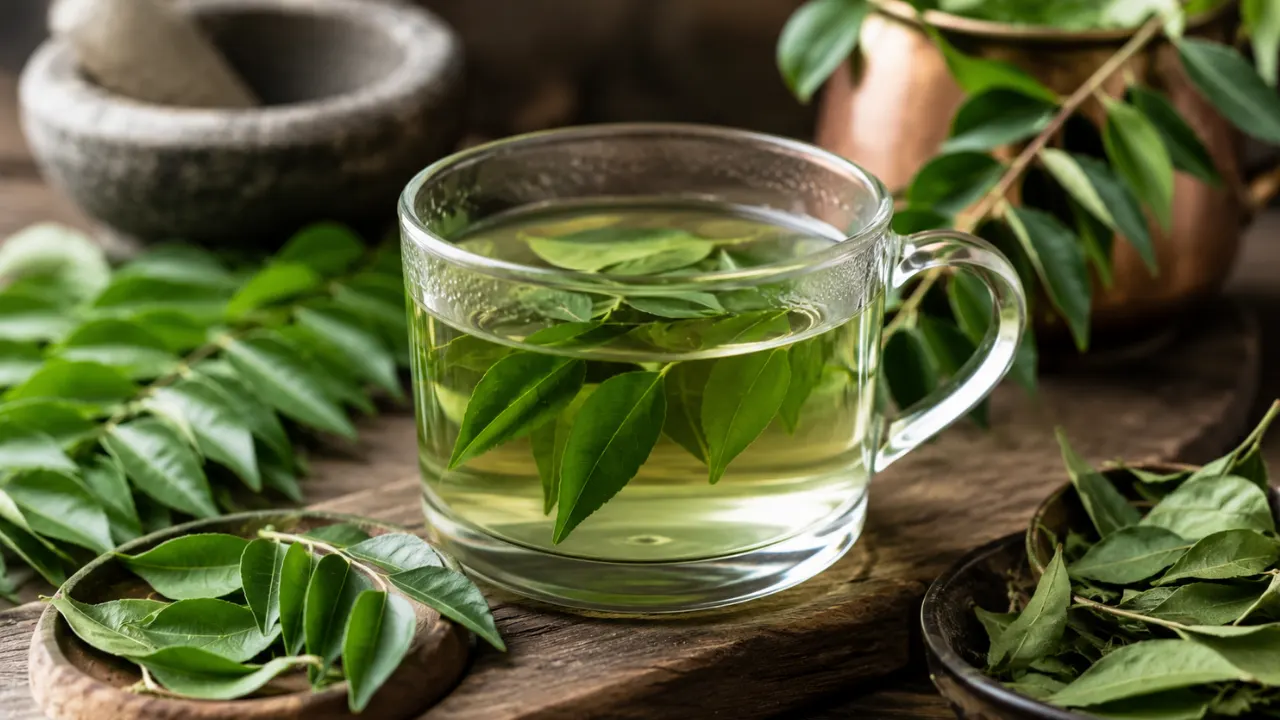

Curry leaves contain compounds that have produced antioxidant and metabolic effects in laboratory and animal studies. A few small human studies have tested measured curry-leaf extracts or powders but homemade curry leaves water has not been shown to treat diabetes, high cholesterol, digestive problems, hair loss or liver disease.
Curry leaves water can be enjoyed as a mild, unsweetened herbal drink. Its clearest practical benefit is hydration, not the long list of medical effects commonly claimed online.
The strength of a homemade drink varies according to the number of leaves, water temperature, crushing and steeping time. This makes it very different from the controlled powders, capsules and extracts used in research.
What Is Curry Leaves Water and Is It Scientifically Proven?
Curry leaves water is a homemade infusion prepared by steeping washed curry leaves in water.
Most people use several fresh leaves and hot water. The leaves may be lightly crushed before steeping to release more aroma and flavour.
No standard recipe defines the exact concentration of the drink. One person may use five leaves for a few minutes, while another may boil a larger quantity for longer.
These drinks will not necessarily contain the same amounts of plant compounds.
Curry leaves, botanically known as Murraya koenigii, contain phenolic compounds, flavonoids and carbazole alkaloids. Researchers have studied these substances for possible antioxidant, glucose-related and anti-inflammatory effects.
Most positive findings come from laboratory experiments, animal studies or preparations that are more concentrated than ordinary leaf water.
A few small human studies have tested measured curry-leaf extracts or dried powders. Those results cannot be transferred directly to a homemade infusion because the preparation and dose are different.
One small study tested encapsulated aqueous curry-leaf extract in 45 women with type 2 diabetes for 45 days. Although some glucose markers changed, the participants received a measured extract based on body weight.
The study did not test a household drink prepared with five or ten fresh leaves.
Research on curry leaves remains interesting but it does not prove that homemade curry leaves water produces a dependable medical effect.
Can Curry Leaves Water Help Digestion?
Curry leaves have a long history of culinary and traditional use, but there is not enough human evidence to conclude that their infused water stimulates digestive enzymes, relieves constipation or treats bloating.
Some people may find a warm, unsweetened drink comfortable after a meal. That personal experience does not establish that curry leaves caused a specific digestive effect.
The drink can be consumed with or between meals according to personal preference.
Drinking it first thing in the morning or on an empty stomach has no proven special advantage.
Curry leaves water may also cause nausea or abdominal discomfort in some people. Stop using it when symptoms consistently appear after drinking it.
Persistent or severe bloating, constipation, diarrhoea, abdominal pain or vomiting requires proper evaluation rather than repeated use of a herbal drink.
Does Curry Leaves Water Lower Blood Sugar?
Laboratory and animal studies suggest that certain curry-leaf compounds may affect glucose metabolism.
Limited human research has also examined measured powders or concentrated extracts. However, researchers have not proved that an ordinary cup of curry leaves water lowers blood glucose.
The amount entering the water is uncertain, and homemade recipes are not standardised.
Curry leaves water should not be described as a natural diabetes treatment or a way to reverse insulin resistance.
People with diabetes should continue prescribed medication, their recommended eating plan, physical activity and blood-glucose monitoring.
Do not reduce insulin or another glucose-lowering medicine after adding curry leaves water to a routine.
Anyone considering curry-leaf capsules, concentrated extracts or medicinal quantities alongside diabetes treatment should speak with a clinician or pharmacist first.
Can It Affect Cholesterol or Weight?
Curry-leaf powders and extracts have been investigated for possible effects on glucose and blood lipids.
Homemade curry leaves water has not been shown to lower cholesterol or cause meaningful weight loss.
An unsweetened serving contains few calories. It may be useful when it replaces a sugary soft drink, sweet tea or another high-calorie beverage.
That does not mean the leaves speed metabolism or burn body fat.
Weight change depends on overall food intake, physical activity, health conditions and other long-term factors. One herbal drink cannot replace those wider changes.
People with high cholesterol should continue professionally recommended dietary changes and medication rather than using curry leaves water as a substitute.
Does Drinking Curry Leaves Water Improve Hair or Skin?
Curry leaves are traditionally used in hair oils, masks and other home preparations.
However, drinking curry leaves water has not been shown to prevent greying, stop hair loss, strengthen hair roots or stimulate new growth.
Claims that the drink clears acne, brightens skin or delays visible ageing also lack strong human evidence.
Sudden, patchy or persistent hair loss may have nutritional, hormonal, genetic or medical causes. It should not be treated only with a herbal drink.
Does Curry Leaves Water Detox the Liver?
Curry leaves water has not been shown to cleanse or detoxify the liver.
The liver and kidneys already process substances and remove waste from the body. They do not need a special morning drink to begin that work.
Research suggesting possible liver-protective effects has mainly involved concentrated extracts in animals with experimentally induced liver injury.
Those findings cannot be applied directly to a household infusion consumed by healthy people.
Drinking water supports hydration, but adding curry leaves does not turn it into a liver treatment.
Symptoms that may suggest a liver or gallbladder problem require medical attention rather than a detox routine.
Is Eating Whole Curry Leaves More Useful?
Eating whole curry leaves provides more of the plant than drinking strained water.
The whole leaf retains its fibre and solid plant material. It can be added to dal, sambar, poha, upma, chutney, vegetable dishes and curries.
Infused water contains only the substances that move out of the leaf during steeping. Many nutrients and compounds remain inside the discarded leaves.
Curry leaves water and whole curry leaves are not nutritionally equivalent.
Eating the leaves does not make them a proven treatment for diabetes, cholesterol or another condition. It simply provides a more complete culinary use of the ingredient.
Curry leaves contain some nutrients, but neither the leaves nor their infused water should replace dependable iron sources or treatment for anaemia. The guide to foods that help increase hemoglobin explains which foods and meal combinations are more useful.
Curry leaves should complement a varied diet rather than serve as its main source of iron, vitamins or antioxidants.
How to Prepare a Mild Curry Leaves Drink
There is no medically proven recipe or therapeutic dose for curry leaves water.
The following method prepares a mild culinary drink:
- Select five to ten fresh curry leaves as an example serving.
- Remove damaged or discoloured leaves.
- Wash the leaves carefully under clean running water.
- Lightly crush them to release their aroma.
- Place the leaves in a clean cup.
- Pour freshly boiled water over them.
- Allow the leaves to steep for five to ten minutes.
- Strain the drink and let it cool to a safe temperature.
The quantity above is not a medically tested dose.
Avoid adding excessive sugar, jaggery or honey. A heavily sweetened drink loses the practical advantage of replacing a sugary beverage.
Prepare a fresh serving and drink it soon after preparation.
Cold preparations should remain refrigerated rather than sitting at room temperature for long periods.
Overnight soaking has no proven health advantage over hot steeping. No preparation method has been shown to create a reliable diabetes, weight-loss or detox effect.
Who Should Be Careful With Curry Leaves Water?
Curry leaves used in ordinary food amounts are different from concentrated powders, extracts and capsules.
Specific interactions between a mild curry-leaf infusion and medicines have not been well established.
Anyone considering a concentrated curry-leaf preparation while taking regular medication should consult a clinician or pharmacist.
People with diabetes should not replace medicine or glucose monitoring with curry leaves water.
Normal culinary use is also different from medicinal or concentrated use during pregnancy and breastfeeding. The safety of concentrated curry-leaf preparations during these stages has not been established, so they should not be used medicinally without professional guidance.
Anyone with a known curry-leaf allergy should avoid the drink.
Stop using it if it causes:
- Nausea or abdominal discomfort
- Diarrhoea
- Itching or a rash
- Swelling of the lips, tongue or face
- Difficulty breathing
Facial swelling, tongue swelling or difficulty breathing requires urgent medical help.
Is Curry Leaves Water Worth Drinking Regularly?
There is no proven need to drink curry leaves water every day.
Research has not established an ideal dose, a required schedule or a long-term daily benefit.
People who enjoy the flavour can treat an occasional mild serving as an unsweetened beverage rather than a treatment.
Its most dependable practical benefit is hydration, especially when it replaces a sugar-sweetened drink.
It should not be expected to lower blood sugar, reduce cholesterol, accelerate weight loss, stop hair loss, improve the skin or detoxify the liver.
Eating whole curry leaves in ordinary meals provides a more complete use of the plant because the fibre and solid material remain in the food.
The evidence-aware conclusion is simple: curry leaves water is a traditional drink with unproven medical benefits.
Anyone managing diabetes, high cholesterol, liver disease, persistent digestive symptoms or unexplained hair loss should rely on appropriate testing and evidence-based care rather than the drink alone.
Medical note: This article provides general information about food and traditional drinks. It does not diagnose, prevent or treat a medical condition and cannot replace personalised medical advice.

1 thought on “Curry Leaves Water Benefits and Side Effects Explained”