
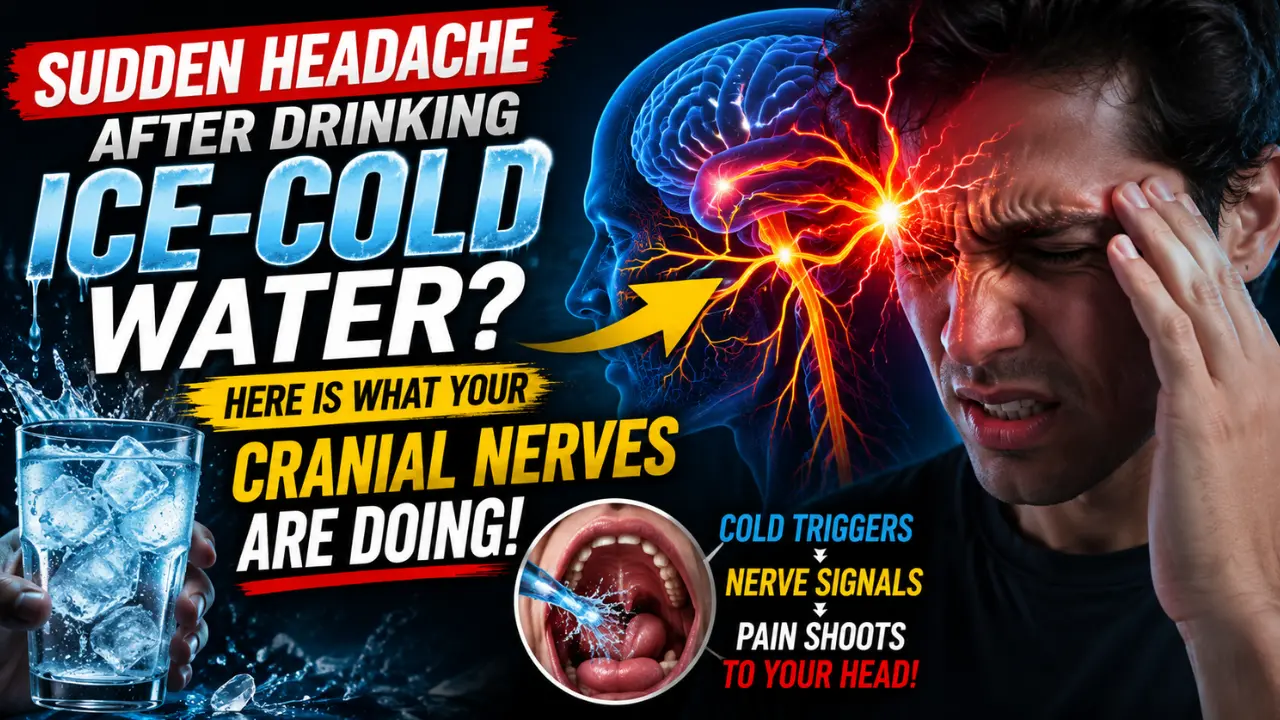

A sudden headache after drinking ice-cold water can feel strange because it arrives almost instantly. You take a cold sip, swallow quickly and within seconds a sharp pain may hit your forehead, temples or the area behind your eyes.
It can feel as if the cold has rushed straight into your head, but that is not what is really happening. Your brain is not freezing. The pain usually begins because cold water touches highly sensitive areas inside your mouth and throat and your cranial nerves react faster than you expect.
These nerves are designed to detect temperature, touch, pressure and pain from the face, mouth, palate and throat. When ice-cold water suddenly passes over them, they may send a strong cold signal into head-pain pathways. That is why a cold drink in your mouth can feel like a headache in your forehead.
The Cold Water Hits a Sensitive Nerve Zone
The roof of your mouth, the soft palate, and the upper throat contain many sensory nerve endings. These areas are not passive surfaces. They are closely connected to nerves that help your body detect temperature and protect the airway and swallowing system.
When you drink normal water, these nerves do not react strongly. But ice-cold water creates a sudden temperature shock. If you drink it quickly, the cold spreads fast across the palate and throat before the tissues have time to adjust.
That sharp temperature drop can activate the nerves suddenly. The signal travels upward through cranial nerve pathways and the brain interprets it as pain in the head rather than only coldness in the mouth.
This is why the headache can happen so fast. The trigger is not deep inside the brain. The trigger is often the cold contact inside the mouth and throat.
Also Read: Cold Hands and Feet Even When It Is Hot Outside
The Trigeminal Nerve Is the Main Pain Messenger
The trigeminal nerve is one of the most important cranial nerves involved in this reaction. It carries sensation from the face, forehead, eyes, nose, mouth, teeth and parts of the palate.
Because this nerve covers so many areas of the face and head, a signal from one region can sometimes be felt in another region. This is called referred pain. The cold water may touch the palate but the discomfort may be felt in the forehead, temples or behind the eyes.
That is why the pain feels like a headache even though the cold drink never touched your forehead. The trigeminal nerve connects the mouth and the front of the head through shared sensory pathways.
In simple words, your mouth feels the cold but your head receives the alarm.
Other Throat Nerves May Also Join the Reaction
The trigeminal nerve is the main nerve people think about with cold-stimulus headaches but it is not the only nerve near the action.
The back of the throat also receives sensory input from nerves involved in swallowing and throat sensation. When ice-cold water rushes past this area, these nerves may also contribute to the strong cold signal.
This is why some people feel the pain more after swallowing cold water quickly, not only when cold food touches the roof of the mouth. The cold stimulus can involve both the upper mouth and the throat.
The body is built to pay attention to this region because it protects swallowing, breathing and airway safety. Sudden cold in this area may therefore create a sharper nerve response than cold touching ordinary skin.
Why the Pain Shoots to the Forehead or Temples
Many people feel this headache in the forehead, temples or behind the eyes. That location makes sense because the trigeminal nerve also supplies those areas.
The brain receives signals from the palate and face through overlapping nerve routes. When a cold shock activates these routes strongly, the brain may map the pain onto the front of the head.
This is similar to how a tooth problem can sometimes feel like jaw or ear pain. The body is not always perfect at locating the exact source. When several areas share nerve pathways, pain may appear in a connected place.
So the forehead pain does not mean cold water has affected the brain directly. It means the nerve network has interpreted the cold signal as head pain.
Also Read: These Real-Life Summer Habits Helping Indians
Blood Vessels May React at the Same Time
Cranial nerves explain much of the sudden pain but blood vessels may also be involved.
When cold hits the palate and throat, nearby blood vessels can narrow quickly. As the area warms again, those vessels may reopen. This fast narrowing and reopening may add pressure, throbbing or sharpness to the sensation.
The important point is that this is usually a short-lived reaction. The vessels are responding to a sudden temperature change. They are not usually being damaged by one brief cold-water headache.
The nerves detect the cold. The blood vessels adjust. The brain receives the combined signal as a short, sharp headache.
Why It Happens More When You Drink Too Fast
Speed matters. A small sip of cold water may not cause any pain because the mouth has time to adjust. But when you drink ice-cold water quickly, a larger cold surface touches the palate and throat at once.
That sudden exposure gives the nerves a stronger signal. The colder the water and the faster you drink, the more likely the nerve reaction becomes.
This is why gulping ice water after being hot, thirsty or physically active can trigger the headache more easily. Your mouth and throat may be warm, and then the cold arrives suddenly. The contrast is strong, so the nerve response becomes stronger.
Why Some People Get It More Often
Some people are more sensitive to cold-stimulus headaches than others. Their cranial nerves may react more strongly, their blood vessels may adjust more sharply or their headache pathways may be more easily triggered.
People who already get migraines or frequent headaches may notice this reaction more often. That does not mean every cold-water headache is a migraine. It simply means their head-pain system may be more sensitive to strong triggers.
The same person may also react differently on different days. Drinking speed, water temperature, stress, lack of sleep, dehydration and how warm the mouth is before drinking can all change the response.
How to Stop It Faster
The fastest way to calm this kind of headache is to remove the cold trigger and warm the sensitive area.
Pressing the tongue against the roof of the mouth may help because it warms the palate. Sipping room-temperature water can also reduce the cold signal. Closing the mouth and breathing calmly through the nose may help the mouth warm naturally.
The goal is not to treat the brain. The goal is to calm the cold-sensitive nerves where the reaction started.
Once the palate and throat warm again, the nerve signal usually settles, the blood vessels return to normal and the headache fades.
How to Prevent It
You do not have to avoid cold water completely. The better approach is to reduce the sudden shock.
Drink slowly instead of gulping. Take smaller sips. Let very cold water sit briefly in the front of the mouth before swallowing. Avoid sending ice-cold liquid straight to the back of the throat.
This is especially useful when your body is hot after walking, exercise, sun exposure or spicy food. In those moments, the contrast between your warm mouth and ice-cold water is stronger, so the nerves may react more sharply.
When It Is Usually Not Serious
A cold-water headache is usually less concerning when it follows a clear pattern. You drink something very cold, the pain appears quickly, it peaks within seconds and it fades soon after the cold exposure stops.
That short pattern is the key. The pain may feel intense but it usually passes because the trigger is temporary.
If the headache only happens with ice-cold drinks or frozen foods and disappears quickly, it is usually a nerve reaction rather than a sign of a serious brain problem.
When You Should Not Ignore It
A headache should not automatically be blamed on cold water if the pattern does not fit.
Take it seriously if the headache is the worst headache you have ever felt, does not fade, keeps getting worse, happens without a cold trigger or comes with weakness, confusion, fainting, fever, stiff neck, vision loss, trouble speaking, chest pain, repeated vomiting or sudden balance problems.
Also pay attention if the headache feels very different from your usual pattern or starts after a head injury.
A normal cold-stimulus headache is quick, clearly triggered and short-lived. A headache that is severe, unusual, persistent or linked with other symptoms needs proper medical attention.
The Main Message
A sudden headache after drinking ice-cold water usually happens because your cranial nerves react to a fast temperature shock inside the mouth or throat.
The trigeminal nerve plays a major role because it connects sensation from the palate, face, forehead and temples. When cold water suddenly activates this pathway, the pain may be felt in the head even though the trigger began in the mouth.
Blood vessels may also narrow and reopen quickly, adding to the sharp or pressure-like feeling.
So the pain is not your brain freezing. It is your nerve system reacting fast to sudden cold. When the headache is brief, clearly connected to ice-cold water and fades completely, it is usually not serious. But if the pain is severe, unusual, persistent or comes with other symptoms, it should be checked instead of dismissed.

2 thoughts on “Sudden Headache After Drinking Ice-Cold Water?”