
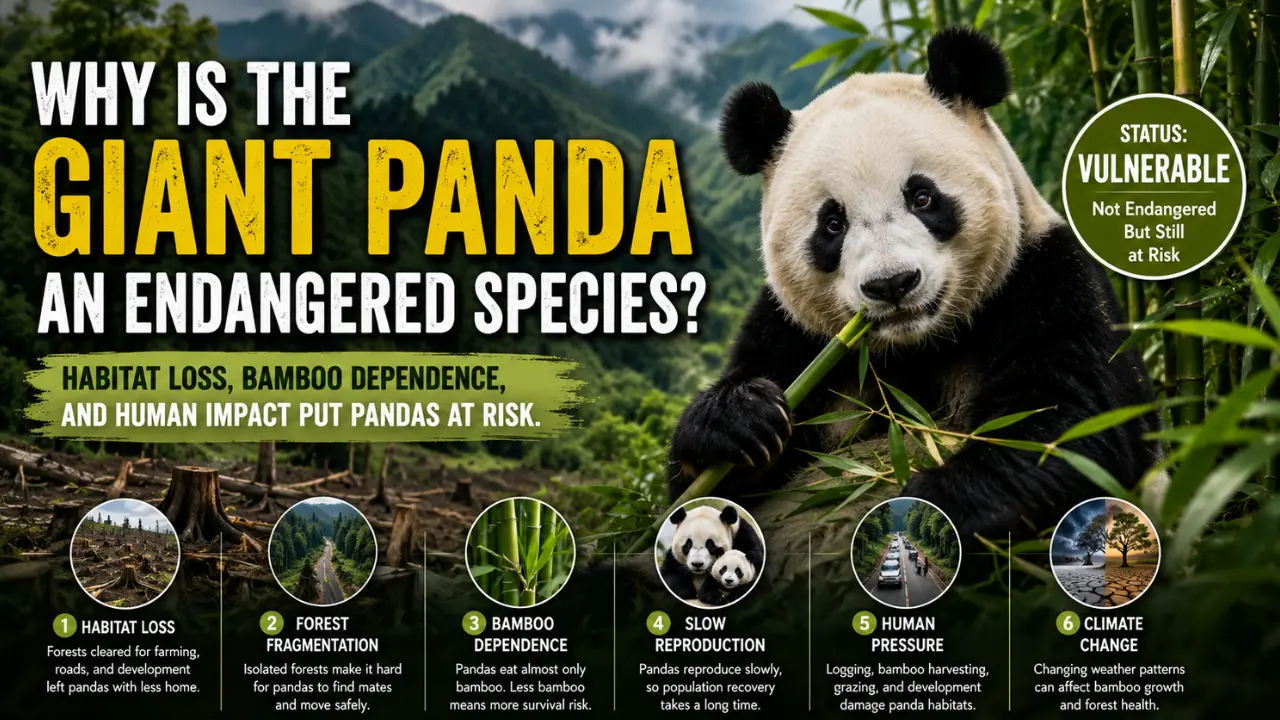

The giant panda became an endangered species because humans destroyed and divided much of its natural bamboo forest habitat. Pandas need large, connected mountain forests to find bamboo, move safely and breed. When farming, roads, logging, and development broke those forests into smaller areas, panda populations became isolated and harder to protect. Today, the giant panda is no longer listed as “Endangered” by the IUCN; it is listed as “Vulnerable,” but it still remains at risk because its survival depends on healthy, connected bamboo forests.
Habitat Loss Is the Main Reason Pandas Became Endangered
Giant pandas live in mountain forests in China, where bamboo grows in large amounts. These forests give pandas food, shelter, and safe breeding space. When people cleared forests for farming, timber, roads, and settlements, pandas lost the places they needed to survive.
This habitat loss did not only reduce the size of panda territory. It also reduced the quality of the remaining forest. A panda cannot survive well in a small patch of land if that area does not provide enough bamboo throughout the year.
WWF notes that severe human threats left only a limited wild population, with just over 1,800 pandas in the wild. This shows why habitat protection matters so much. A species with a small wild population cannot afford to lose more living space.
Also Read: Importance of Biodiversity Explained in Simple Words
Fragmented Forests Make Panda Survival Harder
Habitat fragmentation means one large forest breaks into smaller separated pieces. This creates a serious problem for giant pandas because they need to move between areas to find food and mates.
When roads, farms, villages, or development projects divide panda habitat, pandas may become trapped in small forest sections. This can create isolated groups. Over time, isolated groups face a higher risk because they have fewer breeding options and weaker genetic diversity.
Even if some forest remains, pandas still suffer when those forests do not connect. A protected forest patch helps, but connected forest corridors help more because they allow pandas to move naturally.
Pandas Depend Heavily on Bamboo
The giant panda’s diet makes it especially vulnerable. Bamboo makes up almost 90% of a panda’s diet, and pandas need large amounts of it every day.
This matters because bamboo does not always remain stable. Some bamboo species flower and die off in cycles. When this happens, pandas must move to another area with healthy bamboo. If forests connect, pandas can search for new food. If forests remain broken, pandas may struggle to move when bamboo becomes scarce.
This strong dependence on bamboo makes habitat loss more dangerous for pandas than for animals that can easily switch to many food sources.
Slow Reproduction Makes Recovery Difficult
Giant pandas do not reproduce quickly. Female pandas have a short fertile period each year, and panda cubs need careful care after birth. Smithsonian’s National Zoo explains that the giant panda’s naturally slow breeding rate prevents the population from recovering quickly from habitat loss, illegal hunting, and other human-related threats.
This slow reproduction means panda numbers cannot increase quickly after a population decline. If a species loses habitat and also reproduces slowly, conservation becomes more difficult. Even when protection improves, recovery takes many years.
Human Activity Still Pressures Panda Forests
The biggest historical threat came from large-scale habitat loss, but smaller human pressures still affect panda habitats. In some mountain areas, people harvest bamboo, collect firewood, gather medicinal plants, or use forest resources for income. WWF explains that these activities continue to degrade panda mountain forests.
These actions may not always destroy a forest immediately, but they can slowly weaken it. Pandas need stable bamboo forests, not damaged forests with fewer resources.
Climate Change Adds Another Risk
Climate change may also affect pandas because it can change where bamboo grows. Bamboo may struggle to shift quickly enough as temperature and rainfall patterns change. WWF explains that bamboo has slow colonization rates, which means it may not move to suitable new areas as quickly as pandas need.
This creates a long-term risk. If suitable bamboo areas shrink or move, pandas may need to travel to new places. But if roads, farms, or human development block movement, pandas may not reach better habitats.
Also Read: Life Feels Heavy for No Reason? Here Is Why
The Giant Panda Improved, but It Is Not Fully Safe
Conservation work helped the giant panda recover enough to move from “Endangered” to “Vulnerable.” This improvement came from forest protection, panda reserves, habitat restoration, and long-term conservation efforts. WWF says the panda’s improved status shows conservation can work, but the species still needs protection.
“Vulnerable” does not mean safe. It means the species still faces a real risk if threats increase again. For pandas, the main concern remains habitat. If bamboo forests shrink, break apart, or lose quality, panda recovery can slow down or reverse.
Simple Answer
The giant panda became endangered because people destroyed and fragmented much of its bamboo forest habitat. Pandas depend on bamboo, need connected forests, reproduce slowly, and cannot recover quickly when their population falls. Conservation has improved their status from endangered to vulnerable, but they still need protection because their future depends on healthy mountain forests with enough bamboo.

1 thought on “Why Is the Giant Panda an Endangered Species?”