
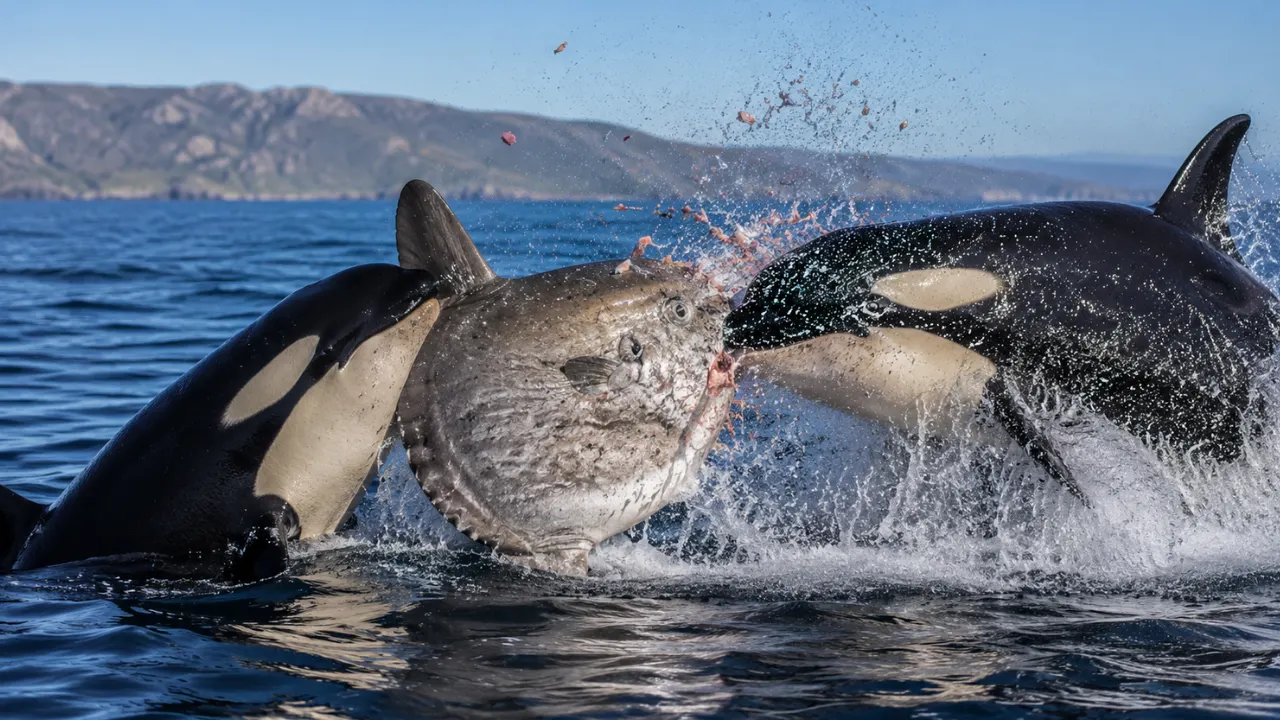

Orcas may ram dead sharp-tail sunfish to break their tissue into smaller portions, possibly making the food easier for younger whales to access. Researchers also consider prey processing, food sharing, social interaction and play possible explanations.
Scientists documented the coordinated behaviour during two separate encounters in Mexico’s Gulf of California. In both events, one adult orca stabilised a dead sunfish while another approached at high speed and struck it, causing tissue to scatter through the water.
Only two events have been recorded in detail, so researchers cannot yet identify one definite purpose.
What Did the Orcas Actually Do?
The researchers described the behaviour as a “ram-to-fragment” technique.
One adult orca held or stabilised the carcass of a sharp-tail sunfish. Another adult then accelerated toward the fish and collided with it at high speed.
The impact caused part of the sunfish’s tissue to break into numerous fragments that dispersed through the water.
The fish were already dead before the recorded collisions. Their bodies had also been opened, indicating that the orcas had begun feeding before the ramming occurred.
This means the collisions did not serve as the killing method. They happened during the prey-handling and feeding stage.
The two adults performed different roles. One controlled the position of the carcass, while the other supplied the force needed to break apart its tissue.
The sequence required the adults to coordinate the carcass’s position, the approaching orca’s direction and the timing of the impact.
Researchers observed the technique during two encounters that occurred more than a year apart. Young orcas were present during both events, although the juvenile and calf did not feed in exactly the same way.
What Happened During the First Sunfish Encounter?
The first documented event occurred on July 29, 2024, near an offshore seamount off San José del Cabo in Baja California Sur, Mexico.
The group included three adult females, one adult male and a juvenile.
Before the sunfish interaction, observers recorded the orcas capturing and eating a spine-tail devil ray. They later encountered the group handling the carcass of a sharp-tail sunfish.
An adult female carried the sunfish by its clavus, the narrow tail-like structure at the rear of its body.
A large wound showed that the internal organs had already been removed, although the main body remained largely intact.
The adult male accelerated toward the fish while swimming with his pale underside facing upward. The female released the carcass immediately before he struck it.
The collision produced a loud sound and caused part of the sunfish’s tissue to fragment throughout the water.
The juvenile then moved into the suspended pieces and began eating them.
The adults continued feeding from the larger, split-open carcass. Observers did not record the adults consuming the smaller fragments that the juvenile selected.
This feeding pattern led researchers to consider whether fragmentation could help younger orcas access more manageable pieces of food.
However, one event cannot prove that the adults performed the behaviour specifically for the juvenile.
What Happened During the Second Encounter?
The second observation occurred on September 7, 2025, in a channel near Isla Cerralvo in the Gulf of California.
This group contained three adult females and a calf.
One adult stabilised the carcass of another sharp-tail sunfish while a second adult approached and rammed it at high speed.
The approaching orca remained upright before impact and changed its body orientation afterward. The collision again caused part of the prey’s tissue to fragment through the water.
A third adult joined the feeding interaction. Two adults bit into the remaining portion of the split-open carcass.
The orca that had initially stabilised the fish later moved through the suspended fragments and manipulated some of them with its mouth.
The calf did not depend only on the small scattered pieces. It extracted tissue directly from the primary carcass.
This difference is important. The juvenile in the first event ate smaller fragments suspended in the water, while the calf in the second fed from the main carcass.
The observations therefore do not show that every young orca required fragmented tissue to eat.
The same group had been observed preying on a shortfin mako shark earlier that day. This suggests that the orcas could switch between different prey rather than relying exclusively on sunfish.
Why Were Orcas Ramming an Already-Dead Fish?
The most direct explanation is prey processing.
Predators often manipulate a carcass after killing it. They may reposition it, remove selected tissues or divide it into portions that are easier to consume.
The orcas had already opened both sunfish before the collisions. The high-impact ramming then changed the remaining carcass by dispersing part of its tissue into smaller pieces.
The behaviour may have allowed different group members to feed from different parts of the prey.
During the first event, the adults ate from the main carcass while the juvenile consumed suspended fragments. This reduced direct competition over the same piece of food.
Researchers describe this possibility as facilitative feeding. An adult changes how food is presented or distributed in a way that may help a younger individual gain access.
However, the evidence does not show that assisting young orcas was the only purpose.
The adults may also have been processing an unusual carcass, distributing food among the group or participating in a stimulating social activity.
These possibilities can overlap. A single behaviour may help prepare food while also creating opportunities for play, cooperation and learning.
Were the Adults Helping Young Orcas Learn or Feed?
The presence of a juvenile during the first event and a calf during the second makes parental support a reasonable possibility.
Young orcas have less hunting experience than adults. They learn many prey-handling techniques by following, watching and participating with older members of their social group.
The juvenile in the first event clearly benefited from the collision because it ate the smaller pieces released into the water.
The calf in the second event also remained close to the feeding adults, although it removed tissue from the main carcass rather than relying on suspended fragments.
Watching adults coordinate the position and impact could provide a social-learning opportunity. A young orca may gain information about how to grip the prey, where to strike it and how to feed after the collision.
However, the observations do not demonstrate deliberate teaching.
Teaching would require stronger evidence that an experienced orca changed its behaviour specifically to help a younger animal learn. Researchers did not record either young orca later copying the ramming technique.
The safest conclusion is that young orcas were present, gained access to food and had an opportunity to observe adult prey handling.
More observations are needed to determine whether adults perform the behaviour more often when juveniles or calves are nearby.
Could the Ramming Also Be Play?
Play remains another possible explanation.
Orcas sometimes push, carry, strike or manipulate prey beyond what appears necessary for immediate feeding. Such interactions may combine exploration, social activity and food handling.
The researchers included play and social interaction among the possible functions of the sunfish ramming.
However, the orcas consumed tissue after both impacts. The behaviour should not be described simply as a game with no feeding purpose.
The practical and playful explanations do not exclude each other. The orcas may have processed the carcass while also engaging in an unusual and stimulating group interaction.
Scientists cannot determine the importance of play from two observations alone.
Why Did the Sharp-Tail Sunfish Break Apart So Dramatically?
The structure of the prey may help explain the extensive fragmentation.
Sunfish possess a thick, gelatinous collagen layer around the body called the capsule. This tissue contains a high proportion of water.
Researchers suggest that the sharp-tail sunfish’s tissue structure may respond differently to high-energy impacts than the bodies of other fish.
Its pronounced clavus may also give an orca a useful place to grip and stabilise the carcass before another animal strikes it.
The documented fragmentation has not been reported in the same way for other sunfish species. Researchers therefore consider the possibility that the dramatic result reflects a feature of the sharp-tail sunfish itself.
This remains a hypothesis. The study did not experimentally compare the strength of different sunfish species or prove that the clavus evolved in a way that makes this feeding technique possible.
The behaviour should therefore remain associated specifically with the sharp-tail sunfish rather than being presented as something orcas perform on every type of sunfish.
Is This Orca Behaviour New?
The behaviour is newly documented by scientists, but it may not be new to the orcas.
Rare marine interactions often happen far from researchers, vessels and cameras. A group of orcas could perform a feeding technique for years before anyone records it clearly enough for scientific analysis.
Researchers based the report on two opportunistic observations. One event was filmed directly by a study author, while another was captured by an outside observer and later examined by the team.
The availability of action cameras, drones and wildlife-tourism footage makes it easier to document behaviour that would once have passed unseen.
More recorded observations do not automatically prove that orcas have recently started behaving differently. Increased observation effort can make an established but uncommon behaviour appear new.
Researchers also could not confirm whether the same individual orcas participated in both encounters. They lacked enough clear identification images of features such as dorsal fins, scars and eye patches.
The two events could involve one group that repeatedly uses the technique, or different groups could have developed similar methods independently.
What Do Scientists Still Not Know?
Researchers need more observations before they can explain the behaviour confidently.
They do not know how often Gulf of California orcas ram sharp-tail sunfish or whether only certain social groups use the technique.
They also do not know whether the presence of young orcas changes the adults’ behaviour.
Future footage could show whether adult-only groups perform the same sequence, whether young animals eventually copy it and whether the technique spreads between related individuals.
Scientists also need to determine whether orcas use comparable impacts on other sunfish species or prey with similar tissue.
Clear identification photographs would help researchers recognise individual whales and establish whether the same orcas appear in different encounters.
For now, the evidence supports a limited conclusion.
During two separate events, adult orcas coordinated high-speed impacts that fragmented the tissue of dead sharp-tail sunfish. Young orcas were present during both encounters, and the juvenile in the first event ate the smaller pieces produced by the collision.
The behaviour may assist prey processing, food distribution or access for young whales. It may also involve social learning and play.
The exact purpose remains uncertain, but the observations reveal how precisely orcas can cooperate when handling unusual prey.
