
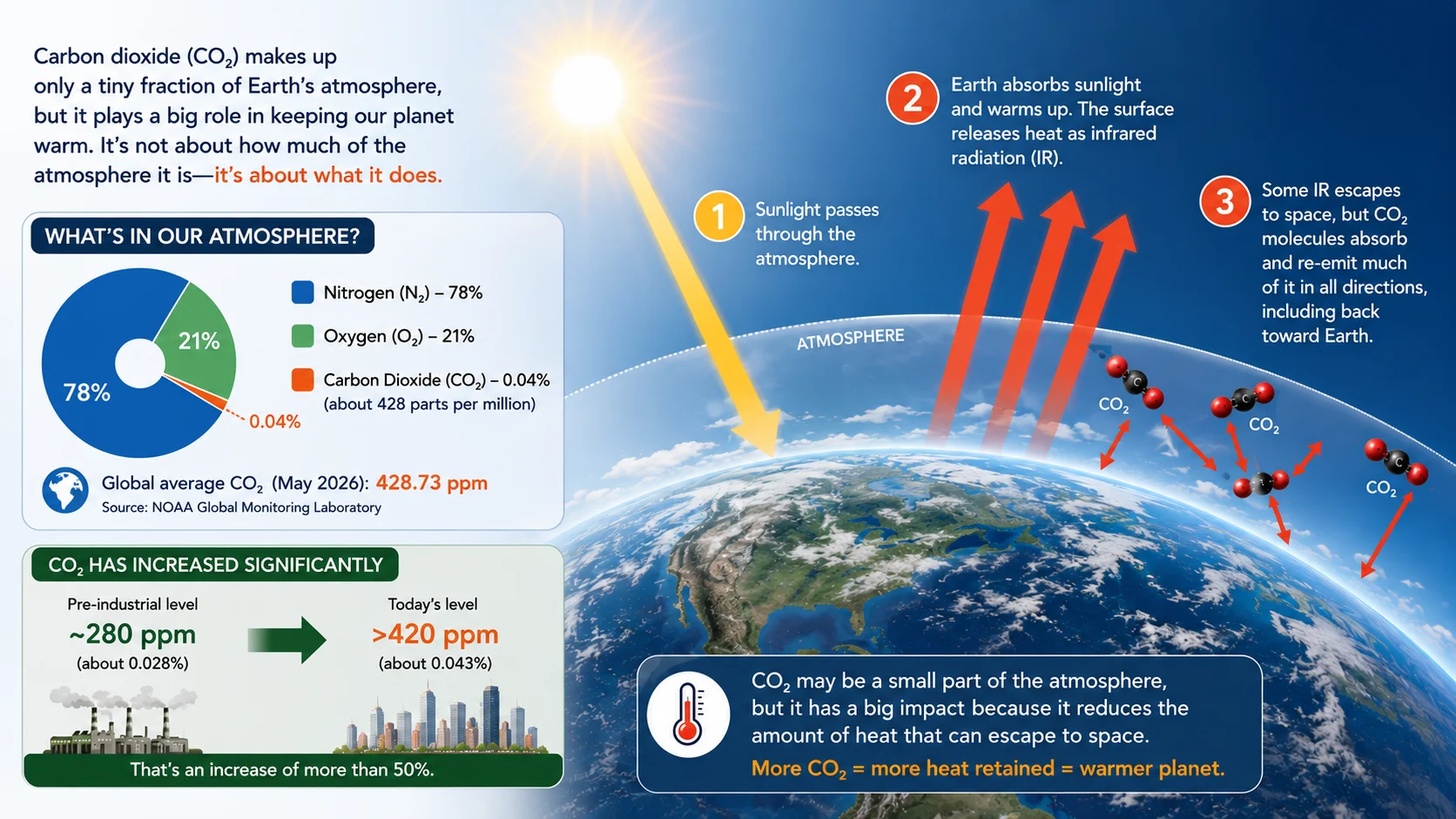

Carbon dioxide makes up only about 0.04% of Earth’s atmosphere, but its climate effect depends on what its molecules do, not simply on how much of the atmosphere they occupy. CO₂ absorbs some of the infrared radiation Earth releases as it cools, while the far more abundant nitrogen and oxygen molecules interact much less strongly with those wavelengths.
That is why the percentage can be misleading when it is considered on its own. A gas does not have to make up a large share of the atmosphere to affect the movement of energy through it, especially when its concentration changes significantly over time.
How small is 0.04% in practical terms?
Atmospheric carbon dioxide is usually expressed in parts per million because its concentration is small. NOAA reported a global monthly mean of 428.73 parts per million for May 2026, which is roughly 0.043% of dry air.
That means there are a little more than four CO₂ molecules for every 10,000 molecules of dry air. By comparison, nitrogen makes up about 78% of the atmosphere and oxygen about 21%, so it is understandable that carbon dioxide can seem almost insignificant beside them.
The difficulty is that this comparison treats all gases as though they behave identically. They do not. Nitrogen can be thousands of times more abundant than carbon dioxide and still have a much smaller direct effect on the particular infrared wavelengths involved in Earth’s greenhouse effect.
What matters is therefore not only the quantity of a gas but also its physical properties.
What happens to the energy Earth receives from the Sun?
Earth is continually receiving energy from the Sun and releasing energy back toward space. Some incoming sunlight is reflected by clouds, ice and other bright surfaces, while much of the rest is absorbed by the land, oceans and atmosphere.
Once the surface has absorbed solar energy and warmed, it releases energy mainly as infrared radiation. If all of that outgoing energy passed easily through the atmosphere, Earth’s surface would be considerably colder.
Greenhouse gases change that process because their molecules can absorb certain infrared wavelengths. Carbon dioxide is one of those gases.
After CO₂ absorbs infrared radiation, the energy becomes part of the ongoing exchange of energy within the atmosphere. Through molecular collisions and the emission of infrared radiation, energy is redistributed in different directions rather than simply passing uninterrupted from the surface into space.
NASA’s description of Earth’s energy budget explains that nitrogen and oxygen are comparatively transparent to outgoing thermal infrared radiation, whereas carbon dioxide, water vapor, methane and other greenhouse gases absorb portions of it.
Increasing the amount of CO₂ therefore changes how efficiently Earth can lose energy at the wavelengths where carbon dioxide absorbs.
Why don’t nitrogen and oxygen have the same effect?
The reason lies in molecular structure rather than abundance.
Nitrogen and oxygen in the atmosphere occur mainly as molecules made from two identical atoms. Their molecular structures mean they interact relatively weakly with many of the infrared wavelengths Earth emits.
Carbon dioxide has a different structure. Its atoms can move and vibrate in ways that allow the molecule to absorb particular bands of infrared radiation.
This does not mean every CO₂ molecule simply captures heat and holds onto it indefinitely. Energy continues moving through the atmosphere and eventually escapes to space. The presence of greenhouse gases changes the path and rate of that energy transfer, which affects the temperature required for Earth to maintain its overall energy balance.
The comparison with nitrogen and oxygen therefore tells us why atmospheric percentage alone is not a useful measure of greenhouse influence. The most abundant gases and the most important infrared-absorbing gases do not have to be the same gases.
Why does adding more CO₂ make Earth warmer?
Earth’s long-term temperature is closely connected to the balance between incoming and outgoing energy. If the planet absorbs more energy than it releases for a period of time, the climate system gains energy and warms.
Increasing carbon dioxide initially reduces the amount of infrared energy escaping to space at the wavelengths where CO₂ absorbs. The amount of sunlight reaching the planet has not increased simply because CO₂ increased, so this creates an imbalance between incoming and outgoing energy.
As the surface and lower atmosphere warm, they emit more infrared radiation. Warming continues until outgoing energy rises enough for the climate system to move toward a new balance.
This is a more accurate way to understand the familiar phrase that carbon dioxide “traps heat.” The phrase is convenient, but it can sound as though heat is being stored permanently beneath an atmospheric barrier. In reality, carbon dioxide alters the rate at which energy can move through the atmosphere and ultimately escape to space.
NASA’s energy-budget explanation describes increasing carbon dioxide as a forcing that changes this balance between incoming and outgoing energy.
If CO₂ already absorbs infrared radiation
It is reasonable to wonder whether carbon dioxide eventually reaches a point where it has already absorbed everything available at the wavelengths it affects.
Some portions of CO₂’s strongest absorption bands are indeed already very effective at absorbing infrared radiation near the surface. The atmosphere, however, is not a single thin layer, and carbon dioxide does not absorb at only one exact wavelength.
Its absorption varies across a range of wavelengths, and atmospheric temperature and pressure change with altitude. Adding more CO₂ strengthens absorption in parts of those bands and affects the altitude from which infrared radiation can efficiently escape to space.
This is why the greenhouse effect of additional CO₂ continues even when carbon dioxide is already present in the atmosphere. The relationship is not simply proportional, so doubling the amount of CO₂ does not mean doubling its greenhouse effect, but additional CO₂ still changes Earth’s energy balance.
Keeping this distinction in mind avoids two opposite misunderstandings: carbon dioxide does not have an unlimited warming effect for every additional molecule, but neither does its influence suddenly disappear once a certain concentration has been reached.
Has the amount of CO₂ changed enough to matter?
The change becomes much clearer when today’s concentration is compared with the pre-industrial atmosphere rather than with nitrogen and oxygen.
Measurements of air preserved in ice cores indicate that atmospheric carbon dioxide before industrialization was about 280 parts per million. NOAA uses 280 ppm as a representative pre-industrial level, while modern global measurements are above 420 ppm.
That represents an increase of more than 50%.
Expressed as percentages of the entire atmosphere, the numbers rise from roughly 0.028% to around 0.043%. Written that way, both numbers look tiny, but the appearance of the percentages hides the size of the change in carbon dioxide itself.
If the same change is written as roughly 280 molecules per million becoming more than 428 molecules per million, it is easier to see what has happened. The relevant greenhouse gas has increased substantially even though it remains a trace component of the atmosphere.
The climate system responds to that change in concentration and to the resulting change in infrared radiation, not to whether the percentage looks visually large.
Can the effect of additional CO₂ actually be measured?
Scientists have understood the infrared-absorbing properties of carbon dioxide through laboratory measurements and atmospheric physics for a long time, but satellite observations now provide another useful way of testing the mechanism.
A 2024 study using NASA’s Atmospheric Infrared Sounder examined infrared radiation leaving Earth while controlling for differences in atmospheric temperature and water vapor. The researchers were able to isolate the effect associated with increasing carbon dioxide and directly measure a reduction in outgoing infrared radiation at the wavelengths affected by CO₂.
The observations closely matched the changes predicted by physical calculations.
This is important because the connection between CO₂ and warming is sometimes described as though scientists merely noticed that carbon dioxide and global temperature increased during the same period. The evidence is much more direct than that. Researchers can measure the infrared properties of CO₂ in laboratories, observe atmospheric concentrations, examine Earth’s outgoing radiation from space and compare those measurements with the expected physical effect.
What about water vapor?
Water vapor also absorbs infrared radiation and plays a major role in Earth’s natural greenhouse effect. Its importance does not make the influence of carbon dioxide disappear because water vapor and CO₂ behave differently within the climate system.
Atmospheric water vapor responds strongly to temperature. When conditions warm, evaporation can increase and warmer air can generally contain more water vapor. Because water vapor is itself a greenhouse gas, this can amplify an initial warming.
Carbon dioxide can remain elevated without depending on an immediate temperature increase in the same way. Rising CO₂ can therefore initiate a change in Earth’s energy balance, while additional water vapor associated with the resulting warming can strengthen that response.
For the question of how a small amount of CO₂ can matter, the important point is that several greenhouse gases can influence infrared radiation at the same time. The existence of one does not cancel the effect of another.
What does the 0.04% figure actually tell us?
The figure tells us the concentration of carbon dioxide relative to all the molecules in dry air. It does not tell us how strongly those molecules interact with infrared radiation, how much the concentration has changed or how that change affects Earth’s energy balance.
Those missing pieces are what make the difference.
Carbon dioxide has risen from roughly 280 parts per million before industrialization to more than 420 parts per million today. Its molecules absorb infrared radiation at wavelengths relevant to Earth’s cooling, and observations from space have detected the expected reduction in outgoing radiation as CO₂ has increased.
There is therefore nothing unusual about describing CO₂ as both a trace gas and an important influence on global temperature. “Trace gas” describes how much is present, while its greenhouse effect depends on what those molecules do and how much their concentration has changed.
Looking only at the 0.04% figure leaves out those physical properties, which is why the number by itself gives a misleading impression of carbon dioxide’s importance in the climate system.

1 thought on “How Can 0.04% CO₂ Cause Global Warming?”