
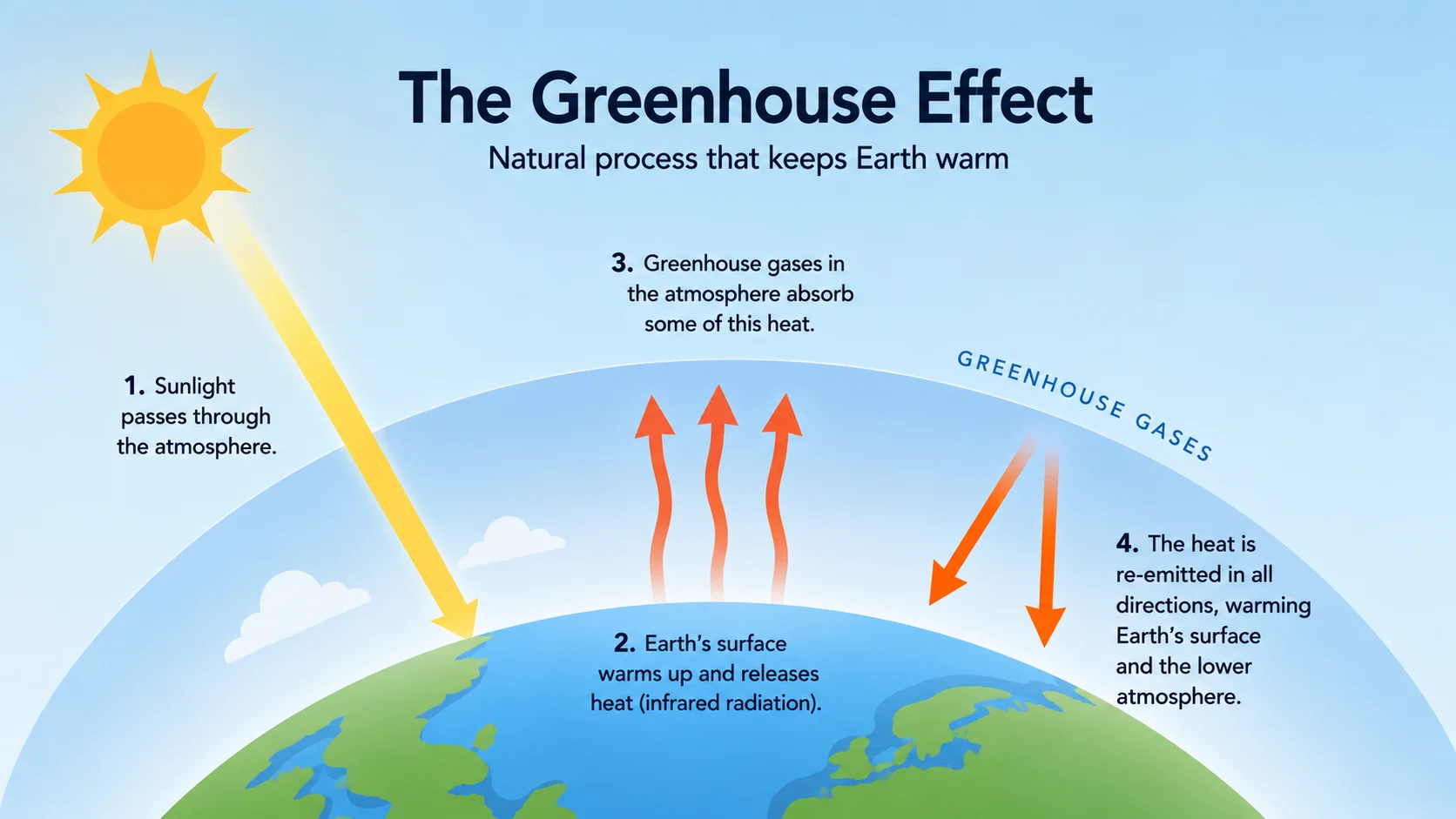

The greenhouse effect itself is not bad for Earth. It is a natural part of the climate system that keeps the planet warm enough for liquid water and the conditions in which life has developed. The climate problem arises when increasing concentrations of greenhouse gases strengthen that natural effect and change Earth’s energy balance.
This is an important difference because “greenhouse effect” and “global warming” are often discussed together as though they were two names for the same problem. They are related, but they are not the same thing. Earth had a greenhouse effect long before humans began burning coal, oil and natural gas on a large scale, and without that natural warming the planet would be far colder than it is today.
NASA estimates that Earth’s average surface temperature is around 15°C because of the natural greenhouse effect. Without it, the average would be roughly −18°C. The difference is more than 30°C, which gives some sense of how important greenhouse gases are to the climate we consider normal.
The concern today is therefore not that greenhouse gases exist. It is that human activities have increased the concentrations of several of them, adding extra warming to a system that was already naturally keeping Earth warm.
What does the natural greenhouse effect actually do?
Earth receives energy from the Sun, mostly as shortwave radiation. Some of that incoming energy is reflected back to space by clouds, ice and other bright surfaces, while the rest is absorbed by the atmosphere, oceans and land.
The warmed surface then releases energy as infrared radiation. Greenhouse gases such as water vapor, carbon dioxide, methane, nitrous oxide and ozone absorb some of that infrared radiation and emit radiation of their own.
Because of this interaction, the surface and lower atmosphere remain warmer than they would be if infrared energy could pass directly from the surface into space without being absorbed along the way.
NASA describes this atmospheric heating as the natural greenhouse effect and estimates that it raises Earth’s average surface temperature by more than 30°C. That is not a minor adjustment to the climate. It is one of the basic reasons Earth has extensive liquid water and a surface environment capable of supporting the ecosystems that exist today.
The term “greenhouse effect” can make the process sound as though Earth’s atmosphere works exactly like the glass walls of a garden greenhouse. The comparison is only approximate. A physical greenhouse stays warm partly because its enclosure restricts the movement of warm air, while the atmospheric greenhouse effect is primarily about the absorption and emission of infrared radiation.
The name is familiar and useful, but the underlying process is an exchange of energy rather than a literal layer trapping warm air beneath it.
Why would Earth be so cold without it?
Earth’s temperature is closely tied to the balance between the energy it receives and the energy it sends back to space.
For the planet’s temperature to remain broadly stable over a long period, outgoing energy eventually has to balance the solar energy Earth absorbs. Greenhouse gases affect the temperature at which that balance is achieved.
Without an infrared-absorbing atmosphere, Earth’s surface could lose energy to space much more directly. A much colder surface would then be sufficient to radiate the amount of energy needed to balance incoming sunlight.
With greenhouse gases present, energy moves through a warmer surface and lower atmosphere before ultimately escaping to space. The surface therefore settles at a considerably higher average temperature.
This is why removing the natural greenhouse effect would not return Earth to some cleaner or more environmentally desirable state. It would produce a fundamentally different and much colder planet.
The natural greenhouse effect is consequently better understood as part of Earth’s normal climate system rather than as pollution or an environmental disturbance.
If the greenhouse effect is natural, why is global warming a problem?
Something being natural does not mean its strength cannot change.
The amount of warming produced by the atmosphere depends partly on the concentrations of greenhouse gases within it. When those concentrations increase, the atmosphere becomes more effective at absorbing infrared radiation at the wavelengths affected by those gases.
That change initially reduces the amount of energy Earth loses to space relative to the amount it receives. The climate system then warms until outgoing energy increases enough to move toward balance again.
Climate scientists commonly refer to the additional warming associated with increasing greenhouse-gas concentrations as an enhanced greenhouse effect.
The Intergovernmental Panel on Climate Change describes this enhancement in terms of increasing atmospheric infrared opacity: higher greenhouse-gas concentrations cause radiation escaping to space to come effectively from higher, colder parts of the atmosphere, creating a radiative forcing that leads to warming of the surface and lower atmosphere.
Human activities have increased the concentrations of several long-lived greenhouse gases since industrialization, especially carbon dioxide. NASA identifies this human expansion of the greenhouse effect as the principal cause of the global warming observed since the mid-20th century.
The distinction is therefore between a natural process that helps make Earth habitable and a human-driven change that is strengthening that process.
Does that mean greenhouse gases are both necessary?
Yes, and there is no contradiction between those ideas.
Carbon dioxide, water vapor and other greenhouse gases were influencing Earth’s temperature long before industrial society existed. Their natural presence is part of the reason the planet is warm enough for its present ecosystems.
At the same time, the climatic influence of a greenhouse gas depends partly on its concentration. Increasing the amount of a gas that absorbs outgoing infrared radiation changes the amount of energy moving through the atmosphere.
This is similar to many other parts of natural systems, where the presence of something can be necessary while substantial changes in its amount still have consequences. The important scientific question is not simply whether a substance occurs naturally, but whether its concentration is changing enough to alter the system in which it operates.
Carbon dioxide provides a particularly clear example. It has always existed naturally in Earth’s atmosphere and is essential to photosynthesis, yet its atmospheric concentration has increased substantially since industrialization.
If the surprising part is how CO₂ can matter despite making up only a tiny fraction of the atmosphere, that question is covered separately in our explanation of how about 0.04% CO₂ can contribute to global warming. The important point here is simply that changing the concentration of an existing greenhouse gas changes the strength of its influence on Earth’s energy balance.
What is the difference between the natural and enhanced greenhouse effects?
The natural greenhouse effect refers to the warming produced by naturally occurring greenhouse gases as part of Earth’s long-established climate system.
The enhanced greenhouse effect refers to the additional influence that occurs when concentrations of greenhouse gases rise.
The underlying physics is not a different process. The enhancement is an increase in the strength of the same basic interaction between greenhouse gases and outgoing infrared radiation.
This helps explain why saying that “the greenhouse effect is natural” does not settle the question of modern global warming. Scientists are not arguing that humans invented the greenhouse effect. The evidence instead shows that human activities have changed the atmospheric concentrations of gases that participate in it.
NASA’s current climate overview states that human activities are driving the warming trend observed since the mid-20th century and specifically attributes that trend to the human expansion of the greenhouse effect.
The distinction also prevents the opposite misunderstanding that greenhouse gases themselves are something Earth would be better off without. Removing the natural effect would make the planet dramatically colder, while increasing it pushes the climate in the other direction.
Is water vapor part of the natural greenhouse effect?
Water vapor is an important greenhouse gas and contributes substantially to Earth’s natural warmth.
Its role is somewhat different from that of long-lived gases such as carbon dioxide because the amount of water vapor in the atmosphere responds strongly to temperature. Warmer conditions generally allow more water vapor to remain in the atmosphere, while cooling encourages condensation and precipitation.
This means water vapor often acts as a feedback. An initial warming caused by another influence can increase atmospheric water vapor, which can then add further greenhouse warming.
Its presence is another reason it would be misleading to talk about completely removing the greenhouse effect. The effect is woven into Earth’s water cycle, atmosphere and energy balance rather than being a single pollutant that could simply be taken away.
For this article, however, the important point is not which greenhouse gas contributes the largest share. It is that Earth’s naturally occurring greenhouse gases collectively maintain a much warmer surface than the planet would otherwise have.
Is the greenhouse effect the same as global warming?
The terms describe different things.
The greenhouse effect is a physical process involving greenhouse gases absorbing and emitting infrared radiation in Earth’s atmosphere. It exists naturally and has operated throughout Earth’s climatic history.
Global warming describes a long-term increase in Earth’s average surface temperature. Modern global warming is occurring because human activities have increased greenhouse-gas concentrations and altered Earth’s energy balance.
The enhanced greenhouse effect is the connection between the two ideas. Rising greenhouse-gas concentrations strengthen the atmospheric warming influence, which contributes to the observed rise in global temperature.
Keeping these meanings separate makes the climate discussion considerably clearer. The existence of a greenhouse effect is not evidence of a climate problem by itself; changes in its strength are what matter when discussing modern warming.
Would solving climate change require stopping the greenhouse effect?
No. Climate action is not intended to eliminate Earth’s natural greenhouse effect.
Reducing greenhouse-gas emissions means limiting the additional buildup caused by human activities. Even if human-caused emissions eventually fell to net zero, naturally occurring greenhouse gases would remain in the atmosphere and Earth would continue to have a greenhouse effect.
This point is sometimes obscured by phrases such as “stop the greenhouse effect” or “prevent greenhouse gases.” Those expressions may be convenient shorthand, but taken literally they describe neither the scientific problem nor the goal of climate mitigation.
The objective is to stop adding enough greenhouse gases to keep driving additional long-term warming, not to strip the atmosphere of the gases responsible for Earth’s natural warmth.
So is the greenhouse effect good or bad for Earth?
The most accurate answer is that the natural greenhouse effect is necessary for the kind of Earth we know, while strengthening that effect changes the climate.
Without natural greenhouse warming, Earth’s average surface temperature would be roughly −18°C rather than around 15°C. The atmosphere’s ability to absorb and emit infrared radiation therefore plays an essential role in keeping the planet habitable.
Modern climate change involves something different from the mere existence of that process. Human activities have increased atmospheric concentrations of long-lived greenhouse gases, particularly carbon dioxide, which has strengthened the warming influence of the atmosphere.
The useful dividing line is therefore not “greenhouse effect versus no greenhouse effect.” It is the difference between the natural greenhouse effect that has long been part of Earth’s climate and the additional warming produced as greenhouse-gas concentrations rise.
That distinction resolves what initially seems like a contradiction. Earth needs greenhouse gases, but the amount of greenhouse warming can still change, and changes in that amount can change the climate.

2 thoughts on “What Would Happen Without the Greenhouse Effect?”