
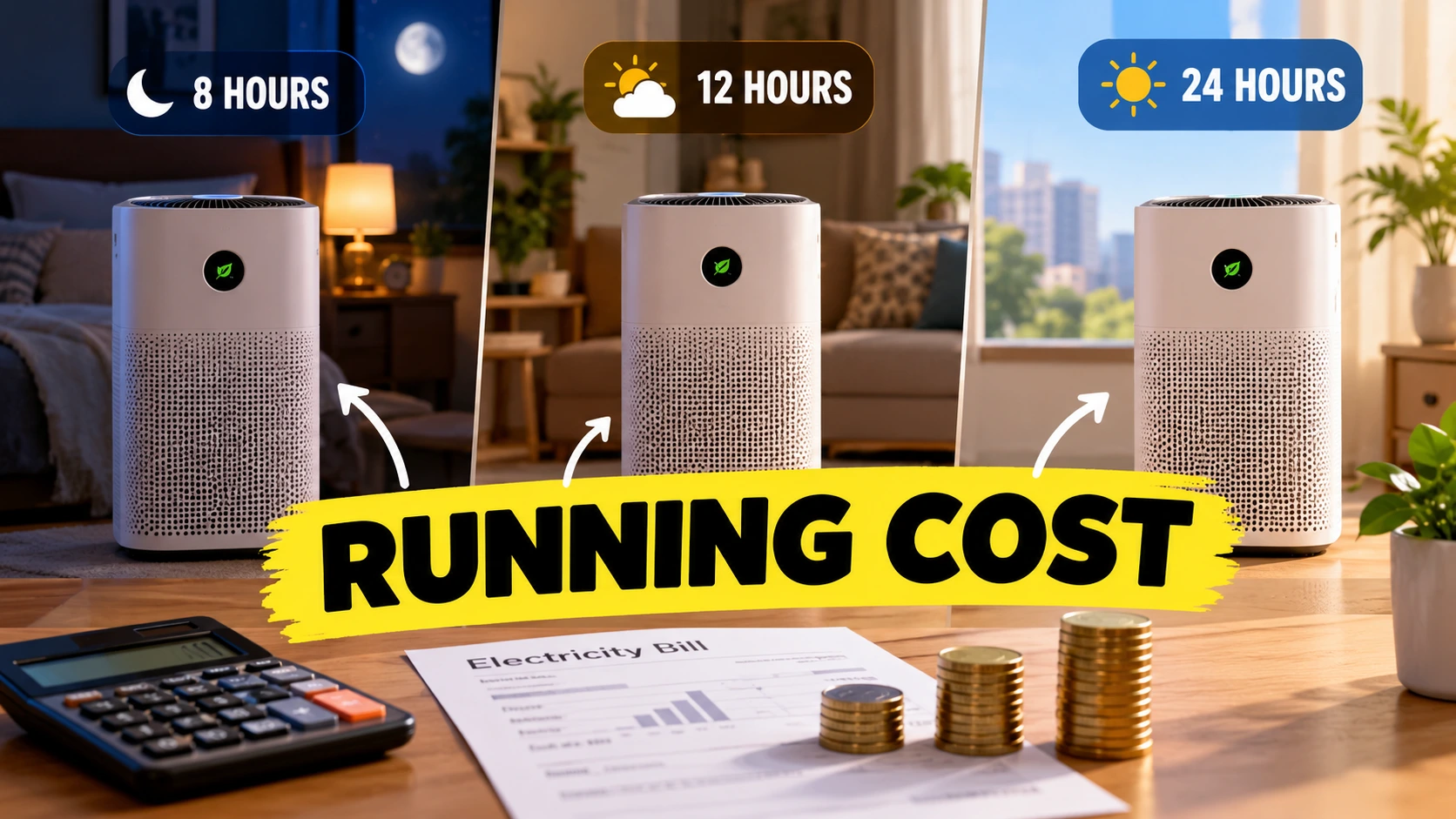

Running an air purifier continuously might sound expensive, particularly when electricity bills are already rising. But when I calculated what a relatively low-powered air purifier would actually cost to operate, the difference between eight hours and an entire day was smaller than I expected.
I compared three operating schedules—8 hours, 12 hours and 24 hours daily—using a documented 33-watt air purifier and an illustrative electricity rate of ₹8 per unit. The calculations showed that running the purifier continuously would cost approximately ₹190 per month, compared with ₹63 for eight hours daily.
The difference is about ₹127 per month, even though the machine operates three times as long. That finding made me examine another question: how much money does reducing operating time actually save and when might those savings justify having the purifier switched off?
Power Rating and Electricity Rate Used
I wanted to base the calculations on a real product specification rather than choosing an arbitrary wattage. Xiaomi’s official Indian product page lists the Smart Air Purifier 4 Lite as consuming approximately 33 watts at maximum filtration, equivalent to around 0.8 kilowatt-hours over 24 hours.
I selected that specification because it provides a consistent basis for comparing different operating schedules. However, this article is a mathematical analysis of published information, not a claim that I physically tested the purifier or measured its electricity consumption.
For the calculations, I used an electricity rate of ₹8 per kilowatt-hour, commonly called one electricity unit. This is an illustrative rate rather than an official tariff applicable across India, where residential electricity prices vary by state, provider and consumption level.
The calculation is:
Electricity cost = (Power in watts ÷ 1,000) × Operating hours × Electricity rate
For a 33W purifier, each hour of operation consumes 0.033 kWh. At ₹8 per unit, that works out to approximately 26.4 paise per hour.
I calculated monthly expenses using 30 days and annual expenses using 365 days. I also assumed that the machine maintained a constant 33W power draw, an assumption I examine more closely below because it can affect real-world electricity bills.
Air Purifier Running Costs
Using the same power consumption and electricity rate, I calculated how much each schedule would add to a household’s electricity bill.
| Operating time | Daily electricity use | Daily cost | Monthly cost | Annual cost |
|---|---|---|---|---|
| 8 hours | 0.264 kWh | ₹2.11 | ₹63.36 | ₹770.88 |
| 12 hours | 0.396 kWh | ₹3.17 | ₹95.04 | ₹1,156.32 |
| 24 hours | 0.792 kWh | ₹6.34 | ₹190.08 | ₹2,312.64 |
These are calculated electricity expenses for a constant 33W load at ₹8 per kWh, excluding filter replacements and fixed electricity charges. Monthly figures assume 30 days, while annual figures account for 365 days.
The results reveal something important about small electrical appliances. Although continuous operation sounds intensive, a device consuming only 33 watts uses less than one electricity unit over an entire day.
The operating schedule still makes a substantial proportional difference. However, because the electricity consumption begins at a relatively low level, even tripling the operating hours does not necessarily create a large monthly expense.
Eight Hours Daily
An eight-hour schedule could cover a typical night’s sleep. At 33 watts, the purifier would consume 7.92 electricity units over a 30-day month, costing approximately ₹63.36 at the selected tariff.
Extending that schedule across a full year produces an estimated electricity expense of ₹770.88. From a purely financial perspective, this is the least expensive option in my comparison, although the machine would remain switched off for 16 hours each day.
Twelve Hours Daily
Increasing the operating schedule to twelve hours raises monthly electricity consumption to 11.88 units. That produces an estimated monthly bill of ₹95.04, only ₹31.68 more than the eight-hour schedule.
What interested me was the amount of additional operating time purchased for that difference. An extra four hours daily provides another 120 hours of operation over a 30-day month, costing just over ₹1 more per day.
Twenty-Four Hours Daily
At 24 hours daily, the purifier would consume 23.76 electricity units during a 30-day month. At ₹8 per unit, that translates to ₹190.08 monthly or ₹2,312.64 annually.
Compared with the eight-hour schedule, continuous operation adds 480 operating hours every 30 days for an additional ₹126.72. Whether that extra expense is worthwhile depends on the household’s air-quality needs, but the electricity difference itself is relatively modest.
How Much Can You Save by Running an Air Purifier Less?
The individual running costs are useful, but I found the differences between schedules more revealing. Someone already operating a purifier continuously is not deciding whether to spend ₹190 from nothing; they are deciding how much they would save by reducing its operating time.
I compared those savings directly.
| Change in daily schedule | Monthly electricity savings | Annual electricity savings |
|---|---|---|
| 24 hours to 12 hours | ₹95.04 | ₹1,156.32 |
| 24 hours to 8 hours | ₹126.72 | ₹1,541.76 |
| 12 hours to 8 hours | ₹31.68 | ₹385.44 |
The largest saving comes from reducing continuous operation to eight hours daily. It would save approximately ₹1,542 annually, but it would also eliminate 5,840 hours of active filtration over the same period.
That trade-off matters because an air purifier is not simply another appliance that can be switched off whenever electricity savings become attractive. Its purpose is to remove airborne contaminants, and the amount of time it operates affects how much air it can filter.
The US Environmental Protection Agency explains that longer operating periods and higher fan speeds generally increase the amount of air filtered by portable air cleaners. Consequently, fewer operating hours may reduce electricity consumption while also reducing opportunities to remove airborne particles.
My assessment is that the ₹31.68 monthly difference between eight and twelve hours is unlikely to be a decisive financial concern for every household. The more meaningful question is whether those four additional hours provide useful filtration when people are using the room.
Actual Power Consumption May Vary
There is an important limitation in my calculations: they assume the purifier continuously draws its specified 33 watts.
In practice, many air purifiers have multiple fan speeds, including automatic modes that respond to detected particle concentrations. Xiaomi’s Smart Air Purifier 4 Lite, for example, supports automatic operation and adjustable settings.
This means the purifier may consume less than 33W when operating below its maximum setting. A machine left running for 24 hours does not necessarily draw its maximum rated power during every minute of those 24 hours.
To understand the financial importance of this distinction, I recalculated monthly running costs using three hypothetical constant power levels.
| Average power draw | 8 hours/day | 12 hours/day | 24 hours/day |
|---|---|---|---|
| 20W | ₹38.40 | ₹57.60 | ₹115.20 |
| 33W | ₹63.36 | ₹95.04 | ₹190.08 |
| 60W | ₹115.20 | ₹172.80 | ₹345.60 |
These figures use the same ₹8 electricity rate and 30-day month. The 20W and 60W figures represent illustrative power-consumption scenarios rather than measured results from particular air purifiers.
The difference is substantial. At an average draw of 20 watts, continuous operation would cost ₹115.20 monthly, compared with ₹190.08 at 33 watts.
That is a monthly difference of ₹74.88 without reducing operating time at all. It demonstrates why knowing a purifier’s actual average power consumption can be more useful than relying exclusively on the number of hours it remains switched on.
However, lower power consumption does not automatically mean equivalent filtration performance. A slower fan may use less electricity while moving less air through the filter, making room size and clean-air delivery important considerations.
The most accurate way to determine actual running costs would be to measure the purifier’s electricity consumption across representative operating conditions. Without those measurements, rated-power calculations should be treated as estimates rather than precise predictions of household bills.
How Electricity Rates Affect Running Costs
The next variable I examined was the electricity tariff. A household paying ₹6 per unit will have a different running cost from one paying ₹10, even when both use the same purifier for identical periods.
For the 33W purifier operating continuously, the difference looks like this:
| Electricity rate | Monthly cost for 24-hour operation |
|---|---|
| ₹6 per unit | ₹142.56 |
| ₹8 per unit | ₹190.08 |
| ₹10 per unit | ₹237.60 |
At ₹6 per unit, continuous operation would cost approximately ₹143 monthly. At ₹10, the estimate increases to nearly ₹238, a difference of ₹95.04 without any change in power consumption or operating time.
This matters in India because residential tariffs are not uniform. Electricity bills can also include fixed charges, adjustments, and consumption-based slabs that affect the final amount paid.
For a more accurate estimate, I would use the additional per-unit charge applicable to the electricity consumed by the purifier. Dividing a household’s entire electricity bill by its total consumption may produce a misleading figure when fixed charges or different tariff slabs are involved.
Other Costs Beyond Electricity
While comparing electricity expenses, I also considered an operating cost that is easy to overlook: filter replacement.
Air purifier filters collect airborne particles over time, and their useful lifespan depends on factors such as pollution levels, operating conditions, and usage. Xiaomi’s Indian FAQ states that the Smart Air Purifier 4 Lite filter typically lasts approximately six to twelve months under normal conditions.
That does not mean operating the purifier for twice as many hours will always halve the filter’s lifespan. The amount of pollution passing through the filter, fan speed, and environmental conditions can also influence replacement frequency.
To illustrate the financial impact, consider a hypothetical replacement filter costing ₹2,500. One annual replacement would average approximately ₹208 per month, while two replacements annually would average approximately ₹417 monthly.
Those are illustrative ownership costs, not verified replacement-filter prices or predictions for the Xiaomi model. Nevertheless, they show why looking only at electricity expenses can underestimate the actual cost of maintaining an air purifier.
In the main calculation, continuous operation costs ₹2,312.64 in electricity over one year. A single hypothetical ₹2,500 filter replacement would exceed that entire annual electricity expense.
I would therefore separate electricity costs from replacement-filter costs when comparing operating schedules. The electricity calculation is straightforward, but total ownership expenses depend on the actual filter price and how frequently replacement becomes necessary.
Which Running Schedule Makes the Most Sense?
After examining the calculations, I would not recommend choosing the shortest schedule automatically.
Eight hours is clearly the cheapest option, but that conclusion only considers electricity expenses. It does not establish whether operating the purifier solely overnight would provide adequate filtration for someone whose room experiences particle pollution throughout the day.
Twelve hours looks financially attractive because it extends operating time by 50% compared with the eight-hour schedule while adding only ₹31.68 to the estimated monthly electricity bill. For someone who wants filtration during sleep and additional evening or daytime hours, that is a relatively small difference.
Continuous operation deserves consideration when particle pollution is persistent or when maintaining filtration throughout the day is important. At an estimated ₹190 monthly for the 33W example, electricity consumption alone may not be a compelling reason to switch the machine off for long periods.
However, I would not assume that continuously running a purifier guarantees clean indoor air. Its clean-air delivery rate, the room’s size, ventilation, pollution sources, and operating speed determine how effectively it can reduce airborne particles.
ENERGY STAR evaluates air-cleaner energy efficiency in relation to clean-air delivery rather than electricity consumption alone. That distinction reinforces my conclusion that the least expensive operating schedule is not necessarily the most useful one.
For a household with significant indoor particle pollution, I would prioritize sufficient filtration while keeping an eye on power consumption. Where pollution levels and filtration needs are lower, shorter schedules may be reasonable, but electricity cost alone cannot determine the appropriate duration.
My Final Assessment of the 8-, 12- and 24-Hour Costs
My calculations changed how I think about the expense of running an air purifier. I initially expected continuous operation to create a more noticeable electricity burden, but the results for a 33W machine suggest that its operating cost can remain relatively modest.
At an illustrative ₹8 per electricity unit, eight hours of daily operation costs approximately ₹63 monthly, twelve hours costs ₹95, and continuous operation costs ₹190. The additional expense of running the purifier around the clock rather than eight hours daily is approximately ₹127 per month.
The finding I consider most useful is that operating time should not be judged independently of power consumption. A purifier drawing an average of 20 watts can cost substantially less to run continuously than a higher-powered model, although its filtration performance must also be considered.
For someone deciding whether to keep an air purifier running all day, I would first examine the actual power rating, electricity tariff, and required filtration time. I would then consider filter expenses and, where possible, measured electricity consumption instead of assuming the rated wattage remains constant.
My conclusion is that running an efficient air purifier for 24 hours can be more affordable than it initially appears. Reducing operating hours certainly saves electricity but the amount saved may be relatively small compared with the benefit of maintaining filtration when indoor air quality requires it.
Calculation References
Xiaomi India — Smart Air Purifier 4 Lite: Official manufacturer specifications used to establish the 33W maximum power consumption and understand the purifier’s operating modes. View official product specifications
Xiaomi India — Smart Air Purifier 4 Lite FAQ: Manufacturer information concerning filter replacement intervals and operating conditions. View Xiaomi’s official FAQ
US Environmental Protection Agency — Guide to Air Cleaners in the Home: Official guidance explaining how operating duration, fan speed and clean-air delivery affect particle filtration. Read the EPA guidance
ENERGY STAR — Air Cleaners: Guidance on energy efficiency, clean-air delivery rates and selecting appropriately sized air cleaners. ENERGY STAR air-cleaner information
Calculation disclosure: All electricity-cost figures were calculated using the stated wattages, operating periods, and illustrative tariffs. No physical product testing or household electricity measurements were performed.
Frequently Asked Questions
How much electricity does an air purifier consume in 8 hours?
An air purifier drawing a constant 33 watts consumes approximately 0.264 kWh in eight hours. At ₹8 per electricity unit, that translates to around ₹2.11 daily or ₹63.36 over a 30-day month.
Is running an air purifier for 24 hours expensive?
Not necessarily, particularly when the purifier has relatively low power consumption. In my calculations, running a 33W purifier continuously costs approximately ₹190 monthly at ₹8 per unit, although higher-powered models and different tariffs can increase that expense.
Is it cheaper to run an air purifier for 8 hours instead of 24 hours?
Yes, assuming the same average power draw and electricity tariff. My comparison found that reducing daily operation from 24 hours to eight hours saves approximately ₹126.72 per 30-day month for a constant 33W load at ₹8 per unit but it also reduces active filtration time.
