
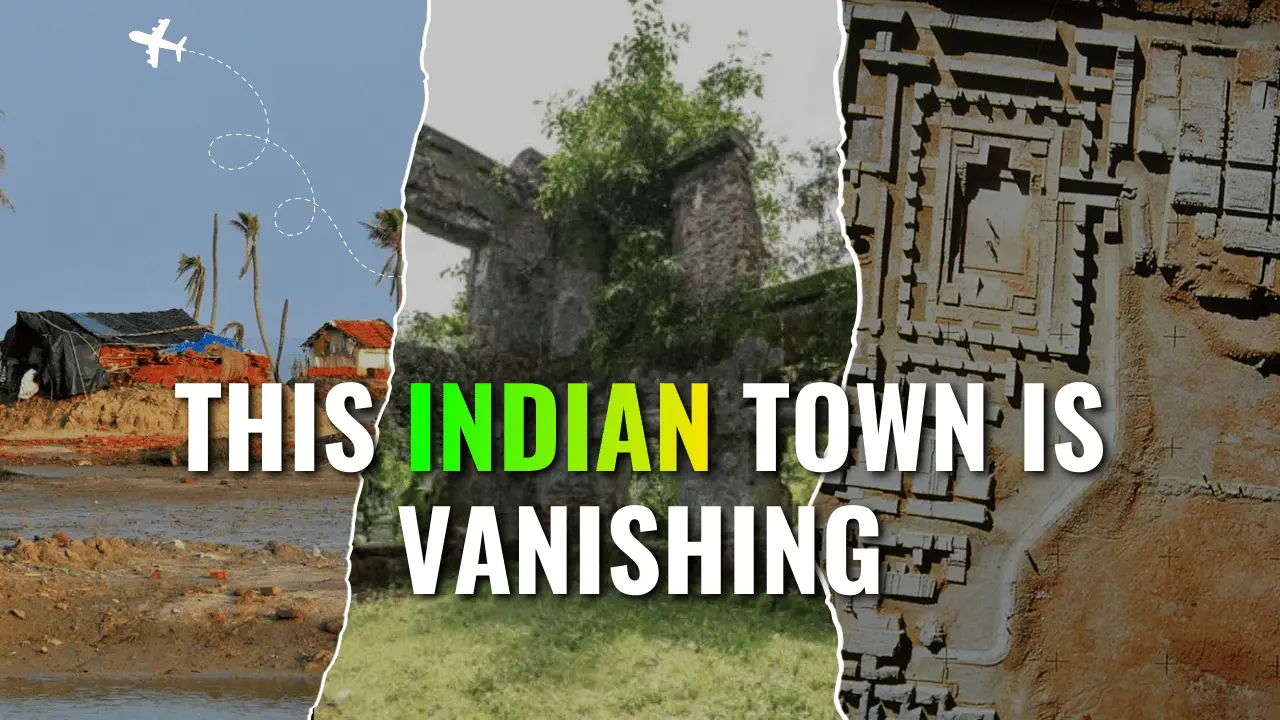

Not all towns die suddenly. Some do not collapse, burn, or explode into headlines. They simply… shrink. A house gone one year. A road missing the next. A school abandoned because the river moved closer.
Across India, there are towns and villages that are quietly disappearing — erased by water, land erosion, floods, and shifting geography. Many of these places were once thriving. Some were ancient. Others were never famous enough to be remembered.
1. Ghoramara Island, West Bengal
Once home to thousands, Ghoramara Island in the Sundarbans is now one of India’s most tragic disappearing settlements.
How It’s Vanishing
Rising sea levels and relentless coastal erosion have swallowed most of the island. Entire villages have collapsed into the Bay of Bengal. What was once farmland is now water.
The Human Cost
Families have migrated to the mainland with no compensation, no clear resettlement plan, and no certainty. Many still return to visit the place where their homes once stood — now marked only by waves.
🌊 Ghoramara proves that climate change does not arrive loudly — it erases silently.
Also Read: 5 Famous Rivers in India That Shaped Civilization, Culture And Curiosity
2. Satabhaya, Odisha: The Village That Relocated Itself
Satabhaya was not one village — it was seven.
What Happened
Over decades, coastal erosion and cyclones destroyed six villages completely. The seventh followed soon after. The sea advanced steadily, swallowing homes, temples, and fields.
India’s First Climate Relocation
Residents were eventually relocated inland. Satabhaya became a case study in climate-induced migration — a warning of what many coastal regions may face in the future.
⚠️ Satabhaya was not defeated by one storm, but by many small ones.
3. Majuli, Assam: The Island That Keeps Shrinking
Majuli is still alive — but it is fighting time.
A River That Won’t Stay Still
The Brahmaputra constantly changes course, eroding Majuli’s edges year after year. Since the mid-20th century, the island has lost a massive portion of its land.
Culture Under Threat
Majuli is not just land — it is a cultural hub of Assamese Vaishnavite traditions. As land disappears, monasteries, homes, and heritage vanish with it.
🏞️ Majuli shows that when land disappears, culture is forced to migrate.
4. Kedarnath’s Surrounding Settlements: Life After the Flood
While Kedarnath itself was rebuilt after the 2013 disaster, many nearby settlements never recovered.
Nature’s Sudden Shift
Flash floods and landslides permanently altered river paths and terrain. Small towns and villages were declared unsafe and abandoned.
What Remains
Ruined houses, broken roads, and empty land where communities once existed. Nature did not just destroy — it redesigned the map.
⛰️ In the Himalayas, land does not stay where humans expect it to.
5. Muziris, Kerala: A City Lost Long Before Climate Change
Not all disappearing towns are modern.
India’s Forgotten Port
Muziris was once one of India’s most important ancient ports, trading with Rome, Greece, and the Middle East.
How It Vanished
A massive flood around the 14th century altered Kerala’s coastline and river systems, burying Muziris under silt and time.
A City Rediscovered, Not Revived
Today, archaeologists are still uncovering fragments — pottery, coins, and ruins — of a city nature chose to erase.
🏺 Muziris reminds us that India has lost cities before — and will again.
Also Read: मौन व्यवहार का मनोविज्ञान: चुप्पी शब्दों से अधिक पीड़ा क्यों देती है
Why Are These Indian Towns Disappearing?
The reasons are rarely singular. Most vanish due to a combination of:
- River erosion
- Rising sea levels
- Unplanned development
- Deforestation
- Climate change
- Fragile geography
India’s rivers are dynamic, its coastline vast, and its mountains young and unstable. Settlements built without respecting these realities often don’t survive long-term.
The Hardest Part: No Memorial, No Closure
Unlike wars or earthquakes, disappearing towns do not get monuments.
There is no single date to remember. No final evacuation day. Just gradual loss.
- Schools close first
- Shops move away
- Young people leave
- Elders stay until there is nothing left
🕰️ Most towns do not die — they fade.
What This Means for India’s Future
Experts warn that many more Indian settlements face similar risks — especially along coasts, riverbanks, and hill regions.
This raises difficult questions:
- Where do people go when land disappears?
- Who owns responsibility — nature or governance?
- How do you preserve culture without geography?
India’s challenge is not just development — it is adaptation.
When Maps Lag Behind Reality
Somewhere in India right now, a house is being claimed by a river. Somewhere else, the sea is advancing a few more meters. These places may still appear on maps, but not for long.
💡 A town truly disappears when no one remembers it existed.
By talking about them, we keep these places alive — at least in memory.

1 thought on “Indian Towns That Are Vanishing Without Noise”