
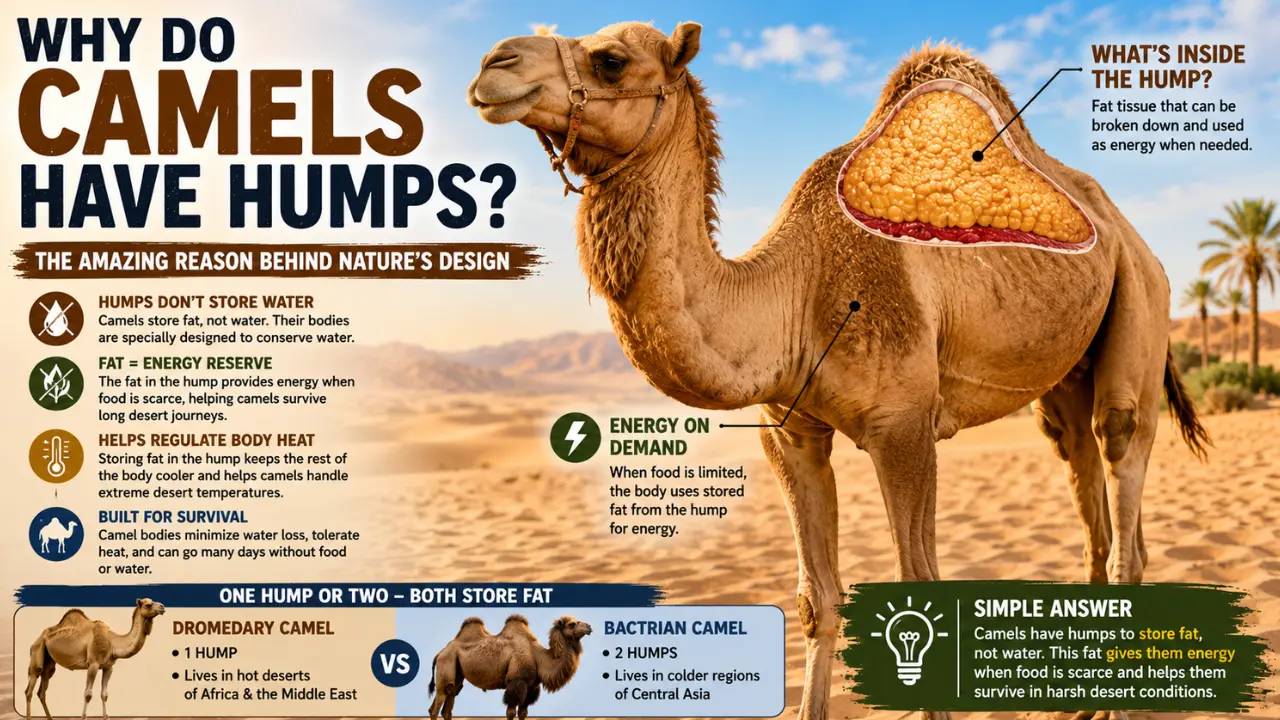

Camels have humps mainly to store fat, not water. Their bodies use this stored fat as energy when food becomes scarce in deserts or dry regions. When a camel goes many days without eating enough plants, its body breaks down the fat in the hump and turns it into usable energy. This helps camels survive long journeys, hot weather and dry landscapes where food does not always grow regularly.
What Is Inside a Camel’s Hump?
A camel’s hump contains fat tissue. It does not contain a water tank, despite the common myth that camels store water in their humps.
The fat stored in the hump serves as an energy reserve. When food is plentiful, a camel stores excess energy as fat in its hump. During long journeys through deserts where food is scarce, the camel gradually uses this stored fat to meet its energy needs.
When the camel eats well, the hump looks fuller and firmer. When it goes without enough food for an extended period, the hump can shrink, become softer, or lean to one side because some of the stored fat has been used.
By storing fat in one place instead of throughout the body, camels also reduce insulation over the rest of their bodies. This helps them release heat more efficiently, making it easier to cope with the extreme temperatures of desert environments.
Also Read: Why Is the Giant Panda an Endangered Species?
Why Do Camels Store Fat in the Hump?
Camels store fat in one place because it helps their bodies manage heat better while also providing a valuable energy reserve. This unique adaptation is one reason they can survive in harsh desert environments.
Many animals store fat under the skin across the whole body. But if camels carried thick layers of fat everywhere, their bodies would trap more heat, making it harder to stay cool in the intense desert sun.
By keeping most of their fat concentrated in the hump, the rest of the body has less insulation and can release heat more efficiently. This helps the camel regulate its body temperature while traveling through extremely hot conditions.
How the Hump Helps
The hump serves two important purposes:
- It stores energy for times when food is limited.
- It keeps most of the body’s fat in one place, helping the rest of the body lose heat more effectively.
When food becomes scarce, the camel gradually uses the fat stored in its hump for energy. Once food becomes available again, the hump is replenished with new fat. This combination of energy storage and improved heat management makes the hump one of the camel’s most remarkable adaptations for desert life.
Do Camel Humps Store Water?
No, camel humps do not store water. This is one of the most common myths about camels.
Instead, the hump stores fat, which serves as an energy reserve when food is scarce. Water is not kept inside the hump.
Camels are able to survive for long periods without drinking because their entire body is specially adapted to conserve water. They can:
- Lose less water through sweating
- Tolerate wider body temperature changes
- Produce highly concentrated urine
- Pass very dry droppings to reduce water loss
- Drink large amounts of water quickly when water becomes available
These adaptations allow camels to make the most of every drop of water they consume and reduce unnecessary water loss during long periods in the desert.
The hump helps by storing energy, while the rest of the camel’s body is designed to conserve water efficiently. Together, these adaptations enable camels to survive in some of the hottest and driest environments on Earth.
Also Read: Importance of Biodiversity Explained in Simple Words
Why Do Some Camels Have One Hump and Some Have Two?
Different camel species have different numbers of humps. This difference is simply a characteristic of the species and does not change the purpose of the humps.
| Camel type | Number of humps | Common habitat |
|---|---|---|
| Dromedary camel | 1 hump | Hot deserts, especially in the Middle East and North Africa |
| Bactrian camel | 2 humps | Colder, harsher regions of Central Asia |
The dromedary camel is adapted to hot, dry deserts, while the Bactrian camel is adapted to environments with cold winters, rocky terrain, and deserts that experience large temperature changes.
Both types use their humps to store fat. The number of humps does not mean one stores water and the other stores food. Both store fat, which provides energy when food is scarce.
Whether a camel has one hump or two, the humps serve the same basic purpose—helping the animal survive in challenging environments by storing energy while allowing the rest of the body to release heat more efficiently.
Also Read: Life Feels Heavy for No Reason? Here Is Why
What Happens When a Camel Uses the Fat in Its Hump?
When a camel cannot find enough food, its body gradually uses the fat stored in the hump as an energy source. This stored fat allows the camel to survive for long periods when vegetation is scarce, reducing its dependence on a constant food supply.
As the body consumes the stored fat, the hump becomes smaller and may lose its firm, upright shape. In some cases, it can become softer or lean to one side because much of the fat reserve has been used.
This change is a normal sign that the camel has relied on its stored energy. It does not mean the hump has disappeared—it simply contains less fat than before.
Once the camel has access to enough food again, it begins storing fat in the hump once more. Over time, the hump gradually becomes fuller, firmer, and returns to its usual shape.
This ability to store and later replenish fat is one of the key adaptations that enables camels to survive in deserts and other harsh environments where food is often difficult to find.

2 thoughts on “Why Do Camels Have Humps on Their Backs?”