
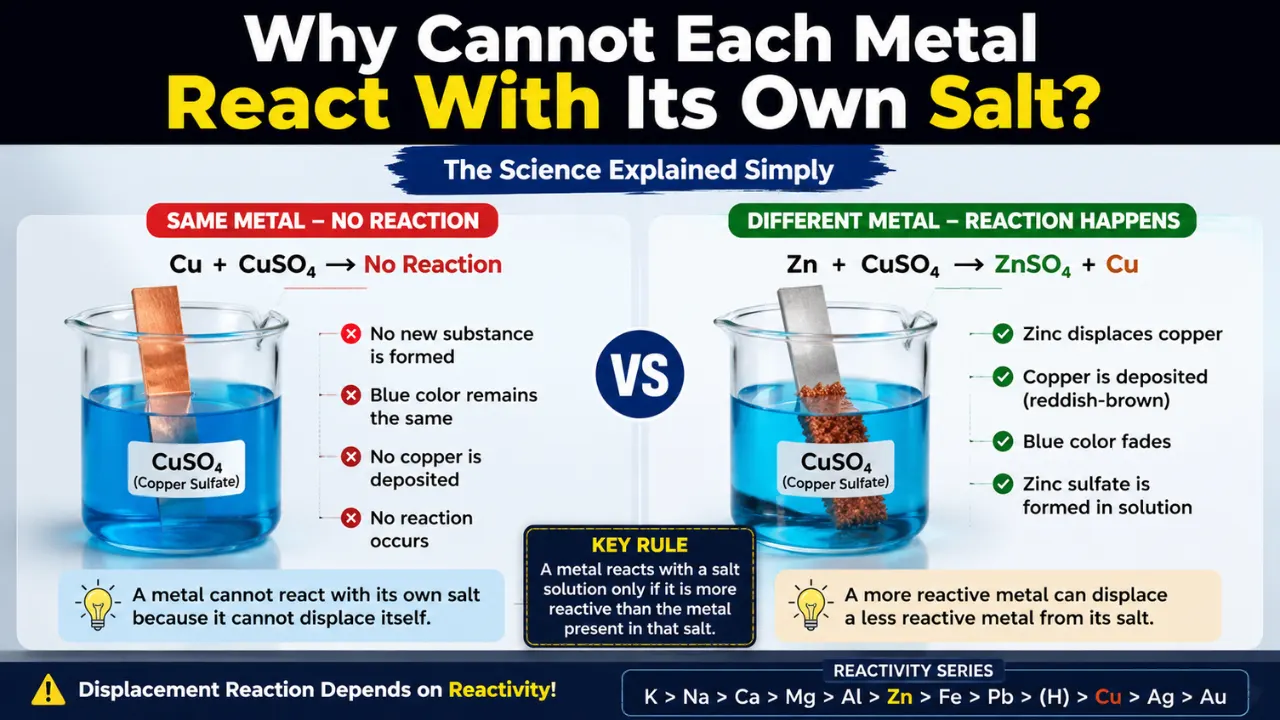

A metal cannot react with its own salt because it cannot displace itself. A displacement reaction needs a more reactive metal to replace a less reactive metal from its salt solution. When the metal and the salt contain the same metal, there is no difference in reactivity, so no new substance forms and no visible chemical reaction takes place.
For example:
Copper + copper sulfate solution → no reaction
Chemical form:
Cu + CuSO₄ → no reaction
This happens because copper sulfate already contains copper. Copper metal cannot remove copper from copper sulfate because both are copper.
What Does “Its Own Salt” Mean?
A metal’s own salt means a salt that already contains the same metal.
For example:
Copper sulfate is copper’s own salt because it contains copper.
Zinc sulfate is zinc’s own salt because it contains zinc.
Iron sulfate is iron’s own salt because it contains iron.
So when copper is placed in copper sulfate solution, the metal and the salt both contain copper. Nothing new can replace anything.
Also Read: 6 Reasons Gold and Platinum Are Suitable for Jewellery
Why Displacement Does Not Happen
Displacement means one metal takes the place of another metal in a compound.
For example:
Zinc + copper sulfate solution → zinc sulfate solution + copper
Chemical form:
Zn + CuSO₄ → ZnSO₄ + Cu
This reaction happens because zinc is more reactive than copper. Zinc replaces copper from copper sulfate. Zinc enters the solution as zinc sulfate, and copper comes out as a reddish-brown solid.
But copper cannot react with copper sulfate in the same way because copper would have to replace copper itself.
Copper + copper sulfate solution → no reaction
Chemical form:
Cu + CuSO₄ → no reaction
Here, there is no different metal to replace. The copper in the metal strip and the copper in the salt solution are the same element.
What Happens Inside the Solution?
Copper sulfate solution contains copper ions. These copper ions are tiny charged copper particles dissolved in water.
When copper metal is placed in copper sulfate solution, the copper atoms in the metal and the copper ions in the solution belong to the same element. Since neither side is more reactive than the other, electrons do not move in a useful direction to form a new substance.
Because of this:
- copper does not replace copper,
- no new salt forms,
- no new metal is deposited,
- the solution remains mostly unchanged.
That is why we say there is no reaction, or more accurately, no net reaction.
Also Read: What Is Time Management and Why Is It Important?
Why Zinc Reacts With Copper Sulfate
Zinc reacts with copper sulfate because zinc is more reactive than copper.
In simple words, zinc has a stronger tendency to give away electrons. Copper ions accept those electrons and become copper metal.
So this reaction happens:
Zinc + copper sulfate solution → zinc sulfate solution + copper
Chemical form:
Zn + CuSO₄ → ZnSO₄ + Cu
You may observe these changes:
- the blue color of copper sulfate slowly fades,
- zinc slowly dissolves,
- reddish-brown copper forms on the zinc strip,
- zinc sulfate forms in the solution.
This proves that a real chemical reaction has happened.
The Main Rule
A metal reacts with a salt solution only if the added metal is more reactive than the metal present in the salt.
So:
More reactive metal + less reactive metal salt → reaction
Example:
Zinc + copper sulfate → zinc sulfate + copper
But:
Same metal + its own salt → no reaction
Examples:
Copper + copper sulfate → no reaction
Zinc + zinc sulfate → no reaction
Iron + iron sulfate → no reaction
Each metal cannot react with its own salt because the metal and the metal ion in the salt are from the same element. There is no more reactive metal present, so no displacement can happen. The solution does not form a new salt, no new metal appears, and the reaction shows no visible chemical change.

1 thought on “Reasons a Metal Can not React With Its Own Salt”