
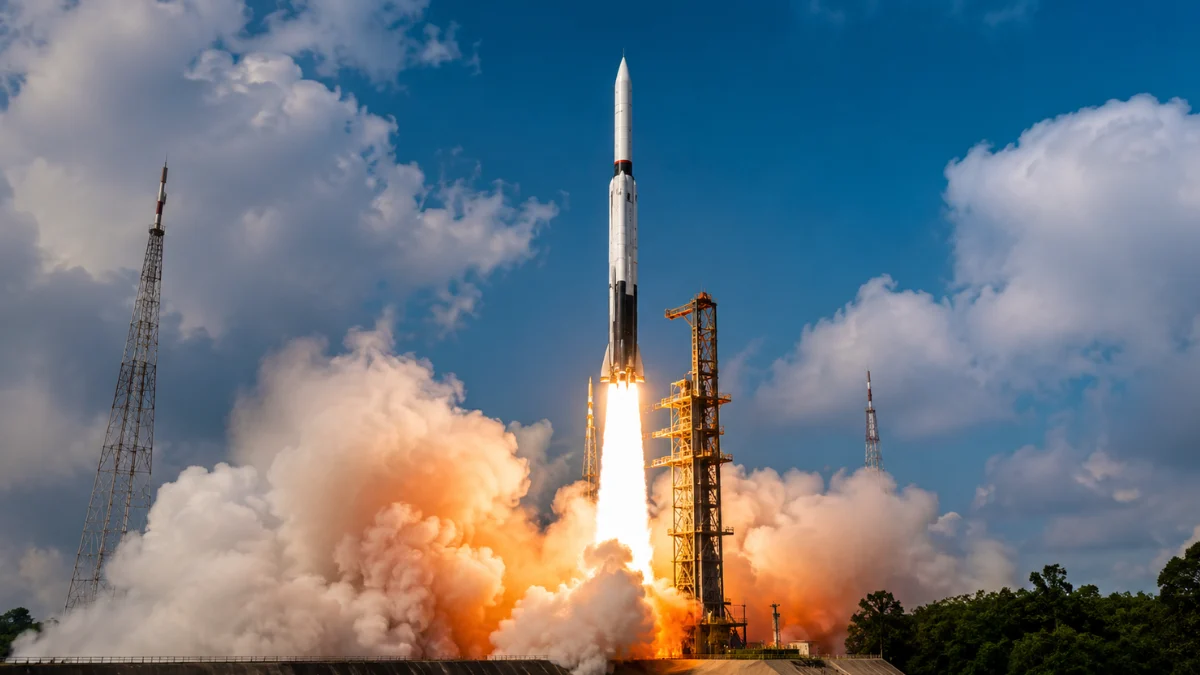

India’s private space industry crossed an important milestone when Skyroot Aerospace’s Vikram-1 successfully carried multiple payloads into low-Earth orbit.
The rocket lifted off from the Satish Dhawan Space Centre in Sriharikota on July 18, 2026, during a test flight called Mission Aagaman. Around 15 minutes later, it placed its payloads into an orbit approximately 450 kilometres above Earth.
Vikram-1 achieved this result by combining three powerful solid-fuel stages with a liquid-fuel orbital adjustment module. The solid stages pushed the rocket through the atmosphere and accelerated it toward orbital speed. The liquid-powered final module then made the precise corrections needed to release the payloads into the planned orbit.
That final step explains why Vikram-1 represented much more than another rocket reaching space.
What Vikram-1 Actually Achieved
A rocket does not enter orbit simply by climbing high above Earth.
It must also travel sideways at an extremely high speed. Without enough horizontal speed, gravity pulls the rocket or its payload back toward the planet, even when it reaches space.
Vikram-1 completed both parts of the challenge. It climbed beyond the dense atmosphere and accelerated its payloads fast enough for them to continue falling around Earth instead of returning directly to the ground.
This continuous movement around the planet creates an orbit.
Skyroot designed Vikram-1 to carry small satellites and experimental payloads into low-Earth orbit. The rocket stands approximately 22 metres tall and can carry payloads weighing up to about 350 kilograms, depending on the required orbit and mission design.
India’s technology push extends beyond the space sector. The country is also exploring why hydrogen trains may still be useful when most railway lines already use electricity, especially on routes where full electrification presents practical challenges.
How Vikram-1 Reached Orbit
Vikram-1 used a four-part propulsion system. Its first three stages burned solid fuel, while its final orbital adjustment module used a liquid-fuel engine.
Each stage performed a different part of the journey.
The First Stage Provided the Initial Power
The first stage had to lift the entire rocket from the launch pad while fighting Earth’s gravity and atmospheric resistance.
Skyroot calls this first-stage motor Kalam-1200. It measures around 11 metres in length and 1.7 metres in diameter. The motor contains approximately 30 tonnes of solid propellant.
When the rocket launched, this stage produced the enormous thrust needed to move Vikram-1 away from the ground and through the thickest part of the atmosphere.
The first stage did not remain attached for the entire flight. Once it consumed its fuel, the rocket separated it to remove unnecessary weight. The second stage then continued the climb.
The Second and Third Stages Increased the Rocket’s Speed
The next two solid-fuel stages continued accelerating Vikram-1 after the first stage separated.
During this part of the flight, the rocket gradually changed its direction. It no longer travelled mainly upward. It began building the horizontal speed required to enter orbit.
This manoeuvre plays a crucial role in every orbital launch. A rocket that only climbs vertically may cross the commonly recognised boundary of space, but it will eventually fall back toward Earth. An orbital rocket must direct much of its energy toward sideways motion.
Vikram-1’s guidance, navigation and control systems continuously monitored the vehicle’s position, speed and direction. The onboard systems made corrections to keep the rocket on its planned path.
After each solid stage completed its burn, the rocket separated it and continued with less weight.
Why Vikram-1 Needed a Liquid-Fuel Final Module
Solid motors offer strong thrust and relatively simple construction, but operators cannot easily stop and restart them after ignition.
A satellite launch requires much greater precision near the end of the flight. Even a small difference in speed, direction or altitude can place a payload in the wrong orbit.
Skyroot therefore equipped Vikram-1 with a liquid-fuel orbital adjustment module. Its 3D-printed engine allowed the vehicle to make more controlled orbital corrections after the three solid stages completed the main ascent.
The module performed the final burn that helped place the payloads into the intended orbit around 450 kilometres above Earth.
Because the liquid engine can support precise manoeuvres, the module can adjust the rocket’s trajectory more accurately than a solid stage alone. This capability becomes especially useful when a mission carries several small satellites that require carefully planned deployment conditions.
What Vikram-1 Carried Into Space
Mission Aagaman carried a mixture of customer payloads, experimental systems and symbolic objects.
The technology payloads included Skyroot’s own SCOPE satellite, Grahaa Space’s SOLARAS S3 satellite and a demonstration from German space company DCUBED.
The rocket also carried Embrace, an experimental robotic-arm system developed by Cosmoserve Space. The project aims to explore technologies that could eventually help capture or manage objects in orbit.
Two artistic payloads accompanied the technical experiments. One was Cosmic Bloom, a flower-shaped artwork. The other was a small 18-karat gold rocket containing microscopic sculptures honouring Indian scientists C. V. Raman, Vikram Sarabhai and A. P. J. Abdul Kalam.
These payloads gave Mission Aagaman a practical purpose beyond testing the launch vehicle. They allowed customers and developers to gather real information about how their technologies behaved in orbit.
How Vikram-1 Differs From Vikram-S
Skyroot had already launched a private rocket from India before Mission Aagaman.
In November 2022, the company launched Vikram-S during Mission Prarambh. The single-stage rocket reached an altitude of 88.8 kilometres before returning to Earth.
Vikram-S followed a suborbital path. It reached the upper atmosphere and helped Skyroot test technologies such as solid propulsion, carbon-composite structures, avionics and telemetry. However, it did not accelerate a satellite into a stable orbit.
Vikram-1 faced a much harder task.
It used multiple stages, an advanced guidance system and an orbital adjustment module. It had to survive stage separations, maintain an accurate trajectory and reach the speed required to keep payloads circling Earth.
Vikram-S demonstrated that Skyroot could build and fly a private rocket. Vikram-1 demonstrated that an Indian private company could build a complete orbital launch system.
Why the Carbon-Composite Structure Matters
Rocket designers constantly try to reduce vehicle weight without weakening the structure.
Every kilogram used for the rocket’s body reduces the weight available for fuel or payload. Skyroot addressed this problem by building Vikram-1 with an all-carbon-composite structure.
Carbon-composite materials can provide considerable strength while weighing less than many traditional metallic structures. A lighter vehicle requires less energy to accelerate and can carry a more useful payload.
The material also supported Skyroot’s goal of producing a relatively compact launcher for small satellites instead of competing directly with much larger rockets designed for heavy spacecraft.
Vikram-1’s small-launch approach could serve companies and research organisations that do not need an entire large rocket for one mission.
Why Small Satellites Need Dedicated Rockets
Many small satellites currently travel as secondary passengers on larger missions.
This method can reduce costs, but satellite operators often have limited control over the launch date and destination orbit. The primary customer usually determines the mission schedule and trajectory.
A smaller dedicated rocket offers another option.
A customer may gain greater control over when the satellite launches, which orbit it enters and how the mission deploys it. This flexibility can matter for Earth-observation constellations, scientific experiments, communication systems and technology demonstrations.
Vikram-1 targets this part of the commercial launch market. Its value will depend not only on whether it can reach orbit, but also on whether Skyroot can eventually provide reliable launches at competitive prices.
Why Mission Aagaman Was Still a Test Flight
The successful orbital insertion did not immediately turn Vikram-1 into a routine commercial service.
Mission Aagaman served as the rocket’s first orbital test flight. Skyroot used it to evaluate propulsion, stage separation, avionics, telemetry, guidance, navigation and control under real flight conditions.
Ground tests can reproduce many stresses, but they cannot perfectly recreate an entire launch. Engineers must study the flight data to understand how every component performed during ascent and orbital insertion.
Skyroot has said that it plans to conduct additional test flights before moving into regular commercial operations.
Those future missions will show whether the company can repeat the result reliably. Reliability matters because customers must trust a rocket with satellites that may take years and significant investment to build.
What Vikram-1 Changes for India
ISRO has developed India’s major launch vehicles and built the foundation of the country’s space programme. Vikram-1 does not replace that role.
Instead, it shows how private companies can begin providing additional launch capacity while using the regulatory framework, expertise and infrastructure that India has developed over several decades.
India opened more of its space sector to private participation in 2020, while the Indian Space Policy 2023 clarified opportunities for non-government organisations across launch services, satellites and space applications.
Vikram-1 turned part of that policy shift into a working orbital mission.
Its success gives Indian satellite startups another potential path to space and shows that private companies can develop launch vehicles within the country. It could also encourage greater investment in propulsion, materials, satellite manufacturing, robotics and other space technologies.
The most important result, however, came at the end of the flight. Vikram-1 did not merely leave the atmosphere. It completed the precise sequence of propulsion, guidance and orbital adjustment required to release working payloads around Earth.
That achievement made it India’s first privately developed rocket to successfully reach orbit.
Frequently Asked Questions
Why is Vikram-1 important for India?
Vikram-1 demonstrated that an Indian private company could develop and fly an orbital launch vehicle. The mission marked an important step in the expansion of India’s private space industry.
How did Vikram-1 reach orbit?
Vikram-1 used three solid-fuel stages to climb through the atmosphere and build speed. A liquid-fuel orbital module then made the final adjustments needed to place the payloads into orbit.
What is the difference between Vikram-1 and Vikram-S?
Vikram-S completed a suborbital flight and returned toward Earth without placing anything into orbit. Vikram-1 used multiple stages to build enough horizontal speed to deploy payloads into a stable orbit.
