
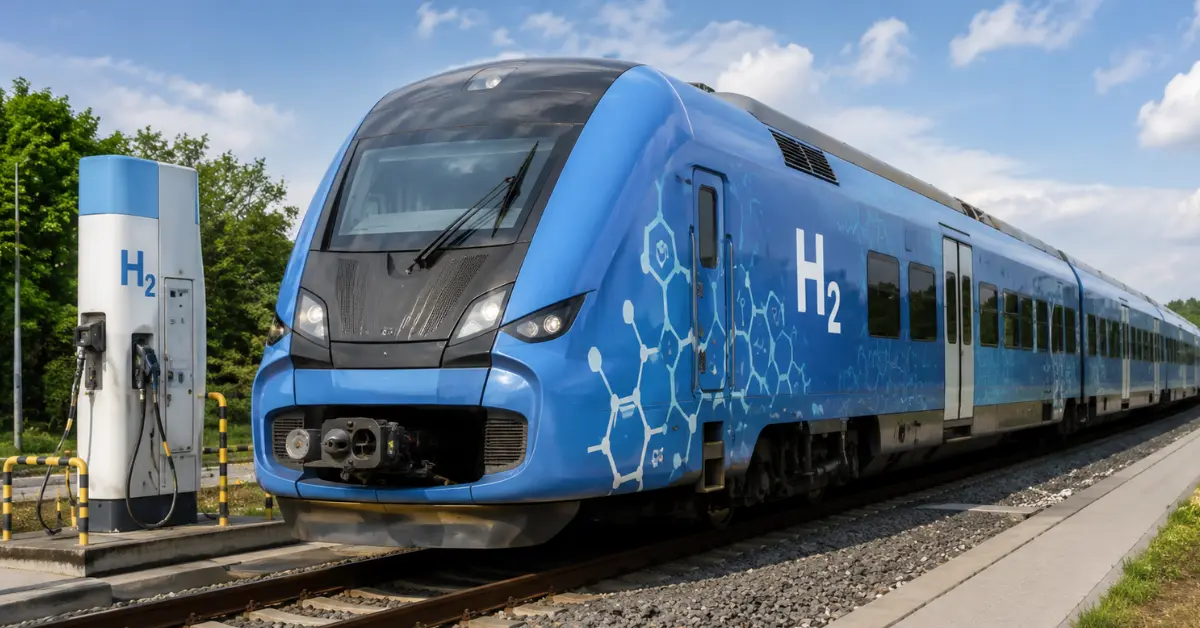

India’s first hydrogen-powered passenger train was officially flagged off at Jind railway station in Haryana on July 17, 2026. The 10-coach train will operate on the Jind–Sonipat section at an approved maximum speed of 75 km/h and can carry around 2,600 passengers.
Unlike a diesel train, it generates electricity onboard through hydrogen fuel cells. This article explains how the system powers the train, why batteries are also required and how the technology allows it to operate without burning diesel.
Where India’s First Hydrogen Train Runs
India’s first hydrogen train will operate between Jind and Sonipat in Haryana. The route connects important locations including Jind Junction, Gohana Junction and Sonipat.
The train has 10 coaches. It includes two hydrogen-powered driving cars and eight passenger coaches. The complete train can carry approximately 2,600 passengers.
Indian Railways has approved an operating speed of up to 75 km/h on this route. The train has a design speed of 110 km/h.
A dedicated hydrogen production and refuelling facility has been built at Jind. This facility produces, stores and supplies hydrogen to the train.
The Jind–Sonipat route will help Indian Railways test the train’s safety, reliability, energy use, maintenance and refuelling requirements during regular operation.
What Actually Powers India’s Hydrogen Train?
A conventional diesel train burns fuel inside an engine. The engine converts the energy from combustion into the mechanical force that moves the train.
A conventional electric train works differently. It draws electricity from overhead wires through a pantograph on its roof. That electricity flows into traction motors, which turn the wheels.
India’s hydrogen train combines features from both systems.
It carries its energy source onboard, just as a diesel train carries fuel. However, it does not burn that fuel inside an engine. Instead, it converts hydrogen into electricity and sends that electricity to electric traction motors.
The train’s power system includes:
- compressed hydrogen storage cylinders;
- Proton Exchange Membrane fuel cells;
- lithium iron phosphate batteries;
- power converters and electronic controls;
- electric traction motors.
These components work together as one hybrid propulsion system. The hydrogen supplies the energy, the fuel cells produce electricity, the batteries support changing power demands and the motors move the train.
Natural events can also create unexpected problems for nearby communities, as seen in How Bamboo Flowering Leads to Rat Outbreaks in Mizoram.
How the Fuel Cell Turns Hydrogen Into Electricity
The train stores hydrogen gas inside high-pressure cylinders. During operation, the system sends hydrogen from those cylinders into a Proton Exchange Membrane, or PEM, fuel cell.
The fuel cell also draws oxygen from the surrounding air.
Inside the fuel cell, a catalyst separates hydrogen molecules into protons and electrons. The membrane allows the protons to pass through it, but the electrons must travel around the membrane through an external electrical circuit.
That movement of electrons creates electricity.
The electrical system regulates this current and sends it toward the train’s batteries, power controls and traction motors. The motors then convert electrical energy into mechanical movement and turn the wheels.
At the end of the process, the hydrogen particles reunite with oxygen. This reaction creates water and heat.
The complete power chain looks like this:
Hydrogen and oxygen enter the fuel cell. The fuel cell produces electricity. The electricity powers the motors. The motors turn the wheels.
The process does not require the repeated explosions that occur inside an internal-combustion engine. The fuel cell produces electricity through an electrochemical reaction rather than by burning hydrogen.
Why the Train Does Not Need Diesel
The train does not need a diesel engine because its fuel cells and batteries already supply electricity to the traction motors.
A diesel train must burn fuel to create movement. That process releases carbon dioxide, particulate matter and other pollutants near the track. It also creates the familiar engine noise and vibration associated with diesel propulsion.
The hydrogen train skips that combustion stage.
It still carries fuel, but it uses hydrogen to generate electricity. Electric motors then provide the force needed to move the coaches.
This design also changes what passengers and people living near railway lines experience. The train does not produce diesel smoke at stations, and electric traction generally creates less engine noise than a large diesel power unit.
However, the absence of a diesel engine does not make the train mechanically simple. It still needs pumps, cooling systems, high-pressure cylinders, fuel-cell stacks, batteries, power converters, sensors and safety controls.
Hydrogen technology replaces diesel propulsion with a different and highly specialised power system.
How It Runs Without Overhead Wires
Most electric trains depend on an external electricity supply.
A pantograph mounted on the roof touches the overhead electrical line. The train draws power through that connection and sends it to the traction system.
A hydrogen train generates its electricity onboard, so it does not need to collect propulsion power from overhead wires.
As long as the train has enough hydrogen and its power system operates correctly, it can continue producing electricity during the journey. The fuel-cell system functions like a compact power station carried inside the train.
This independence gives hydrogen trains their main practical advantage. Railway operators can use electric traction on a suitable route without installing continuous overhead electrical infrastructure specifically for that service.
The train may still travel beneath existing electric wires. Their presence does not change how its hydrogen propulsion system works. The train simply does not depend on those wires for its main traction power.
That distinction matters because hydrogen trains will not necessarily replace conventional electric trains. Overhead electrification already provides an effective solution on heavily used routes. Electricity can flow directly from the grid to the train without first converting energy into hydrogen and then converting it back into electricity.
Hydrogen offers a different option for selected services where railway operators want to replace diesel but find conventional electrification difficult, expensive or unsuitable.
India is also home to unusual natural cycles that attract scientific interest, including India’s World Cup Cicada and Its Four-Year Life Cycle.
Why the Hydrogen Train Also Carries Batteries
The fuel cells provide the train’s primary energy, but the train cannot rely on fuel cells alone for every operating condition.
Power demand changes constantly during a journey.
The train needs a large amount of power when it starts moving from a station. It may also need extra power while accelerating, climbing a gradient or carrying a heavy passenger load. Once it reaches a steady speed, its immediate power demand may fall.
Fuel cells work best when they provide a relatively stable output. Batteries help the train respond to sudden changes.
When the train needs extra power, the batteries can support the fuel cells and send additional electricity to the traction motors. When demand falls, the system can manage the available energy more efficiently.
The battery bank also helps stabilise the electrical supply. It can respond more quickly than the fuel-cell system when the train’s power needs change within seconds.
This arrangement makes the train a hydrogen fuel-cell hybrid rather than a machine powered by one isolated component.
Hydrogen provides the stored energy. Fuel cells convert that energy into electricity. Batteries balance the changing demand. Electric motors create movement.
Why the Train Has Power Cars at Both Ends
India’s hydrogen train uses two Hydrogen Driving Power Cars, with one positioned at each end of the 10-coach trainset.
Each power car contains hydrogen storage cylinders, fuel cells, lithium iron phosphate batteries and related electrical equipment. Each unit can produce 1,200 kW, giving the complete train a combined output of 2,400 kW.
Placing power equipment at both ends distributes the propulsion system instead of concentrating every major component in one locomotive.
This configuration also allows the train to change direction without moving a separate locomotive from one end to the other. The driver can operate it from the cab at either end, depending on the direction of travel.
The remaining eight coaches carry passengers rather than the main hydrogen propulsion equipment. Together, the 10 coaches can accommodate around 2,600 passengers.
The design therefore tests hydrogen propulsion on a much larger passenger train than the short two-car or three-car hydrogen units commonly associated with regional rail experiments.
What Comes Out of the Fuel Cell?
The electrochemical reaction inside the fuel cell directly produces electricity, water and heat.
The train does not release diesel exhaust, soot or tailpipe carbon dioxide while it operates on hydrogen fuel cells. It also avoids the smoke associated with combustion-based engines.
This gives the train near-zero emissions at the point of use.
“Point of use” remains an important phrase. It describes what the train releases while moving, not the environmental impact of every stage that brought the hydrogen to the train.
Hydrogen does not exist freely in a ready-to-use form. Producers must separate it from water, natural gas or other compounds. That process requires energy.
The Jind facility produces hydrogen through electrolysis, which uses electricity to split water into hydrogen and oxygen. When renewable power supplies that electricity, the process can create green hydrogen with a much lower carbon footprint.
When fossil fuels provide the electricity, hydrogen production can still create indirect emissions elsewhere.
The train therefore solves the local diesel-emission problem, but the source of the hydrogen determines its complete climate benefit. A hydrogen train becomes truly low-carbon only when the production, compression, storage and transportation system also uses clean energy efficiently.
How the Train Refuels
The train cannot use a normal diesel pump or an electric charging point. It requires dedicated hydrogen infrastructure.
Indian Railways has developed a hydrogen production and refuelling facility at Jind in Haryana. The facility produces hydrogen through electrolysis, stores it and compresses it before transferring it into the train.
The plant compresses hydrogen to a high pressure because hydrogen has a very low density under normal conditions. Compression allows the storage system to fit more fuel into a limited space.
The dispensers then transfer hydrogen into the storage cylinders in both power cars.
This process resembles vehicle refuelling more than battery charging. Instead of connecting the train to electricity for an extended charging period, operators fill its cylinders with compressed hydrogen.
The train can then carry the energy required for its service.
The dedicated plant also highlights one of hydrogen rail’s biggest challenges. A railway cannot introduce hydrogen trains without also creating production, storage, compression, dispensing and maintenance facilities.
Hydrogen trains need an entire supporting ecosystem, not just new rolling stock.
How the Train Manages Hydrogen Safely
Hydrogen can ignite easily, so the train requires strict safety systems.
Hydrogen also has no colour or smell. People cannot depend on their senses to notice a leak. Electronic monitoring must detect a problem before gas can collect in a confined space.
The train uses multiple systems that monitor hydrogen leaks, unusual heat, flames and smoke. Continuous ventilation helps prevent leaked gas from accumulating around equipment.
Automatic controls can shut off the hydrogen supply when sensors detect abnormal conditions. The power cars also contain monitoring systems that show the driver the health of the propulsion equipment.
The refuelling plant uses similar protections, including leak detectors, flame detection, automatic shutdown equipment, alarms and fire-control systems.
Engineers use several independent protective layers because no single sensor or valve can provide complete safety. Safe operation depends on strong storage cylinders, suitable materials, ventilation, constant monitoring, automatic isolation, careful maintenance and trained staff.
The system must manage hydrogen safely during every stage, from production and compression to refuelling, storage and use inside the train.
Why Hydrogen Will Not Replace Every Electric Train
The hydrogen train demonstrates a new way to replace diesel, but it does not make conventional railway electrification unnecessary.
Overhead electric trains receive power directly from the electrical grid. Hydrogen trains require several additional steps: producers create hydrogen, compress it, store it, transfer it to the train and convert it back into electricity through a fuel cell.
Each conversion uses energy.
For a busy route with reliable overhead electrification, a conventional electric train will often provide a more direct and efficient solution.
Hydrogen may offer greater value on routes where diesel trains still operate and full electrification presents practical difficulties. It may also suit selected regional, remote or heritage lines that need cleaner propulsion without continuous overhead equipment.
India’s first hydrogen train will help Indian Railways understand those limits more clearly. Engineers can study its energy use, maintenance needs, refuelling time, operating reliability and long-term cost under real passenger conditions.
The train’s importance does not come from replacing every locomotive. It comes from proving that a full-size passenger train can carry hydrogen, generate electricity onboard and move through electric traction without burning diesel or depending on an external overhead power supply.
That is the central idea behind the technology: the train carries its fuel, creates its own electricity and uses electric motors to complete the journey.

4 thoughts on “How India’s First Hydrogen Train Works Without Diesel”