
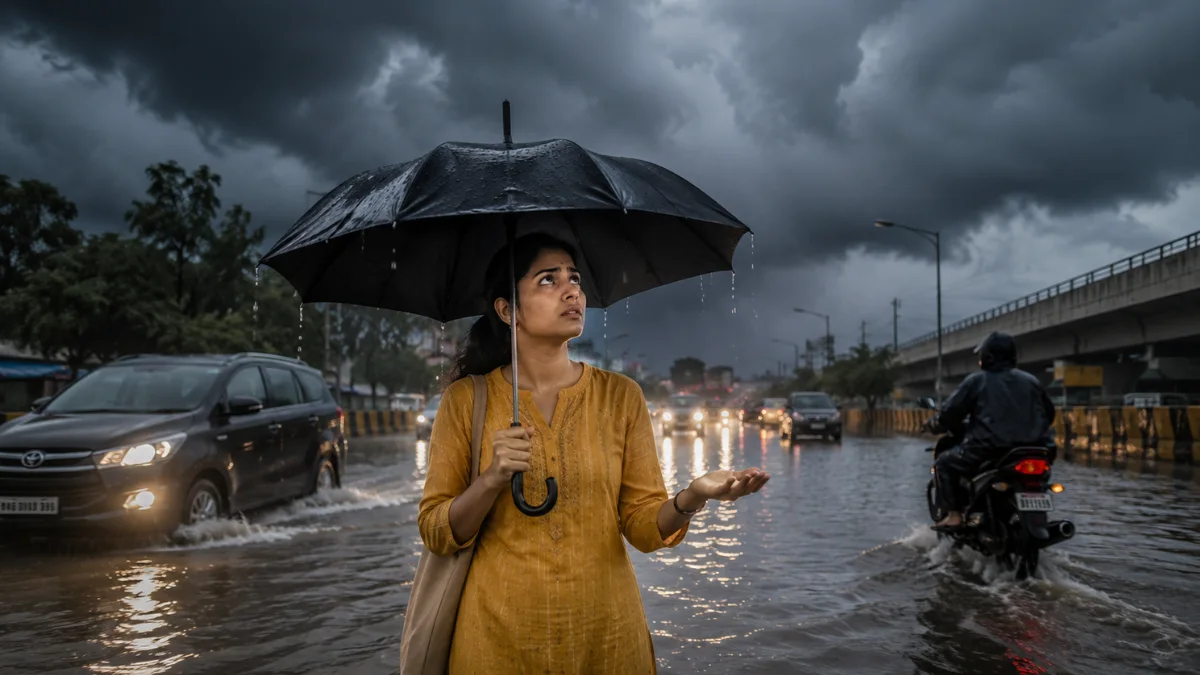

The India Meteorological Department uses green, yellow, orange and red warning colours to help people understand the possible impact of dangerous weather. These colours do more than describe how much rain may fall. They also indicate how closely people should follow updates and whether they should prepare or act.
A yellow warning does not mean that every location will experience severe damage. A red warning also does not guarantee that a disaster will occur. Weather conditions can vary sharply within the same district, especially during the monsoon.
The colour tells people how seriously they should treat the forecast based on the expected weather, its probability and its possible effects. IMD presents the four levels as green for no warning, yellow for watch, orange for alert and red for warning. Its warning products also use action-oriented language such as remaining updated, preparing and taking action.
What Do IMD Rain Warning Colours Mean?
The simplest way to understand the system is to treat each colour as a different level of readiness.
| Warning colour | General meaning | What people should do |
|---|---|---|
| Green | No warning | Continue normal activities while checking routine forecasts |
| Yellow | Watch and remain updated | Follow local forecasts and stay alert to changing conditions |
| Orange | Prepare for possible disruption | Review travel plans, secure vulnerable property and prepare to act |
| Red | Take action | Avoid unnecessary exposure and follow instructions from local authorities |
The warning applies to a defined area and time period. It does not mean that every village, neighbourhood or road within the warned district will experience the same conditions.
IMD provides subdivision-level and district-level warnings because weather risks can vary significantly across a state. It also issues nowcasts for shorter periods when radar, satellite and surface observations show that dangerous weather may develop within the next few hours.
What Does a Green Weather Warning Mean?
Green means that IMD has issued no significant warning for the selected weather hazard and forecast period.
People can generally continue their normal plans, but green does not mean that rain cannot occur. A district may receive ordinary rain without reaching the level that requires a yellow, orange or red warning.
Weather can also change after the forecast is issued. People travelling through hilly areas, flood-prone roads or remote regions should still check the latest district forecast before starting their journey.
A green status should provide reassurance, not encourage people to ignore changing skies, rising water or local administrative notices.
What Does a Yellow Rain Warning Mean?
A yellow warning asks people to watch the weather and remain updated.
IMD may issue it when weather conditions could cause local inconvenience or limited disruption. Some places within the warned area may receive intense rain, thunderstorms, lightning or strong winds, while others may experience much milder conditions.
People usually do not need to cancel every activity under a yellow warning. They should instead check whether their particular journey, workplace or neighbourhood faces additional risk.
Under a yellow warning, practical preparation may include:
- Checking the latest district forecast before travelling
- Allowing extra time for traffic and waterlogging
- Avoiding roads that regularly flood
- Keeping phones charged
- Moving important items away from leaking roofs or low floors
- Following school, workplace and district-administration updates
An IMD nowcast from Goa, for example, advised people under a watch-level warning to avoid areas known for waterlogging, check traffic conditions and stay updated with official forecasts.
What Does an Orange Rain Warning Mean?
An orange warning means that people should prepare for conditions that may cause meaningful disruption.
The weather may affect road travel, rail movement, electricity, vulnerable buildings, crops or low-lying areas. The exact risk depends on local geography and the hazard listed in the warning.
An orange warning does not automatically order everyone to stay indoors. However, it should change how people plan the day.
Travellers should reconsider journeys through:
- Flood-prone urban roads
- Mountain routes exposed to landslides
- Roads beside swollen rivers
- Low-water bridges and causeways
- Areas with poor drainage
- Routes where authorities have reported closures
Families in vulnerable areas should charge essential devices, store drinking water, keep medicines accessible and identify a safer location before conditions worsen.
People should also read the complete warning instead of relying only on the colour. An orange warning for lightning requires different action from an orange warning for heavy rain, strong winds or a cyclone.
What Does a Red Rain Warning Mean?
A red warning represents the highest level in IMD’s colour system and tells people to take action.
It indicates that the expected weather could create serious disruption or danger in the affected area. People should avoid unnecessary travel, remain away from hazardous locations and follow instructions from district authorities, police and disaster-management agencies.
The required action depends on local conditions. A city may face dangerous waterlogging, while a mountain district may face landslides, falling rocks or sudden river-level increases.
People under a red warning should not wait for water to enter their home or block the road before responding. They should act on evacuation instructions, road closures and local safety orders as soon as authorities issue them.
The term “red alert” often appears in news reports, but IMD’s public warning pages describe the colour as a red warning. The practical message matters more than the label: people should take protective action.
Does the Warning Colour Depend Only on Rainfall Amount?
No. Rainfall amount matters, but the warning colour can also reflect the probability of the event and its expected impact.
The same amount of rain can produce very different consequences in different places.
A short spell of intense rain may cause serious flooding in a densely built city with blocked drains. Similar rain may create landslide danger on a steep mountain slope. A region with dry soil, open drainage and low population density may experience less disruption.
Forecasters therefore consider factors such as:
- Expected rainfall intensity and duration
- Confidence in the forecast
- Soil and ground conditions
- River and drainage levels
- Terrain
- Urban waterlogging risk
- Existing weather damage
- The vulnerability of roads and settlements
IMD’s forecasting procedure uses an impact-based and risk-based approach when assigning warning colours rather than relying on one rainfall number alone.
Does a Red Warning Mean a Cloudburst Is Coming?
No. A red rain warning does not prove that a cloudburst will occur.
A red warning can cover a district or broader region where severe rainfall may cause major impacts. A cloudburst is a much more localised event involving exceptionally intense rain over a small area within a short period.
Meteorologists may identify conditions favourable for extreme rain without being able to predict the exact village, slope or valley where the most intense cell will develop.
Understanding how cloudbursts form and why they are difficult to predict explains why a broad warning can identify serious danger even when forecasters cannot pinpoint every local downpour.
People should therefore take a red warning seriously without assuming that every heavy-rain warning predicts a cloudburst.
Do Schools and Offices Close Automatically Under a Red Warning?
No. An IMD warning does not automatically close every school, office or business in the affected region.
IMD provides weather forecasts and warnings. District administrations, state governments, education authorities and individual institutions decide whether local conditions require closures or changes in working hours.
A red warning may lead authorities to close schools in one district while another district keeps them open because the expected impact differs. The final decision may also depend on road safety, water levels, transport availability and the condition of school buildings.
Parents and employees should check official orders from the district administration or institution instead of relying only on social-media messages.
IMD sends heavy-rain warnings to disaster-management authorities, district collectors, police and other agencies so that local machinery can prepare and respond.
When Should You Postpone Travel?
People should consider postponing a journey when the forecast and local conditions create a risk that cannot be managed safely.
Travel becomes especially risky when:
- Authorities have closed or restricted the route
- Water is flowing across the road
- Landslides or falling rocks have occurred nearby
- Visibility has dropped sharply
- A river or stream is rising rapidly
- The route crosses a low bridge or causeway
- Continuous rain has weakened nearby slopes
- An orange or red warning covers the destination and route
Drivers should never assume that shallow-looking floodwater is safe. Water can hide damaged roads, open drains, strong currents and sudden drops.
A warning for the destination alone may not provide enough information. Travellers should check the weather and road conditions along the entire route.
What Should People Near Rivers and Slopes Watch For?
People living near rivers, streams, hills and unstable slopes should watch local conditions closely even when rain is falling somewhere else.
Water from higher ground can reach a settlement after the heaviest rain has ended. A clear sky above one village does not guarantee that the upstream catchment is safe.
Warning signs may include:
- Rapidly rising or muddy water
- Unusual sounds from a slope
- New cracks in the ground or walls
- Falling stones
- Leaning trees or poles
- Water emerging from a new place on a hillside
- Blocked drains overflowing toward homes
People should move away from the danger area and contact local authorities when they notice these signs. They should not gather near swollen rivers, waterfalls or landslide zones to take photographs.
Where Can You Check Official Weather Warnings?
People should use official and recent information rather than forwarded screenshots that may be old or edited.
IMD provides:
- District-wise warnings
- Subdivision-wise warnings
- Short-range forecasts
- District and station nowcasts
- Radar and satellite information
- State meteorological-centre bulletins
Its district-wise warning and nowcast pages help readers check conditions closer to their location instead of relying only on a national forecast.
The government-backed SACHET platform also distributes geo-targeted alerts from authorised agencies and allows users to follow selected states or districts.
People should check the issue time and validity period whenever they view a warning. A forecast issued in the morning may change after new radar or satellite observations become available.
How Should You Respond to Each IMD Warning Colour?
The most useful way to remember the system is:
Green: Continue normally
Follow routine weather updates, particularly before long journeys or outdoor work.
Yellow: Stay aware
Check local forecasts, prepare for inconvenience and avoid known risk areas when the weather worsens.
Orange: Be prepared
Review travel plans, protect essential belongings and prepare to move or change plans if authorities advise it.
Red: Take action
Avoid unnecessary exposure, follow local orders and move away from locations facing flooding, landslide or lightning danger.
The colour does not replace local judgement. People should respond to the actual hazard, their surroundings and instructions from authorities.

1 thought on “IMD Rain Alert Colours Explained: Red, Orange and Yellow”