
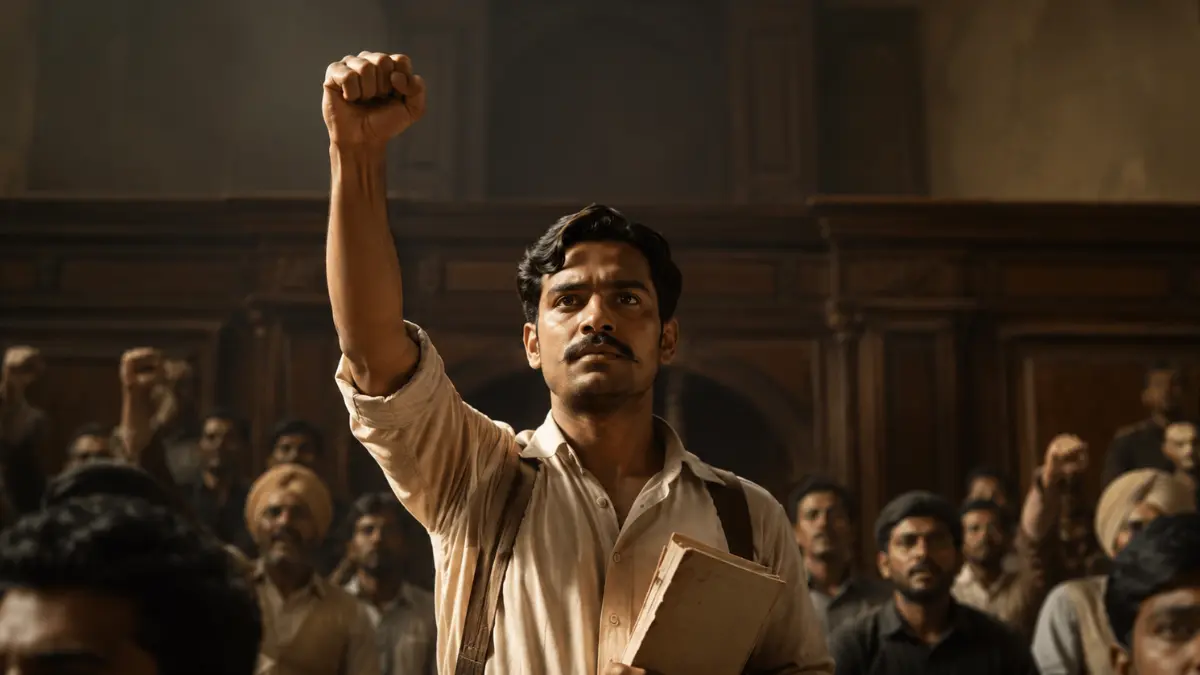

Maulana Hasrat Mohani gave the “Inquilab Zindabad” slogan and is widely credited with coining it in 1921. Bhagat Singh did not originate the phrase, but he and his revolutionary associates made it one of the most powerful slogans of India’s freedom struggle.
“Inquilab Zindabad” is commonly translated into English as “Long live the revolution.” The phrase represented a demand for political freedom, social transformation and resistance against British colonial rule.
Many people associate the slogan entirely with Bhagat Singh because he repeatedly raised it during some of the most important moments of his revolutionary life. However, its history began with Hasrat Mohani several years earlier.
Who Gave the Inquilab Zindabad Slogan?
Maulana Hasrat Mohani is widely recognised as the person who coined “Inquilab Zindabad” in 1921.
Hasrat Mohani was an Urdu poet, journalist, political leader and freedom fighter. His original name was Syed Fazl-ul-Hasan, while “Hasrat” was his pen name and “Mohani” referred to his connection with the town of Mohan in present-day Uttar Pradesh.
He belonged to a generation of Indian leaders who believed that the country should demand complete independence rather than accept limited reforms under British rule.
In 1921, Mohani openly supported the demand for complete independence at the Ahmedabad sessions of the Indian National Congress and the All-India Muslim League. This was years before the Congress formally adopted complete independence, or Purna Swaraj, as its objective in 1929.
The slogan reflected Mohani’s belief that freedom required a deep transformation in the existing political order. It was not simply a call for minor concessions from the colonial government.
It demanded a fundamental change.
What Does Inquilab Zindabad Mean in English?
Inquilab Zindabad means “Long live the revolution” in English.
The word “Inquilab” means revolution, major transformation or a fundamental change in an established system.
“Zindabad” is an expression used to wish that a person, movement, idea or cause may continue to live and prosper. In political slogans, it is usually translated as “long live.”
Together, the words create a declaration of support for revolution:
Long live the revolution.
The meaning should not be reduced to violence or armed rebellion. In the context of India’s freedom movement, revolution could refer to the replacement of colonial rule with freedom, justice and a more equal social order.
Different movements have used the phrase in different situations, but its historical importance comes mainly from the anti-colonial struggle.
Did Bhagat Singh Coin Inquilab Zindabad?
No, Bhagat Singh did not coin the slogan.
Bhagat Singh and Batukeshwar Dutt acknowledged in a 1929 explanation that they were not the originators of the revolutionary cry. However, Bhagat Singh gave the slogan national recognition and transformed it into an enduring symbol of resistance.
This distinction explains why two names appear whenever the slogan’s history is discussed:
- Hasrat Mohani coined or introduced the slogan.
- Bhagat Singh popularised it across India.
Both played important but different roles.
Without Hasrat Mohani, the slogan may not have existed in its recognised form. Without Bhagat Singh and his associates, it may not have become one of the best-known expressions of the Indian freedom movement.
How Did Bhagat Singh Popularise the Slogan?
Bhagat Singh adopted “Inquilab Zindabad” as a declaration of revolutionary purpose during the late 1920s.
The slogan became closely linked with the Hindustan Socialist Republican Association, the revolutionary organisation associated with Bhagat Singh, Chandrashekhar Azad, Sukhdev Thapar, Shivaram Rajguru and several other anti-colonial activists.
One of the most significant moments came on April 8, 1929.
Bhagat Singh and Batukeshwar Dutt threw bombs inside the Central Legislative Assembly in Delhi while protesting colonial legislation, including the Public Safety Bill and the Trade Disputes Bill.
The action was designed to attract public attention rather than cause mass casualties. The revolutionaries distributed printed leaflets, raised slogans and allowed the authorities to arrest them instead of attempting to escape.
“Inquilab Zindabad” rang through the Assembly and later appeared repeatedly during their court proceedings.
Newspapers reported the trials, political workers repeated the phrase, and young Indians began connecting the slogan with Bhagat Singh’s courage and sacrifice. The Assembly incident and subsequent court appearances turned it from a revolutionary expression into a nationally recognised rallying cry.
What Did Revolution Mean to Bhagat Singh?
Bhagat Singh did not define revolution as continuous violence, disorder or the permanent use of weapons.
In December 1929, Bhagat Singh and Batukeshwar Dutt responded to criticism of the phrase “Long Live Revolution.” They explained that revolution did not necessarily mean bloody conflict and was not simply a “cult of bomb and pistol.”
For them, revolution represented a desire for meaningful change.
Bhagat Singh believed that people could become so accustomed to an unjust system that they began fearing any attempt to change it. A revolutionary spirit challenged that passivity and prevented society from becoming stagnant.
His interpretation focused on replacing an unjust order with a better one. It included opposition to exploitation and support for political, economic and social transformation.
Therefore, when Bhagat Singh raised “Inquilab Zindabad,” he was not demanding violence without purpose. He was expressing the hope that the struggle for positive change would remain alive.
Why Is the Slogan So Closely Associated With Bhagat Singh?
A slogan is often remembered through the person who gives it the greatest public visibility rather than the person who first creates it.
Bhagat Singh became one of the most recognised faces of India’s revolutionary movement. His youth, writings, court statements, imprisonment and execution at the age of 23 turned him into a lasting symbol of sacrifice.
He raised “Inquilab Zindabad” at moments that attracted national attention. His supporters repeated it outside courtrooms, during public gatherings and after his execution.
The phrase consequently became inseparable from his public memory.
This is similar to how an existing song, expression or idea may become strongly associated with the person who brings it to a much larger audience. Bhagat Singh’s role was not authorship. His role was historic popularisation.
Who Was Maulana Hasrat Mohani?
Hasrat Mohani was far more than the originator of a famous slogan.
He was a prominent Urdu poet whose literary work included romantic and political poetry. He also worked as a journalist and used his publications to criticise British colonial policies.
His political position was unusually bold for his time. While several national leaders initially demanded greater self-government within the British Empire, Mohani supported complete independence.
He faced imprisonment for his political activities and writings, but continued opposing colonial rule.
Mohani also wrote the well-known Urdu ghazal “Chupke Chupke Raat Din,” later made famous among wider audiences through musical performances. His legacy therefore occupies two very different areas of South Asian history: poetry and revolutionary politics.
The same writer associated with delicate Urdu poetry also gave the freedom movement one of its strongest political expressions.
Was Inquilab Zindabad the Official Slogan of India’s Freedom Movement?
India’s freedom movement did not have only one official slogan.
It included many organisations, leaders, political philosophies and regional movements. Each produced expressions that reflected its own method and vision.
“Inquilab Zindabad” became especially important among revolutionary and socialist groups. Other slogans, including “Vande Mataram,” “Jai Hind,” “Do or Die” and “Swaraj is my birthright,” became connected with different leaders and stages of the independence struggle.
The significance of “Inquilab Zindabad” came from its ability to communicate urgency in only two words.
It did not ask colonial rulers to improve the existing system. It declared that the system itself needed to change.
Was Inquilab Zindabad a Violent Slogan?
The phrase itself does not call for violence.
It supports revolution, but revolution can refer to political, social, economic or intellectual transformation. The intended meaning depends on the people using the slogan and the situation in which they use it.
Bhagat Singh directly rejected the idea that revolution always meant bloodshed. He viewed bombs and weapons as possible instruments in particular struggles, not as the complete meaning of revolution.
The deeper objective was to end exploitation and create a more just system.
Describing the slogan as automatically violent therefore ignores Bhagat Singh’s own explanation. At the same time, removing it completely from its revolutionary political background would also be historically inaccurate.
It was a forceful anti-colonial slogan, but its meaning extended beyond physical conflict.
Why Did Inquilab Zindabad Become So Powerful?
The slogan succeeded because it was brief, emotional and easy to repeat.
A strong public slogan must communicate a large idea in very few words. “Inquilab Zindabad” achieved this by combining a demand for change with a declaration that the revolutionary ideal would survive.
It also carried several meanings at once.
For one person, revolution could mean independence from British rule. For another, it could mean ending economic exploitation. For workers and farmers, it could represent dignity and fair treatment. For young revolutionaries, it could express courage and resistance.
This flexibility allowed the phrase to cross regional and social boundaries.
It also survived the people who made it famous. Hasrat Mohani died in 1951, while Bhagat Singh was executed in 1931, but the words continued to appear in political movements, student demonstrations, literature, films and public commemorations.
Is It Spelled Inquilab or Inqilab?
Both “Inquilab” and “Inqilab” are commonly used English spellings.
The variation exists because the word comes from a language written in a different script. When Urdu or Hindustani words are written with the Roman alphabet, more than one transliteration may become acceptable.
“Inquilab Zindabad” is particularly common in India, while “Inqilab Zindabad” also appears in books, newspapers and academic writing.
The pronunciation and meaning remain essentially the same.
Other spelling variations may include “Inqalaab” or “Zindabad,” but they refer to the same historic slogan.
A Short Timeline of Inquilab Zindabad
1921: Hasrat Mohani is widely credited with coining “Inquilab Zindabad.” During the same period, he publicly demanded complete independence from British rule.
Late 1920s: Bhagat Singh and other members of the revolutionary movement adopted and popularised the slogan.
April 8, 1929: Bhagat Singh and Batukeshwar Dutt raised revolutionary slogans following their action in the Central Legislative Assembly in Delhi.
1929–1930: The slogan received wider attention through court proceedings, political reporting and public demonstrations.
March 23, 1931: Bhagat Singh, Sukhdev and Rajguru were executed. “Inquilab Zindabad” became permanently connected with their martyrdom.
After 1947: The phrase continued to appear in political, social, labour and student movements across South Asia.
