
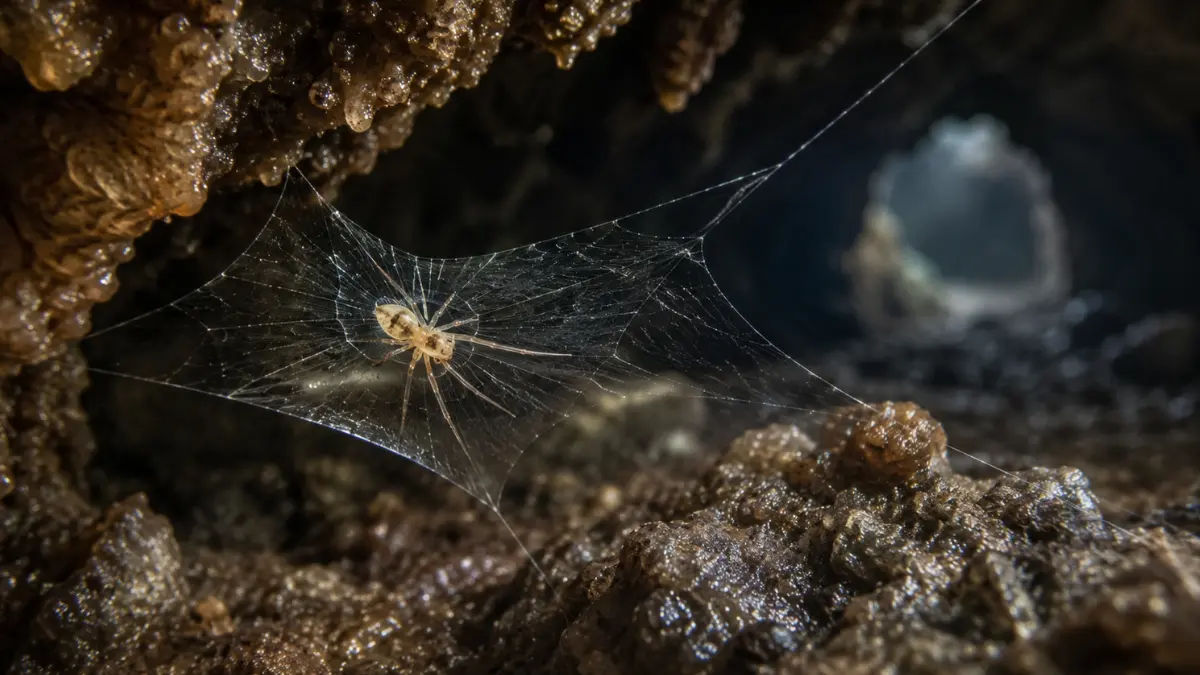

Krem Lawbah Cave in Meghalaya.
Named Simonia lawbah, the spider measures less than two millimetres and lives in a dark, humid cave environment. It belongs to the ray-spider family Theridiosomatidae, whose members build tensioned, cone-shaped webs that can spring towards passing prey.
The discovery also marks the first scientific record of the genus Simonia in India. It highlights how Meghalaya’s caves protect small and specialised animals that researchers can easily overlook during ordinary wildlife surveys.
What Scientists Discovered in Krem Lawbah Cave
Researchers from the Zoological Survey of India collected female spider specimens from Krem Lawbah Cave in Meghalaya.
Detailed examination showed that the spiders did not match any previously described species. The researchers placed them in the genus Simonia and formally named the new species Simonia lawbah.
The discovery extended the known distribution of Simonia into India for the first time. Scientists had established the genus only a few years earlier from specimens found elsewhere in Asia.
The new species belongs to Theridiosomatidae, a family commonly known as ray spiders. These spiders remain difficult to notice because many species have extremely small bodies and occupy damp, shaded habitats.
How Small Is Simonia lawbah?
Simonia lawbah measures less than two millimetres in body length.
A spider of this size can remain hidden among fine roots, wet rock surfaces, moss, silk threads and organic debris inside a cave. Its small body also makes collection and identification difficult without targeted fieldwork and magnification.
Small size does not make the spider biologically simple. It still builds silk, detects movements around its web, captures prey and survives within a specialised environment.
Researchers can easily miss such animals when surveys focus mainly on birds, mammals, reptiles or other larger wildlife. Discovering them often requires scientists to inspect cave walls, narrow passages and tiny webs carefully.
What Is a Ray Spider?
Ray spiders belong to the family Theridiosomatidae.
Most members of this family are very small and prefer dark, humid places. Scientists often find them near streams, shaded forest floors, cave entrances and other places where moisture remains available.
Their name comes from the radial silk lines that form part of their webs. Although the web may resemble a small orb web at first, the spider changes its shape by pulling the centre backwards.
This action turns the web into a shallow cone and stores tension in the silk. The resulting structure works as both a trap and a spring-loaded hunting system.
How the Cone-Shaped Slingshot Web Works
A ray spider does not always wait for an insect to become trapped in a completely motionless web.
It adds a tension line connected to the centre of the web. The spider pulls on this line and draws the web backwards, creating a three-dimensional cone rather than a flat circle.
The stretched silk stores elastic energy. When suitable prey approaches, the spider releases the tension and allows the web to spring forward.
The moving web increases the chance that sticky silk will strike and trap a small flying insect. The spider can then reach the prey and secure it.
Researchers have described this system as a slingshot-style web because the spider loads and releases tension instead of relying only on passive contact.
The public description of Simonia lawbah connects the new species with this specialised ray-web behaviour. However, scientists still need detailed behavioural observations to document exactly how this species builds, aims and releases its web under natural cave conditions.
Why the Web Does Not Work Like a Weapon
The term “slingshot web” can create an exaggerated picture of the spider firing silk across the cave.
The web remains attached to its supporting structure. The spider pulls its centre into a cone, stores energy in the tensioned silk and releases that energy when prey comes close.
The entire web moves over a short distance. It does not detach, fly freely or chase insects through the air.
The mechanism gives the small spider a practical advantage. Tiny flying insects may escape from a static web after touching only a few strands, but a rapidly moving web can press more sticky silk against them.
This hunting method shows how web shape and spider behaviour can work together as one system.
Why Scientists Call It Troglophilic
Researchers describe Simonia lawbah as troglophilic, meaning it shows a strong association with cave habitats.
A troglophile can live and reproduce inside caves, but the term does not automatically prove that it survives nowhere else. Some troglophilic animals may also occupy dark, damp environments outside caves.
Scientists should not call Simonia lawbah permanently cave-exclusive until surveys establish its full habitat range.
The spider’s small body and preference for humid darkness suit the conditions found inside Krem Lawbah. Stable moisture, sheltered surfaces and small flying insects can support ray spiders and their delicate webs.
Future surveys may reveal whether the species occurs only deep inside the cave, near its entrance or in similar shaded habitats around the surrounding landscape.
Is Simonia lawbah Blind?
The discovery does not establish that Simonia lawbah is blind.
People often assume that every cave animal loses its eyes, but cave-associated species show many different levels of adaptation. Some retain functional eyes, while others develop reduced vision, pale colouring, longer sensory structures or other specialised traits.
Scientists need anatomical and behavioural evidence before describing a species as blind or fully adapted to permanent underground life.
Calling the spider blind merely because researchers found it in a cave would create an unsupported claim.
Its classification as a troglophile provides a more accurate description of the available evidence.
How Scientists Confirm a New Spider Species
Scientists do not establish a new species through location or body colour alone.
Researchers examine the spider’s body proportions, eyes, legs, mouthparts, surface structures and reproductive anatomy. They compare these features with descriptions, illustrations and preserved specimens of related species.
Reproductive structures often provide especially important evidence because closely related spiders may look similar externally while having consistent anatomical differences.
The known Simonia lawbah material consists of female specimens. Researchers compared their defining features with other members of the genus before describing the new species.
The team also deposited the type specimens in the National Zoological Collections of the Zoological Survey of India. These preserved specimens now provide the official reference for the species’ scientific identity.
Future researchers can examine them when identifying new samples or reviewing the classification.
Why Finding a New Genus Record Matters
The discovery does more than add one species name to India’s wildlife list.
Before this research, scientists had not formally recorded the genus Simonia from India. Finding it in Meghalaya expands the genus’s known geographical distribution and improves understanding of Asian ray-spider diversity.
A genus groups species that share a close set of characteristics and evolutionary relationships. Recording a genus in a new country can reveal wider biological connections between regions.
The discovery may indicate that related spiders also occur in other humid cave systems or forests across Northeast India. Scientists cannot confirm that possibility without further evidence, but it gives future surveys a clearer target.
Why Krem Lawbah Matters
Krem Lawbah is part of Meghalaya’s extensive limestone cave landscape.
Caves create specialised habitats with low light, stable temperatures, high humidity and limited food sources. Water, roots, insects and organic material entering from outside support underground food webs.
A cave may appear empty during a brief visit because many inhabitants remain tiny, hidden or active only under particular conditions.
Spiders, insects and other invertebrates can occupy small ecological spaces on walls, ceilings, damp sediments and narrow passages. Researchers need careful, repeated surveys to document them.
The discovery of Simonia lawbah shows that a cave’s biological value does not depend only on large or visually dramatic animals. A species smaller than a grain of rice can still represent a unique part of India’s natural heritage.
What the Spider Reveals About Meghalaya’s Hidden Biodiversity
Meghalaya receives high rainfall and contains humid forests, limestone formations, streams and extensive cave networks.
These conditions create many small habitats where specialised organisms can evolve and survive. Some species may occupy only one cave system or a limited geographical area, although scientists need broader surveys before confirming such narrow ranges.
The new spider strengthens the case for studying Meghalaya’s micro-biodiversity rather than focusing only on familiar wildlife.
DesiVibe’s article on Meghalaya’s living root bridges shows how the state’s humid environment supports an unusual relationship between people, flowing water and living plant roots. The cave-spider discovery reveals another side of the same landscape: tiny animals surviving inside its dark subterranean habitats.
Both subjects show how rainfall, geology and living organisms interact across Meghalaya.
Why Tiny Species Remain Undiscovered
An animal can remain unknown to science even when it lives near human settlements or visited caves.
Extremely small species require specialised collection techniques. Researchers may also need microscopes and taxonomic expertise to distinguish them from similar animals.
Many biological surveys operate under limited time and funding. Teams naturally record visible species first, while organisms hidden in soil, leaf litter, cave walls or forest canopies receive less attention.
Scientists may collect a tiny spider but remain unable to identify it until they compare it with newer scientific descriptions or examine its anatomy in detail.
Northeast India’s World Cup cicada and its four-year life cycle demonstrates another gap between local observation and complete scientific documentation. Local communities knew the cicada’s unusual timing, but researchers still needed focused study to understand its identity and cycle.
Simonia lawbah presents a different case, yet it reinforces the same lesson: small or hidden species can remain scientifically unresolved for years.
Does the Discovery Mean the Spider Is Endangered?
Scientists have not yet established a formal conservation status for Simonia lawbah.
A new species description usually provides information about anatomy, collection location and taxonomy. It does not automatically supply enough evidence to estimate population size, distribution or decline.
Researchers need to survey additional caves and nearby habitats before determining whether the spider has a broad range or survives only around Krem Lawbah.
A species found at one known location may deserve careful attention, but one collection site does not prove that the animal exists nowhere else.
It would therefore be premature to assign a precise threat level without population and habitat data.
What Could Threaten Cave Microhabitats?
Cave organisms depend on stable conditions that human activity can disturb.
Uncontrolled tourism, litter, artificial lighting, construction, quarrying, changes in water flow and repeated physical disturbance can alter cave temperature, moisture and surfaces.
Damage may affect tiny animals long before visitors notice any visible change. A web-building spider can lose suitable habitat when people repeatedly touch walls, remove vegetation near an entrance or change airflow and humidity.
This does not mean every visit harms a cave. Responsible access, scientific monitoring and site-specific management can reduce disturbance while allowing education and research.
The discovery provides another reason to treat caves as living ecosystems rather than empty rock passages.

1 thought on “India’s First Simonia Spider Found in Meghalaya”