
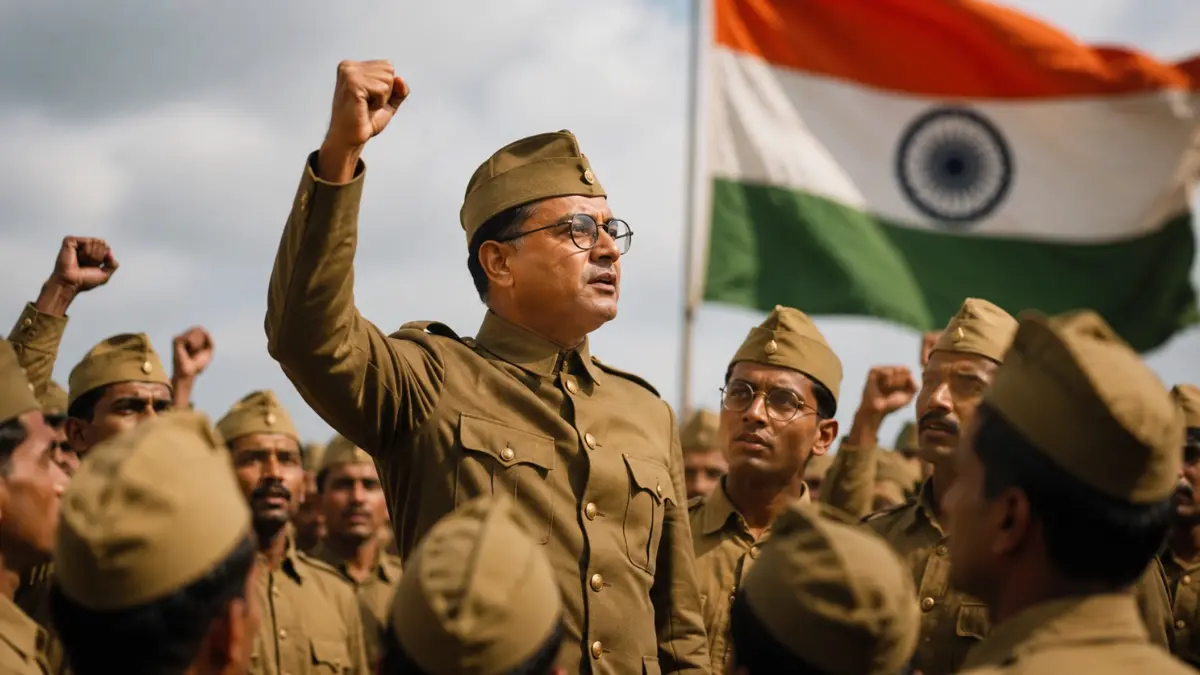

Abid Hasan Safrani is widely credited with creating or shortening “Jai Hind” into the patriotic salutation adopted by Subhas Chandra Bose and the Indian National Army. Netaji approved the expression and made it famous across India. Some accounts credit revolutionary Chempakaraman Pillai with using the phrase earlier, but that claim is not documented as consistently.
The most reliable answer therefore separates the roles:
- Abid Hasan Safrani shaped the familiar two-word salutation.
- Subhas Chandra Bose adopted and popularised it.
- Chempakaraman Pillai is associated with a disputed claim of earlier use.
This distinction explains why examination guides, books and online articles sometimes name different people.
Who Gave the Jai Hind Slogan?
Abid Hasan Safrani is the strongest answer when the question refers to the “Jai Hind” salutation used by Subhas Chandra Bose’s movement.
Hasan was an Indian nationalist from Hyderabad who travelled to Germany to study engineering. He later joined Bose’s independence campaign in Europe and served as his secretary and interpreter.
Bose’s movement included Indians from different religious, linguistic and regional backgrounds. A common salutation could give its members a shared identity without favouring one religious greeting over another.
Accounts based on Hasan’s recollections say that several possible greetings were discussed. Hasan eventually proposed the short and memorable expression “Jai Hind,” which Bose accepted.
The salutation then became closely associated with the Indian National Army and the Azad Hind movement. Biographical accounts and a published collection based on Hasan’s notebooks credit him with coining the expression that became a national salutation.
The clearest short answer is:
Abid Hasan Safrani gave the INA its familiar “Jai Hind” salutation, while Subhas Chandra Bose made it nationally famous.
What Does Jai Hind Mean?
Jai Hind commonly means “Victory to India,” “Hail India” or “Long live India.”
The word “Jai” expresses victory, triumph or praise. “Hind” refers to India.
The phrase works both as a patriotic slogan and as a greeting. A person can use it at the beginning or end of an address, while saluting another person or while expressing support for the country.
Its simplicity helped it spread.
Jai Hind contains only two short words. It does not mention a particular religion, region, caste or language. Indians from different communities can say it without changing its central meaning.
This inclusive quality made it especially suitable for a national movement that wanted to unite people from across the subcontinent.
Did Subhas Chandra Bose Coin Jai Hind?
Subhas Chandra Bose is not generally credited with personally creating the familiar two-word expression.
His central role was approving, adopting and popularising it.
A phrase suggested in a private discussion does not automatically become a national salutation. Bose gave Jai Hind visibility by connecting it with the public identity, speeches and mobilisation of the Azad Hind movement.
The distinction resembles the history of who gave the Inquilab Zindabad slogan and how Bhagat Singh popularised it.
Hasrat Mohani is widely credited with originating Inquilab Zindabad, while Bhagat Singh made it one of India’s most recognisable revolutionary cries.
Similarly, Abid Hasan is closely associated with the creation of the familiar Jai Hind salutation, while Netaji gave it a national voice.
Recognising Hasan’s contribution does not reduce Bose’s importance. Without Bose’s leadership and public influence, the words may never have reached such a large audience.
Why Is the Origin of Jai Hind Disputed?
The origin is disputed because some accounts credit another revolutionary, Chempakaraman Pillai, with using or coining Jai Hind before Abid Hasan joined Bose.
Pillai was an Indian nationalist who spent much of his political life in Europe. He became involved with anti-British revolutionary activity and overseas organisations seeking Indian independence.
Several later articles and biographical summaries identify him as the original creator of Jai Hind. Other published accounts directly credit Abid Hasan.
The competing claims do not have equal documentary clarity.
The Hasan account includes a clear context: Bose’s movement needed a common greeting, Hasan proposed Jai Hind, and the expression was adopted as a salutation.
The Pillai attribution is repeated in several later sources, but those accounts do not always provide a contemporary speech, letter, publication or dated document showing when he first used the exact phrase.
The responsible conclusion is therefore:
Some accounts credit Chempakaraman Pillai with an earlier use of Jai Hind, but Abid Hasan Safrani has the strongest documented association with the salutation adopted by Bose’s movement.
Published coverage continues to acknowledge both claims, which is why the origin should not be presented as completely undisputed.
Who Was Chempakaraman Pillai?
Chempakaraman Pillai was an Indian revolutionary connected with nationalist activity in Europe during the early twentieth century.
He worked with overseas groups that opposed British colonial rule and sought international support for Indian independence.
Later accounts credit him with using Jai Hind before the phrase became connected with Subhas Chandra Bose and the INA.
However, the article should not state an exact year for Pillai’s alleged first use unless a reliable contemporary record supports it. Different retellings provide different details, and many repeat the attribution without showing its original documentary source.
It is also unnecessary to claim that Hasan copied Pillai.
Two expressions may emerge independently, or a later activist may shorten, revive or institutionalise words that another person had previously used.
Even if stronger evidence eventually confirms an earlier Pillai use, Hasan would still remain important because he helped turn Jai Hind into the shared salutation adopted by Bose’s movement.
Who Was Abid Hasan Safrani?
Abid Hasan Safrani was a Hyderabad-born nationalist who became one of Subhas Chandra Bose’s close associates during the Second World War.
He was studying engineering in Germany when he joined Bose’s campaign. He subsequently worked as Bose’s secretary and interpreter.
Hasan also accompanied Bose during the dangerous submarine journey from Europe toward Asia in 1943. They travelled aboard a German submarine before transferring to a Japanese submarine during the voyage.
The journey placed Hasan beside Bose during a crucial period in the development of the Azad Hind movement.
Hasan later served in independent India’s diplomatic service. A published biographical collection based on his notebooks and family archives describes his experiences with Bose and identifies him as the man who coined Jai Hind.
His contribution was especially meaningful because the expression supported the movement’s effort to build unity across community divisions.
Why Did Bose’s Movement Need One Common Greeting?
Members of the independence movement came from many regions and religious traditions.
They naturally used greetings associated with their languages, cultures and faiths. Those expressions were not inherently divisive, but Bose wanted the movement to possess a common national identity.
A shared salutation could remind members that they were united by one political objective despite their personal differences.
Jai Hind met that need because it was:
- Short and memorable
- Easy to pronounce
- Directly connected with India
- Free from an exclusive religious identity
- Suitable for speeches and personal greetings
- Strong enough to function as a rallying cry
The phrase did not require anyone to abandon an existing cultural identity. It gave everyone one additional patriotic expression that they could share.
That unifying function is central to understanding why Jai Hind became so influential.
Was Jai Hind the Official Greeting of the INA?
Jai Hind became a recognised salutation of the Indian National Army and the wider Azad Hind movement under Subhas Chandra Bose.
It appeared in the movement’s public language and became strongly associated with its soldiers and supporters.
However, “official” should be used carefully unless an organisational order or contemporary document is being quoted directly.
The safer description is:
Subhas Chandra Bose adopted Jai Hind as a common salutation of the Azad Hind movement, and the INA made it famous.
This communicates its practical historical role without claiming a specific formal declaration that may not be available in the public record.
How Did Netaji Make Jai Hind Famous?
Bose understood the power of shared words, uniforms, symbols and public rituals.
By adopting Jai Hind, he connected the expression with the major ideals of the Azad Hind movement:
- Indian independence
- Unity across communities
- Military discipline
- National dignity
- Collective sacrifice
The phrase appeared in an environment where political communication needed to be immediate and memorable.
As public interest in the INA grew, Jai Hind became inseparable from Netaji. This association became so strong that many people later assumed he had created the slogan himself.
Bose’s role should therefore be described as historic popularisation rather than original coinage.
He transformed a concise salutation into a message recognised far beyond the INA.
How Did Jai Hind Spread Beyond the INA?
By the final years of British rule, Jai Hind had moved into wider nationalist language.
Jawaharlal Nehru published an editorial titled “Jai Hind!” in the National Herald on November 30, 1945. Its use as a title shows that the phrase had already become publicly recognisable beyond the INA’s immediate organisational setting.
After independence, politicians, soldiers, teachers, students and ordinary citizens continued using it.
The expression became common during:
- Independence Day celebrations
- Republic Day programmes
- School assemblies
- Military gatherings
- Government speeches
- Patriotic commemorations
- Public addresses
Its meaning also adapted to India’s changing circumstances.
Before independence, “Victory to India” expressed the hope that British rule would end. After independence, the same words became a wish for India’s unity, security, development and success.
Is Jai Hind India’s Official National Slogan?
Jai Hind is widely recognised as a national salutation and patriotic slogan, but it should not be described as India’s constitutionally designated national slogan.
The phrase has extensive public and official use. National leaders commonly use it, and it regularly appears in military, educational and ceremonial settings.
However, widespread acceptance does not automatically create a formal constitutional or statutory designation.
The accurate description is:
Jai Hind is one of India’s most widely recognised national salutations and patriotic expressions.
This wording respects its importance without assigning it an unsupported legal status.
How Is Jai Hind Different From Vande Mataram?
Jai Hind and Vande Mataram both express patriotism, but they developed in different forms.
Jai Hind is a brief salutation and rallying expression closely connected with Abid Hasan, Subhas Chandra Bose and the Azad Hind movement.
Vande Mataram is a composition by Bankim Chandra Chattopadhyay that became deeply associated with India’s freedom struggle and is honoured as the National Song.
Their present legal contexts also differ.
Readers can separately examine what the Vande Mataram Bill 2026 proposes and whether it has become law.
Keeping the subjects on different pages protects their separate search intents:
- Jai Hind: origin, disputed attribution and Netaji’s role
- Vande Mataram: National Song history and proposed legal protection
How Is Jai Hind Different From Inquilab Zindabad?
Inquilab Zindabad means “Long live the revolution.”
It expresses support for revolutionary political or social transformation.
Jai Hind means “Victory to India” or “Hail India.”
It functions more naturally as a patriotic greeting and declaration of national unity.
Their histories also reveal a similar pattern:
- Hasrat Mohani is credited with originating Inquilab Zindabad, while Bhagat Singh popularised it.
- Abid Hasan Safrani is widely credited with shaping Jai Hind as the Azad Hind salutation, while Subhas Chandra Bose popularised it.
- Chempakaraman Pillai remains connected with a disputed claim of earlier Jai Hind use.
These distinctions explain why the creator of a slogan and the person most strongly associated with it are not always the same.
