
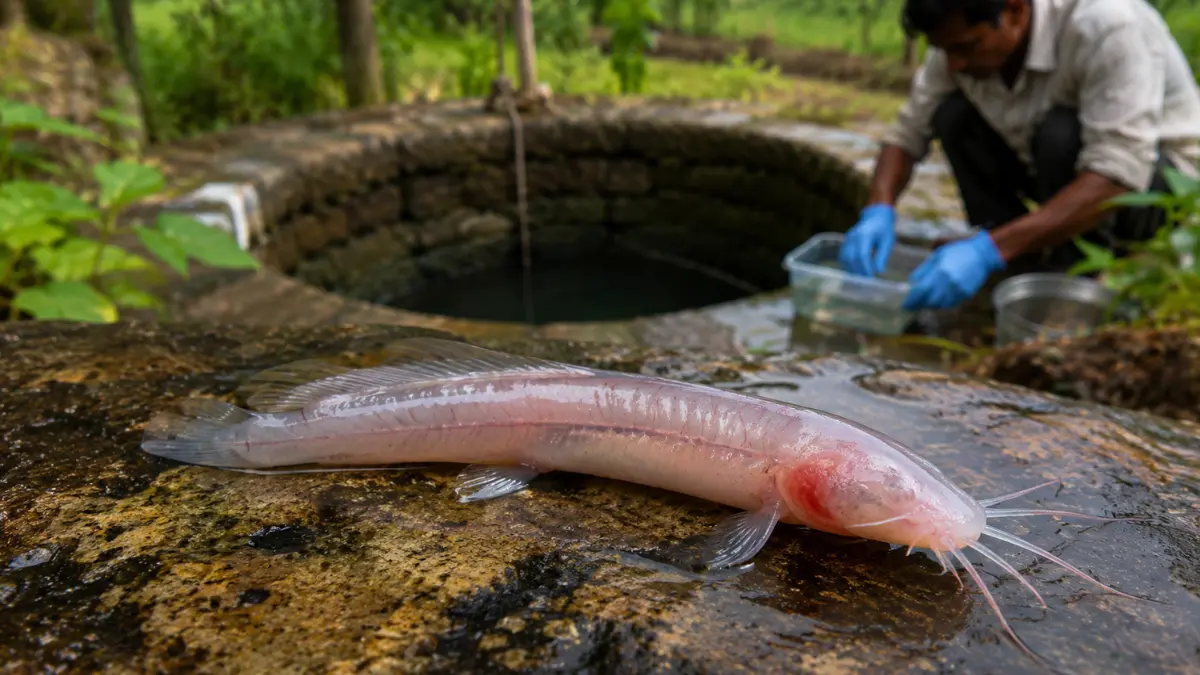

Gitchak nakana is a tiny blind groundwater fish discovered through a dug-out well in Assam’s Goalpara district. Scientists identified it as a new species and an entirely new genus, making it the first known aquifer-dwelling fish from Northeast India.
The fish has no externally visible eyes, very little pigmentation and unusually long sensory barbels. Its most striking feature is a large opening in the upper part of its skull because the bones that usually form a roof over the brain do not meet in the middle.
This does not mean that the fish has no skull. It has a developed skull and other cranial bones but the upper surface of its brain is covered by skin rather than a continuous bony roof.
Scientists collected specimens from the same well in 2021, 2024 and 2025. They formally described the fish as a new genus and species in February 2026.
What Is Gitchak Nakana?
Gitchak nakana is a miniature freshwater loach belonging to the family Cobitidae.
Most loaches are small, elongated fish that live near the bottom of rivers, streams, ponds or wetlands. Gitchak nakana, however, appears specially adapted to groundwater held inside an underground aquifer.
An aquifer is a layer of water-bearing sediment, soil or rock beneath the surface. Humans normally cannot enter or directly observe these environments.
The fish became accessible because a village well opened into the groundwater system where it lived.
Researchers found that its skeletal structure, body features and genetic identity differed significantly from recognised loach groups. These differences were substantial enough to justify creating the new genus Gitchak rather than placing the fish within an existing genus.
The species is therefore not merely a new variation of a familiar Assam fish. It represents a previously undocumented evolutionary lineage.
Where Was the Blind Fish Found in Assam?
Scientists found all known specimens in one open, dug-out well in a village in Goalpara district, western Assam.
The area lies near the foothills of the Shillong Plateau and the Brahmaputra Valley. Groundwater there moves through alluvial deposits formed from sand, soil, silt and other material carried and deposited by rivers over long periods.
Researchers collected fish from the well on three occasions:
- The first specimens were collected in 2021
- Additional specimens were collected in 2024
- Further sampling took place in 2025
The scientific description was based on 13 specimens.
The researchers did not reveal the village name or exact coordinates. This precaution reduces the risk of uncontrolled collection or disturbance before scientists understand the species’ distribution and conservation needs.
The well itself is probably not the fish’s entire habitat. It is more likely an opening into a wider groundwater system beneath the surrounding landscape.
Attempts to find the fish in neighbouring wells were unsuccessful, but that does not prove it lives only beneath one property. Underground channels can be irregular, disconnected or difficult to sample.
Why Does Gitchak Nakana Have No Visible Eyes?
Gitchak nakana has no externally visible functional eyes.
Researchers observed only a very small dark spot in the area where eyes would normally develop. The fish also has greatly reduced pigmentation, leaving much of its body pale or translucent.
These features are commonly associated with animals that spend their entire lives underground.
Scientists use the term troglomorphy for traits repeatedly seen in species adapted to dark subterranean habitats. Common examples include:
- Reduced or absent visible eyes
- Loss of body pigmentation
- Elongated sensory structures
- Changes in skull and body shape
The study identifies these characteristics in Gitchak nakana, but it does not establish the precise evolutionary sequence through which its visible eyes became reduced.
Its ancestors may have gradually become more dependent on non-visual senses as the lineage adapted to permanent darkness. Confirming that history would require wider genetic, developmental and comparative research.
The fish’s blindness should therefore be described as an evolutionary adaptation associated with subterranean life, not as a change experienced by an individual fish after entering a dark well.
How Does the Fish Detect Its Surroundings?
The fish has several pairs of elongated barbels around its mouth and head.
Barbels are thin, whisker-like structures found in many bottom-dwelling fishes. In Gitchak nakana, researchers found that these structures were densely covered with taste buds.
This suggests that the barbels may help the fish locate food and detect chemical information in complete darkness.
However, the study did not prove that Gitchak nakana has more taste buds or a more advanced gustatory system than all related loaches.
Scientists have also not observed the fish’s behaviour inside its natural aquifer habitat. They do not yet know exactly how it navigates, searches for food or responds to water movement.
The anatomy provides strong clues, but its precise sensory behaviour remains open for future research.
Is Gitchak Nakana Really Skull-Less?
No. Gitchak nakana is not a skull-less fish.
The fish has a skull containing several developed cranial bones. The unusual feature is the absence of a continuous bony roof across the top of its brain.
In most related loaches, paired bones known as the frontals and parietals extend towards the centre of the head. They meet with the bones from the opposite side and form a protective upper covering.
In Gitchak nakana, these bones remain mostly towards the sides of the skull and do not meet across the centre.
This leaves a large opening above the brain that is covered by skin rather than solid bone.
Researchers examined this anatomy using micro-computed tomography, commonly known as micro-CT scanning. This technique produced detailed three-dimensional images of the fish’s skeleton without requiring the researchers to physically cut through every structure.
The scans confirmed that the missing bony roof is not damage caused during collection. It is a consistent anatomical feature of the species.
The accurate description is therefore a fish without a bony skull roof, not a fish without a skull.
Why Is the Missing Skull Roof Important?
The open skull roof is important because researchers did not find the same structure in other recognised genera within the loach family.
It was one of several features supporting the decision to establish Gitchak as a new genus.
The fish also has:
- A shortened front region of the skull
- Unusually shaped bones near the gill covering
- A distinctive swim-bladder capsule
- Unusual vertebral and fin structures
- A highly miniature adult body
Some of these traits may be connected to miniaturisation.
When a fish evolves an extremely small adult size, its skeleton may retain features resembling earlier developmental stages of larger relatives. Biologists sometimes describe this pattern as developmental truncation or progenesis.
However, the researchers did not conclude that every unusual structure in Gitchak nakana resulted from incomplete development.
Several features appear specialised rather than merely reduced.
The fish is therefore scientifically valuable because it combines three unusual conditions:
- Adaptation to permanent underground water
- Extreme body miniaturisation
- A distinctive pattern of skull development
Studying that combination may help researchers understand how vertebrate skeletons change when species evolve in dark, narrow and isolated habitats.
How Small Is Gitchak Nakana?
The largest examined specimen measured only 20.8 millimetres in standard length.
Standard length measures a fish from the tip of its head to the base of its tail fin. It does not include the tail fin itself.
This means the largest known specimen was only slightly longer than two centimetres.
Despite its tiny size, the fish has functioning internal organs, developed fins, sensory barbels and a specialised skeleton.
Its body is so translucent that blood vessels and some internal structures can be visible through the skin.
Researchers also examined female specimens containing developing eggs. One female carried eight relatively large eggs arranged inside the body cavity.
The presence of large eggs compared with the fish’s small body may suggest that it invests substantial biological resources in a limited number of offspring.
However, scientists have not yet documented its breeding cycle, egg-laying behaviour or juvenile development.
Why Is the Fish Called Gitchak Nakana?
The name reflects characteristics of the fish and the language of the region where it was discovered.
The genus name Gitchak comes from a Garo word meaning “red.”
Although the fish has little body pigment, its translucent skin allows red blood vessels and internal organs to remain visible. This can give living specimens a reddish appearance.
The species name nakana refers to blindness and is derived from Garo words connected with “fish” and “blind.”
The full name therefore reflects the animal’s red appearance and lack of visible eyes.
Using words from the Garo language also gives the scientific name a direct connection with the cultural and geographical setting of the discovery.
How Did Scientists Prove It Was a New Genus?
Blindness alone was not enough to classify the fish as a new genus.
Unrelated underground animals can independently evolve similar traits when they face similar environmental conditions. Pale bodies, reduced eyes and elongated sensory structures may appear in different lineages without proving close evolutionary relationships.
Researchers therefore combined several types of evidence.
They examined:
- External measurements and body proportions
- Skull and skeletal anatomy
- Micro-CT scans
- Fin and vertebral structures
- Preserved reference specimens
- Mitochondrial DNA
- Nuclear DNA
- Evolutionary relationships with other loaches
The genetic evidence placed Gitchak within a broader group related to Lepidocephalichthys and certain southern Indian Pangio loaches.
However, it remained a clearly distinct lineage.
The researchers’ molecular time-tree analysis estimated that the Gitchak lineage separated from its sampled sister group approximately 33.4 million years ago. The estimated range extended from about 21.4 million to 45.5 million years.
This estimate should not be treated as an exact date.
The authors warned that the available genetic sequences were not sufficient to resolve every evolutionary relationship with complete confidence. Broader genomic sampling may refine or revise the proposed family tree.
The use of anatomy and genetic evidence together resembles how modern DNA analysis helped scientists recognise the Himalayan pangolin as a distinct species.
The animals are very different, but both discoveries show why scientific classification depends on multiple lines of evidence rather than appearance alone.
How Is an Aquifer Fish Different From a Cavefish?
Cavefish and aquifer fish both live underground, but their habitats are different.
A cave may contain open chambers, pools or flowing streams that researchers can physically enter and examine. Scientists may be able to observe animals directly, map their habitat and measure environmental conditions.
An aquifer contains water inside pores, cracks and spaces within underground rock or sediment.
Humans generally cannot enter it.
Researchers can usually access aquifer animals only through wells, boreholes, pumps or natural springs. This makes them extremely difficult to locate and study.
Most documented subterranean fishes have been found in cave systems. Only a much smaller number are known exclusively from groundwater aquifers.
This is one reason Gitchak nakana is important. It expands the known range of underground fish habitats in Northeast India beyond accessible caves.
Meghalaya’s cave systems reveal a different form of hidden life. DesiVibe previously covered a tiny cave-associated Simonia spider discovered in Meghalaya.
The spider inhabits a cave environment researchers can investigate directly, while Gitchak nakana lives inside groundwater that remains largely inaccessible.
Why Is the Discovery Important for Northeast India?
Gitchak nakana is the first known aquifer-dwelling fish formally described from Northeast India.
Scientists had already documented blind and reduced-eye fishes in some limestone caves of Meghalaya. Assam’s alluvial aquifers, however, had not previously produced a recognised specialised groundwater fish.
The discovery provides the first evidence that Assam’s underground water systems may support specialised subterranean fauna.
Researchers are now investigating whether other underground organisms occupy the same difficult-to-access environment.
This does not yet prove that a large hidden ecosystem exists beneath Goalpara. It does show that the aquifer can support at least one highly specialised vertebrate lineage.
The fish’s ancestry may also be much older than the present landscape in which it was found.
Researchers suggested several possible explanations. An ancient lineage may have survived while groundwater habitats shifted across geological time, or an older surface lineage may have entered underground water more recently.
Additional genetic and geological evidence will be needed to distinguish between these possibilities.
Assam’s biodiversity history is also recorded in fossils. A 24-million-year-old Kewra relative discovered in Assam provides evidence of the state’s ancient plant life, while Gitchak nakana reveals an unusual living lineage hidden beneath the modern landscape.
Together, these discoveries show that Assam contains both a deep biological past and living habitats that remain poorly explored.
What Is Known About Its Conservation Status?
Scientists have not completed a formal conservation assessment for Gitchak nakana.
All 13 known specimens came from one open well. Attempts to collect the fish from nearby wells were unsuccessful.
This does not prove that the entire species lives beneath one property. The well may provide access to a larger aquifer extending below the surrounding area.
Researchers withheld the exact locality until the fish’s distribution and possible threats are better understood.
Further studies must determine:
- How widely the species occurs
- Whether other populations exist
- Which groundwater conditions it requires
- How frequently it reproduces
- What it eats
- Whether its population is stable
- Whether changes in the aquifer could affect it
Until those questions are answered, the species should not be described as common, widespread, critically endangered or restricted permanently to one village.
The most accurate conclusion is that its known distribution is extremely limited because scientific sampling remains limited.
Local residents may become important partners in future research because village wells provide rare access to a habitat that scientists cannot survey directly.
