
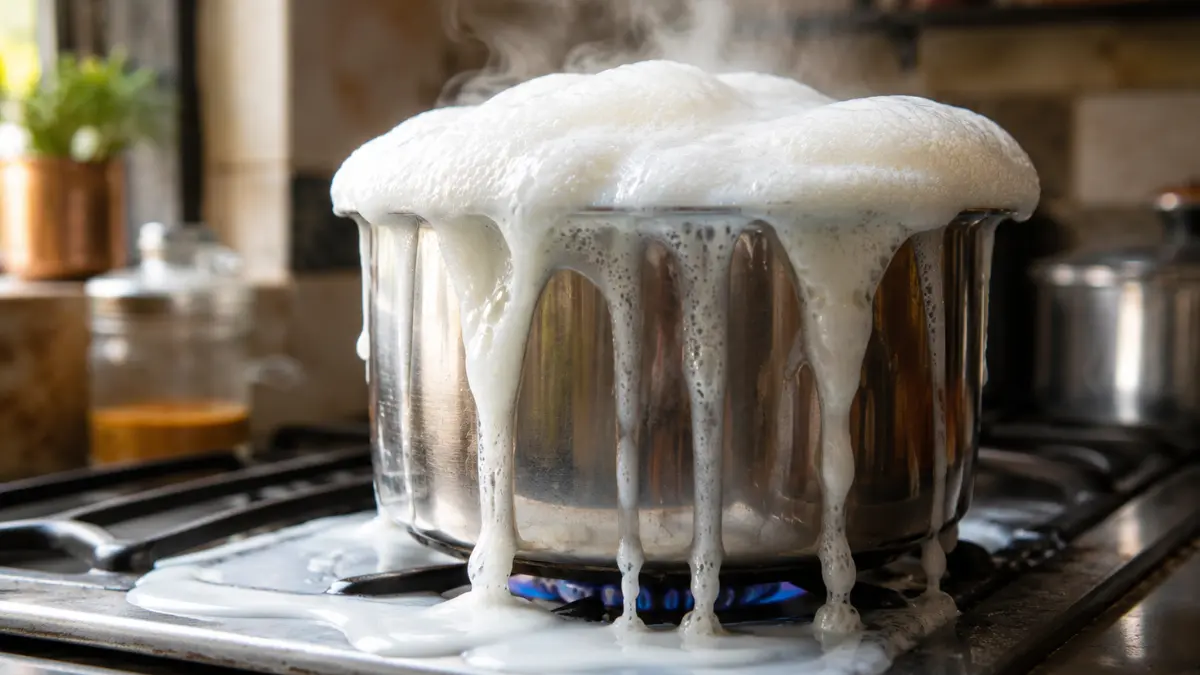

Why does milk boil over while water usually stays inside the pot? Milk boils over because its proteins stabilise rising steam bubbles, creating foam that expands faster than it can collapse. Plain water lacks those milk proteins, so most of its bubbles break more easily at the surface.
Milk is mostly water, but it also contains proteins, fat, lactose and minerals. These extra components change how bubbles form, how long they survive and how the surface behaves during heating.
The overflow may appear sudden, but the process begins before the milk reaches the rim.
Why Does Milk Suddenly Rise While Boiling?
As milk heats, the water inside it starts turning into vapour.
Small vapour bubbles form near the hot bottom of the pot and rise through the liquid. At lower temperatures, only a small number of bubbles appear. As the milk approaches boiling, vapour forms much more rapidly.
In plain water, most bubbles rise to the surface, burst and release their vapour into the air.
Milk behaves differently because its proteins gather around the bubbles and help form thin films around them. These films slow the bubbles from breaking.
As more bubbles survive, they collect into a layer of foam.
New vapour continues entering this foam from below. When bubbles form faster than the existing foam can collapse, the foamy layer expands upward.
Once it reaches the rim, the milk spills over.
This explains why milk can appear calm for several minutes and then rise within seconds. A small increase in temperature near the boiling point can cause a rapid increase in vapour production.
How Do Milk Proteins Stabilise the Bubbles?
Milk contains two main groups of proteins: casein and whey proteins.
These proteins interact with both water and air. When a bubble forms, some protein molecules move toward the boundary between the vapour inside the bubble and the surrounding liquid.
The proteins create a flexible film around the bubble.
This film does not make the bubble permanent, but it allows the bubble to survive longer than a bubble in plain water.
One bubble cannot cause a spill. Thousands of longer-lasting bubbles can.
As these bubbles gather at the surface, they create foam that occupies much more space than the liquid milk beneath it.
The water in the milk creates the vapour. The proteins determine how easily many of the bubbles collapse.
That is the central reason milk rises so dramatically.
What Role Does Milk Fat Play?
Fat affects the foam, but fat alone does not cause milk to boil over.
As milk heats, its fat becomes more fluid. Some proteins also begin changing structure, while water molecules move more rapidly.
The interaction between fat and protein influences how strong and stable the foam becomes.
In some conditions, fat can weaken the film around bubbles. In other conditions, the overall milk mixture can still produce enough stable foam to rise quickly.
This means neither full-fat milk nor low-fat milk always boils over first.
The result depends on several factors:
- Milk composition
- Protein-to-fat balance
- Heating intensity
- Pot size
- Stirring
- Space above the milk
A small pot filled close to the rim creates a much greater risk than a large pot holding the same amount of milk.
Why Does Boiling Water Behave Differently?
Water also forms vapour bubbles when it boils.
The difference is that plain water does not contain milk proteins that can stabilise the bubbles in the same way.
When bubbles in water reach the surface, their thin walls usually break quickly. The vapour escapes, and the liquid falls back into the pot.
The water may move vigorously, but it normally does not create a thick, stable layer of foam.
Water can still overflow under certain conditions.
A pot filled too high may spill when boiling becomes violent. Water containing rice, pasta, lentils or starch can also foam and rise.
Starch and other dissolved substances help bubbles survive longer, which is why pasta water or rice water can behave more like milk than plain water.
The real difference is not simply milk versus water. It is a liquid containing substances that stabilise bubbles versus a liquid that does not.
Is Milk Skin Responsible for the Overflow?
Heated milk may develop a thin film made from proteins and fat at the surface.
As boiled milk cools, this layer can become thicker and richer in fat, forming what many Indian households call malai.
The surface film and boiling over are related because both involve milk proteins, fat and evaporation. However, they are not the same process.
The film does not seal the pot like an airtight lid.
Milk rises because foam expands, not because dangerous pressure builds inside an open vessel.
The surface layer may make it harder for some bubbles to break cleanly, but milk can begin foaming before a visible skin forms.
Milk can also develop a skin while cooling without boiling over.
The overflow comes mainly from rapidly forming vapour bubbles that remain stable long enough to collect into foam.
Why Does Milk Rise So Quickly Near the End?
The final rise happens quickly because vapour production accelerates near the boiling point.
At lower temperatures, the milk warms gradually. Closer to boiling, water inside the milk changes into vapour more rapidly.
More vapour means more bubbles.
If the proteins stabilise those bubbles, the foam begins expanding faster than it can collapse.
This creates the familiar sudden rise.
High heat makes the change more difficult to control because energy enters the milk quickly. The milk can move from gentle bubbling to an overflowing foam within a few seconds.
Lower heat slows the process and gives the bubbles more time to break.
Does Milk Boil at a Higher Temperature Than Water?
Milk normally boils at a temperature slightly above pure water under the same atmospheric conditions.
This happens because milk contains dissolved lactose, minerals and other solids.
However, the small difference in boiling temperature does not cause the overflow.
Milk boils over mainly because its proteins stabilise foam.
Altitude also affects boiling. At higher elevations, both milk and water boil at lower temperatures because atmospheric pressure is lower.
The foam mechanism remains the same even when the exact boiling temperature changes.
Why Does Stirring Reduce the Foam?
Stirring disrupts the films around the bubbles and releases trapped vapour.
It also prevents one thick layer of foam from building across the entire surface.
When milk begins rising, stirring causes many bubbles to collapse. The milk level falls because the vapour escapes.
Stirring also distributes heat more evenly.
Without stirring, the milk near the bottom of the pot can become much hotter than the liquid above it. This creates rapid bubble formation in one area and increases the risk of scorching.
Moving the milk brings cooler liquid toward the bottom and carries hotter liquid upward.
However, stirring once does not prevent a later spill. New foam can form as long as the milk continues heating.
Regular stirring and lower heat work better together.
How Can Milk Be Stopped From Boiling Over?
The safest method is to reduce the heat before the foam reaches the rim.
Milk does not need to remain over maximum heat once it becomes hot. Medium or low heat slows vapour production and makes the surface easier to control.
Several simple steps help prevent spills.
Use a larger pot
Leave plenty of empty space above the milk.
A pot filled almost to the top gives the foam no room to expand. A deeper vessel provides more time to notice the rise and lower the heat.
Heat the milk gradually
Strong heat creates vapour rapidly.
Moderate heat gives bubbles more time to collapse and makes the final rise less sudden.
Stir regularly
Stirring breaks up the surface foam, distributes heat and reduces scorching.
Pay particular attention when small bubbles begin appearing around the sides of the pot.
Lower the heat early
Do not wait until the milk reaches the rim.
Reduce the flame when the surface begins lifting or when bubbles collect steadily around the edges.
Keep the pot uncovered
An uncovered pot makes the rising foam easier to see.
A lid can hold in additional heat and prevent close observation.
Stay near the stove
Milk can rise quickly during the final stage.
Leaving it unattended for even a short period creates a greater chance of waste and cleanup.
Preventing spills also supports reducing food waste in Indian kitchens, since milk lost over the side of a pot cannot be safely recovered.
Is Milk Left Inside the Pot Still Safe?
Milk remaining inside the pot is normally usable if it was fresh and handled hygienically.
Milk that spilled onto the stove, counter or floor should not be poured back into the pot.
Those surfaces may contain dust, cleaning residue, old food particles or microorganisms.
If milk scorches at the bottom, avoid scraping the burnt layer into the rest of the liquid.
Carefully transfer the unburnt milk into another clean container. Leaving the burnt residue behind can prevent the unpleasant flavour from spreading.
Is Boiling Over the Same as Curdling?
Boiling over and curdling are different processes.
Boiling over happens when stable foam expands beyond the rim of the pot.
Curdling happens when milk proteins lose their normal stability and form visible clumps.
Fresh milk can boil over without curdling.
Milk can also curdle without producing a large amount of foam, especially when acid is added.
Lemon juice or vinegar can cause controlled curdling during the preparation of paneer and other foods.
Spoilage, acidity and certain ingredients can also cause unwanted curdling.
The two events may happen during heating, but they involve different changes inside the milk.
Why Does Milk Boil Over but Water Usually Does Not?
Milk rises because the water inside it creates vapour while its proteins help the bubbles survive.
Those bubbles collect into foam. When vapour enters the foam faster than the bubbles can collapse, the milk level rises rapidly and spills over the pot.
Plain water does not contain the same bubble-stabilising proteins, so its vapour usually escapes more easily at the surface.
The most reliable way to prevent a spill is simple: use a larger pot, heat the milk gradually, stir regularly and reduce the heat before the foam reaches the rim.
