
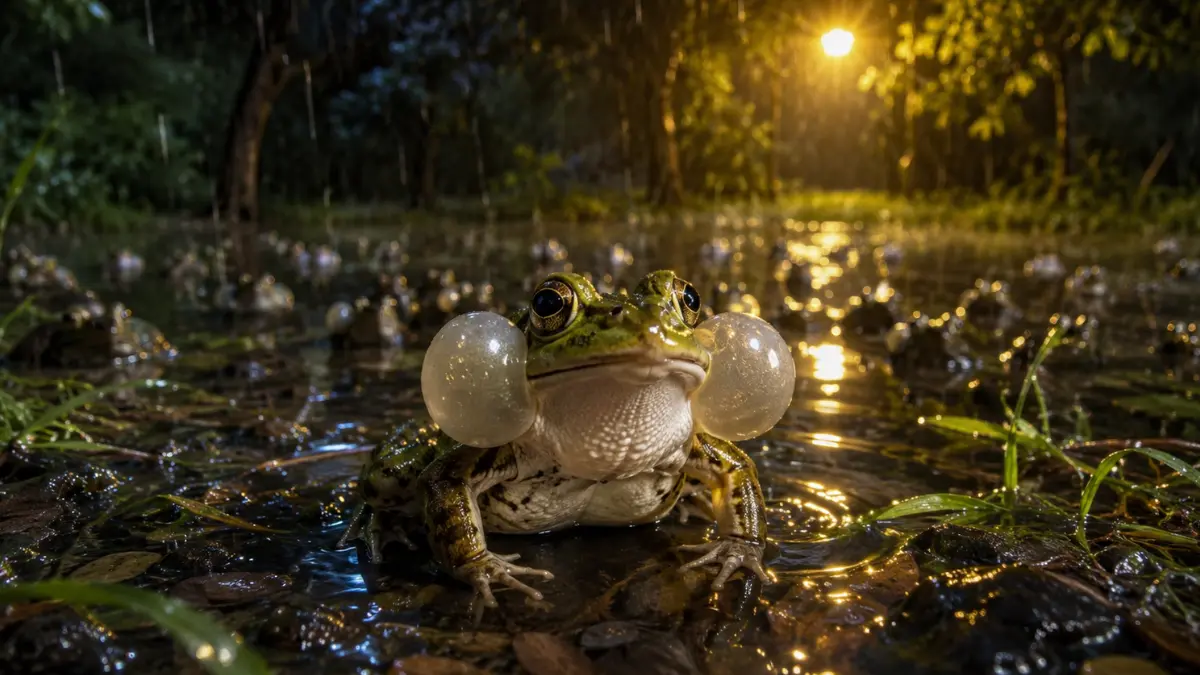

Why do frogs croak after rain, and how can such small animals produce enough sound to fill an entire neighbourhood? Rain creates moist breeding conditions that encourage many frogs to leave shelter, gather near water, and call at the same time.
Most of the loud croaking comes from male frogs trying to attract females and communicate with nearby rivals. In many species, an inflatable vocal sac helps radiate the call efficiently while air cycles between the sac and the lungs.
The noise often becomes strongest during warm, humid nights when temporary pools, ponds, ditches, and flooded fields provide suitable places for breeding. One frog can sound surprisingly loud, but dozens or hundreds calling together create the powerful chorus people hear after rainfall.
Why Does Rain Trigger Frog Calling?
Rain changes several parts of a frog’s environment at once. It raises humidity, wets the ground, fills shallow depressions, and creates pools where eggs and tadpoles may develop.
Frogs have thin, permeable skin that can lose moisture quickly. Dry conditions make movement across land risky because frogs can dehydrate while travelling between sheltered areas and breeding sites.
Wet ground gives them a safer opportunity to emerge from beneath soil, leaves, rocks, logs, and dense vegetation. Once they reach suitable water, males begin calling to announce their presence.
Temporary pools are especially important for species that breed after heavy rain. These pools may appear in fields, forest hollows, roadside ditches, gardens, and other low areas that collect water.
Some temporary pools contain fewer fish than permanent ponds. This can reduce one source of danger for frog eggs and tadpoles, although insects, birds, reptiles, and other predators may still be present.
Rain does not automatically make every frog call. The response depends on the species, season, temperature, humidity, water depth, and whether the frogs are ready to breed.
A brief shower during the wrong season may produce little activity. Heavy rain during the breeding season can trigger a large chorus within hours.
Frogs are not calling because they simply enjoy the weather. Rain opens a breeding opportunity, and the calls help them use that opportunity before the water level falls or the conditions change.
Are the Frogs Calling for Mates?
Most familiar frog choruses are made mainly by males. A male uses an advertisement call to tell females where he is and to identify himself as a member of the correct species.
A female may hear several males calling from different positions around the same pond. Their calls help her locate the breeding site and choose where to move.
Different frog species produce different sounds. Some make deep croaks, while others whistle, chirp, click, trill, bark, or produce a sound similar to metallic tapping.
People often describe all of these sounds as croaking, but a wetland chorus may contain several species calling at the same time.
The call also communicates with competing males. It can signal that a position is occupied, discourage another male from moving closer, or begin a calling contest between neighbours.
Some males change the timing, speed, or intensity of their calls when rivals are nearby. They may try to call during quieter moments so females can hear them more clearly.
Advertisement calls are not the only sounds frogs make. A frog may also produce territorial, release, warning, or distress calls, but the repeated chorus heard after rain usually serves a breeding purpose.
How Can Such Small Frogs Make So Much Noise?
A calling frog uses its lungs, larynx, mouth cavity, and vocal sac as a connected sound-producing system.
The frog moves air from its lungs through the larynx, where vibrating tissues generate the call. In many species, that air then moves into a flexible vocal sac beneath or beside the throat.
The sac expands like a balloon. It helps radiate the sound efficiently and allows the frog to reuse air instead of releasing a fresh breath after every call.
The frog can move air back and forth between the lungs and vocal sac while keeping its mouth closed. This allows it to repeat calls rapidly without stopping for a full breath each time.
Vocal sacs differ between species. Some frogs have one large central sac under the throat. Others have paired sacs on the sides of the head, and some have less visible internal structures.
The sac does not work in exactly the same way in every species, but it plays an important role in how many frog calls travel through the surrounding air.
A small frog can therefore produce a call that seems far louder than its body size would suggest. The sound becomes even more impressive when many frogs call together.
Why Does a Whole Frog Chorus Sound So Loud?
A single male may already produce a powerful call at close range. A breeding chorus contains many males calling from different places around the same water body.
Some sit partly submerged in water. Others call from muddy banks, floating leaves, grass, shrubs, tree branches, or vegetation above the water.
Their calls overlap and repeat from several directions. When one male pauses, another may begin. Several species may also call at once, each using a different rhythm or pitch.
The result can sound almost continuous. People may hear a wall of noise even though each frog calls in short bursts.
The habitat also affects how the chorus is heard. Open water, vegetation, wind, temperature, terrain, and the frequency of the call can all influence how sound travels.
Wetlands range from small temporary pools to complex habitats such as the phumdis of Loktak Lake. Different frog species use different breeding environments, but a large gathering of calling males can make almost any suitable site sound extremely loud.
The loudness does not come from one unusually large frog. It comes from many efficient callers competing to be heard in the same limited space.
Why Do Frogs Usually Call at Night?
Many frog species become more active after sunset because night conditions reduce the risk of drying out.
Temperatures often fall after dark, while humidity rises. These conditions help frogs move, feed, and call in exposed places without losing moisture as quickly as they might during the day.
Darkness can also make frogs less visible to predators that hunt mainly by sight. Calling still carries risk because snakes, bats, birds, mammals, and other predators may locate frogs by sound or movement.
Night is also an active period for many insects. Frogs can hunt while travelling through wet vegetation or waiting near the edge of a breeding pool.
Artificial light can disturb the normal behaviour of nocturnal insects. For example, lights can disrupt the flight control of moths, which changes how insects move through the same night-time environment used by frogs.
Not every species calls only at night. Some frogs call during daylight, especially in shaded forests, beside noisy streams, or during intense breeding events.
However, cooler air, higher humidity, and darkness make evening and night especially suitable for many common frog species.
Do Frogs Call During Rain or After It Stops?
Frogs may call before, during, or after rainfall. The exact timing depends on the species and local conditions.
A light shower can encourage frogs to emerge without producing enough background noise to cover their calls. Some males begin calling while rain is still falling, especially when breeding water has already formed.
Heavy rain can mask frog calls for human listeners and recording equipment. A chorus may therefore seem stronger after the downpour weakens, even if some frogs were already calling during the rain.
After rainfall, humidity often remains high and water continues collecting in low areas. These conditions allow more frogs to reach the site and join the chorus.
The strongest calling period may begin shortly after the storm, continue through the night, and return after later showers.
This timing explains why a place can seem quiet during heavy rain and suddenly become noisy when the rain slows.
Why Do Frogs Suddenly Stop When Someone Approaches?
Frog choruses often become silent when a person walks toward the water.
Calling reveals a frog’s location. A male that continues calling while a possible predator approaches may make itself easier to find.
Frogs can detect movement, shadows, light, footsteps, and vibrations through the ground or water. Several nearby frogs may respond to the same disturbance and become silent almost simultaneously.
A frog may freeze, lower its body, hide in vegetation, or move into deeper water. The sudden silence can make it difficult to locate even one animal after hearing dozens from a distance.
The frogs often begin again after the disturbance passes. One cautious male may restart, followed by others as the area becomes quiet.
This stop-and-start pattern is a defensive response, not evidence that the frogs have left the area.
Can Frogs Predict Rain?
People sometimes hear frogs calling before a storm and assume that the frogs can predict the weather.
Some frogs do become active as humidity and temperature change before rainfall. These environmental changes can make movement safer and signal that breeding conditions may soon improve.
However, frog calls cannot reliably predict whether rain will occur. Frogs respond to immediate conditions rather than understanding a future weather event.
A humid evening may trigger activity even when heavy rain does not arrive. The calls may provide a rough local sign that conditions are suitable for frogs, but they should not be treated as a dependable forecast.
Do All Frogs Croak After Rain?
Not every frog responds to rain in the same way.
Some species depend strongly on heavy rainfall and temporary pools. Others breed in permanent ponds, streams, tree holes, marshes, or wet forest habitats and may follow different seasonal patterns.
Temperature also matters. Conditions can become too cold, too hot, too dry, or too windy for active calling even after rainfall.
The timing of the breeding season is equally important. Frogs may remain quiet if their reproductive cycle is not active, even when the ground is wet.
In tropical regions, some species may call during many suitable periods throughout the year. In seasonal climates, the loudest calling may occur only during a limited breeding window.
This is why one rainstorm produces a deafening chorus while another produces only a few isolated calls.
Frogs croak loudly after rain because wet conditions improve movement, create breeding water, and bring many males together near the same site. Their calls attract females, communicate with rivals, and help each species find its own breeding group.
The sound becomes especially powerful when many frogs call at once. What seems like random night-time noise is actually a burst of reproductive communication shaped by moisture, temperature, habitat, and season.

1 thought on “Why Frogs Croak at Night After Rain”