
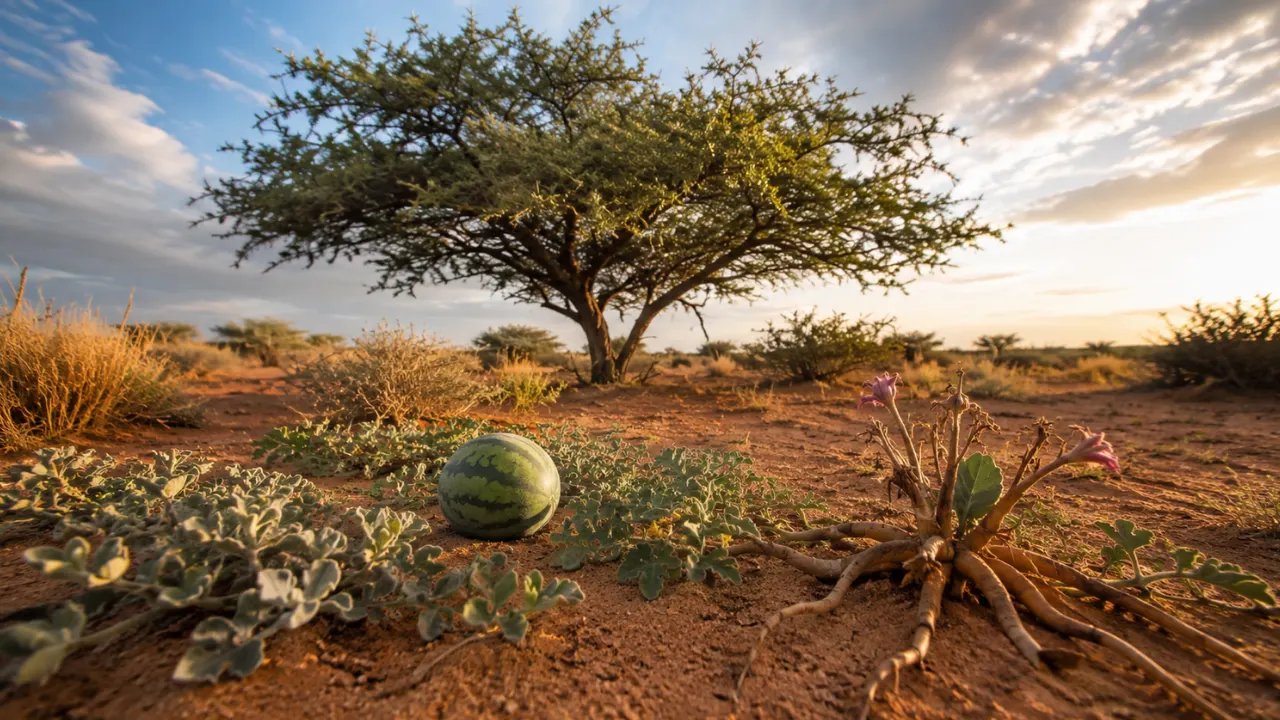

Plants in the Kalahari Desert survive through deep roots, small and durable leaves, underground storage organs, dormant seeds and rapid growth after seasonal rain. Each strategy helps a plant reach water, conserve moisture or pause its growth when conditions become too dry.
The Kalahari may look nearly lifeless during a drought, but many of its plants remain alive beneath the sand or continue drawing moisture from deep underground. When rain returns, dormant seeds and perennial roots quickly restore the vegetation.
Is the Kalahari Desert Completely Barren?
The Kalahari is not a vast expanse of bare sand without vegetation. Much of the region consists of dry savanna, grassland, scrub and open woodland growing across deep sandy soil.
Conditions also vary across the Kalahari. The southwestern areas are generally drier, while northern and eastern areas can support thicker grasses, shrubs and trees.
Rain usually arrives seasonally and can be unpredictable. A storm may soak one area while leaving another nearby location dry. Long periods without meaningful rainfall can follow.
The sandy ground creates another challenge. Water can drain quickly through its upper layers, leaving the surface dry soon after rain. Plants must use the temporary moisture immediately or reach water stored deeper underground.
Different plants solve this problem in different ways. Grasses often use shallow water after rain, while established trees can reach much deeper supplies. Some plants remain hidden underground until favourable conditions return.
Extreme habitats do not affect every living organism in the same way. The newly discovered Simonia lawbah spider in Meghalaya’s Krem Lawbah Cave depends on dark, humid surroundings, while Kalahari plants face the opposite challenge of intense heat and scarce surface water. Both examples show how specialised life can persist when it develops the right adaptations for a demanding environment.
How Do Camel Thorn Trees Reach Hidden Water?
The camel thorn is one of the most recognisable plants in the Kalahari. It can grow in dry riverbeds, sandy plains and areas where few other large trees survive.
Its main advantage is an exceptionally deep root system. In suitable ground, a camel thorn’s taproot can descend as far as 60 metres. This allows the tree to reach groundwater that remains unavailable to shallow-rooted grasses and young plants.
Not every camel thorn grows roots to that depth. Root development depends on the soil, the location of underground water and the conditions surrounding the tree. However, the species has the ability to explore deep layers of the ground when necessary.
This explains why a camel thorn may remain green when the surrounding surface looks completely dry. The tree does not depend only on recent rainfall.
Its small, divided leaves also help it live in an arid environment. They expose less surface area to hot, dry air than broad leaves would. The tree can therefore collect sunlight while controlling the amount of water lost through its foliage.
Paired thorns protect valuable leaves and new shoots from some browsing animals. This defence reduces the amount of tissue the tree must replace during periods when water and nutrients are limited.
Camel thorn trees also support the wider Kalahari ecosystem. Their large crowns provide shade, nesting places and cooler ground for animals. Their pods supply food, and animals help spread the seeds after eating them.
A mature camel thorn is therefore more than a drought-resistant tree. It becomes a small centre of life within an otherwise exposed landscape.
How Do Small, Leathery Leaves Reduce Water Loss?
Leaves allow a plant to absorb sunlight and carbon dioxide, but they also release water. This creates a serious problem in places with high temperatures, dry air and irregular rainfall.
Many plants in dry parts of the Kalahari grow small, firm or leathery leaves. These leaves expose less delicate tissue to the air and tolerate arid conditions better than large, soft foliage.
The shepherd’s tree provides a clear example. It carries clusters of leathery, grey-green leaves and grows in some of southern Africa’s driest environments.
Its leaves do not store large amounts of water like the thick tissues of a cactus. Instead, their compact size and durable structure help the tree function without losing moisture as quickly as a plant with broader, thinner leaves.
Some Kalahari plants also reduce their activity during severe drought. They may stop producing new shoots or shed part of their foliage.
This response protects the roots and stems that the plant has already established. Growing new leaves requires both water and energy, so slowing growth can increase the plant’s chance of surviving until rain returns.
The goal is not to prevent all water loss. A plant still needs to exchange gases and perform photosynthesis. Successful desert plants control that exchange carefully enough to remain alive without exhausting their limited supply of moisture.
How Does Devil’s Claw Survive Underground?
Devil’s claw follows a different survival strategy. Instead of maintaining a permanent woody stem above the ground, it protects important living structures beneath the surface.
The plant develops a perennial rootstock and secondary storage tubers. These underground structures hold water and nutrients that support future growth.
Its trailing stems, leaves and flowers appear during the growing season. When conditions become unfavourable, the visible growth can disappear while the perennial underground structures remain alive.
The surrounding soil insulates the rootstock from direct surface drying and extreme changes in temperature. When warmth and moisture return, the plant can use its stored resources to produce new stems.
This gives devil’s claw an advantage over a plant that must begin again entirely from seed. An established underground system can respond quickly when rainfall creates a brief growing opportunity.
Devil’s claw later develops a woody fruit covered with long hooked arms. These hooks can attach to the feet, fur or bodies of passing animals.
The animal carries the fruit away from the parent plant, helping its seeds reach new ground. This form of dispersal is useful in a large, open landscape where wind alone may not move heavy fruit effectively.
The underground tubers are not completely safe from wildlife. Porcupines and some antelope can dig them up and eat them. However, the root system still allows the plant to survive seasonal changes that would destroy exposed annual growth.
How Does the Tsamma Melon Protect Moisture and Seeds?
The tsamma melon is one of the best-known fruits associated with the Kalahari. Its vine spreads across the ground and produces round fruits protected by firm outer rinds.
The fruit contains moisture-rich flesh surrounding numerous seeds. The rind slows the drying of the flesh and keeps the seeds enclosed as the fruit develops.
This does not mean the melon works like a cactus that stores water for the long-term survival of the parent plant. The moisture inside the fruit primarily supports seed development and makes the fruit attractive to animals.
Animals can bite into the melons during dry periods to obtain food and moisture. When they eat or carry the fruit, they may move its seeds away from the parent vine.
This helps the plant reproduce across a wide landscape. A seed transported to a new location may remain in the soil until rainfall provides suitable conditions for germination.
People have also used Kalahari melons as seasonal sources of food and water. This has made the fruit culturally important in a region where reliable surface water can be scarce.
The name “tsamma melon” has been applied to wild melons within the Citrullus group, and botanical classifications have varied. The common name remains useful when discussing their broader ecological role without assuming that every wild Kalahari melon belongs to one identical species.
As an annual vine, the tsamma melon does not invest energy in building a large woody trunk. It can grow, spread, flower and produce fruit during a favourable season before the surface becomes dry again.
Why Does Kalahari Vegetation Grow So Quickly After Rain?
One of the most striking features of the Kalahari is how rapidly its appearance can change. Ground that looked brown and empty can develop a layer of green grass and flowering plants after sufficient rain.
This transformation happens because much of the next generation is already present.
Seeds remain buried in the sand during dry periods. Dormancy prevents them from germinating when conditions cannot support a young plant.
A small or brief shower may not provide enough moisture. If a seed germinated immediately, the seedling could die before its roots became established.
When rainfall, temperature and soil moisture become suitable, dormant seeds begin to germinate. The young plants then grow quickly because the wet period may not last long.
Annual grasses and flowering plants complete their life cycles within this temporary window. They produce leaves, flowers and new seeds before the upper soil dries again.
Perennial grasses use another method. Their visible leaves may dry out, but roots and protected growth points remain alive close to or below the surface.
After rain, these established plants do not need to create an entirely new root system. They can send up fresh shoots quickly.
Their shallow roots collect water from the upper soil, while deeper-rooted shrubs and trees benefit when heavier rainfall penetrates farther into the sand.
The result is a layered response. Small plants use immediate surface moisture, and established trees continue drawing from deeper reserves after the surface has dried.
How Do Kalahari Plants Support Desert Animals?
Kalahari plants form the foundation of the region’s food web.
Grasses feed antelope and other grazing animals. Trees and shrubs provide leaves for browsers, while flowers supply nectar and pollen for insects.
Camel thorn pods and tsamma melons offer food during seasons when other resources may be limited. Fruits can also provide moisture to animals living far from dependable surface water.
Large trees create shade in an exposed environment. The ground beneath their crowns can remain cooler than the surrounding open sand, giving mammals, birds and reptiles places to rest.
Birds use branches for nesting and observation. Insects live in the bark, flowers and soil around the trees. Smaller plants may also benefit from the shade and organic matter beneath a mature crown.
Animals help plants in return. They pollinate flowers, carry hooked fruits and spread seeds through their droppings.
These relationships allow plants to reproduce beyond the immediate area surrounding the parent. They also connect scattered patches of vegetation across the wider Kalahari landscape.
Can Kalahari Plants Survive Every Drought?
Desert adaptations do not make plants indestructible. Every species has limits.
A deep-rooted tree may survive a period without surface rain but struggle if underground water levels fall. Dormant seeds can wait for suitable conditions, but several failed rainy seasons can reduce successful germination and reproduction.
Heavy grazing may remove plants before they produce seeds. Damage to mature trees can also reduce shade, nesting sites and food for many other species.
The resilience of the Kalahari comes from its variety of survival strategies. When annual plants disappear, underground tubers may remain alive. When shallow soil dries, deep-rooted trees may continue reaching water.
No single adaptation keeps the entire landscape alive. The combination of roots, dormancy, seasonal growth and seed dispersal allows vegetation to persist through uncertainty.
Roots, Dormancy and Timing Keep the Kalahari Alive
Kalahari plants survive by using water carefully and growing at the right time.
Camel thorn trees reach deep groundwater. Shepherd’s trees limit moisture loss through small, leathery leaves. Devil’s claw protects resources underground, while tsamma melons enclose moisture and seeds inside firm fruits.
Grasses and annual plants remain hidden as seeds until rain creates a short opportunity for growth and reproduction.
During the driest periods, the landscape may appear empty. Beneath the sand, however, living roots, storage tubers and dormant seeds remain ready to respond.
The plants have not disappeared. Many of them are simply waiting for rain.
