
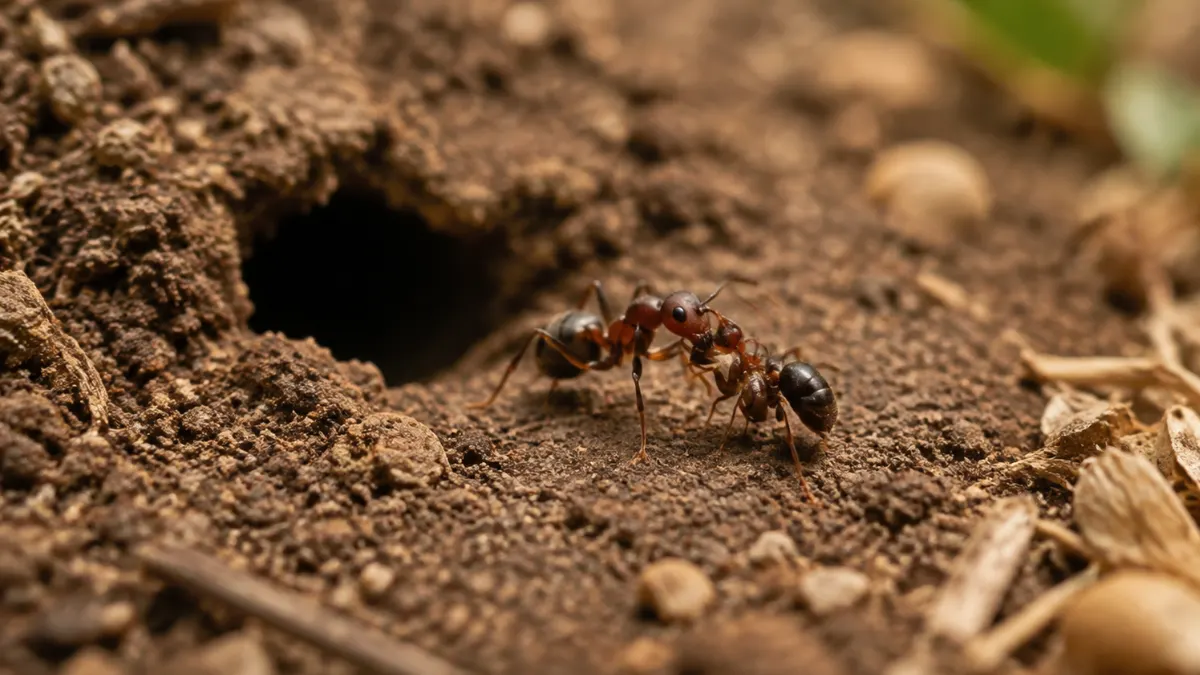

Ants carry dead ants away from the nest to keep the colony clean and reduce the risks associated with decomposing bodies. This sanitation behaviour is called necrophoresis. Workers identify a dead nestmate, pick up the body and transport it to a refuse area outside the nest or another location separated from the colony’s living chambers.
The behaviour protects the living colony rather than representing an ant funeral in the human sense. Ants often live close together with their queen, developing larvae, food stores and other workers. Allowing corpses to accumulate in that crowded environment could increase exposure to microorganisms and interfere with the colony’s normal activity.
However, the familiar explanation that dead ants simply release oleic acid is incomplete. Research shows that ants can use several chemical changes to distinguish a corpse from a living nestmate and the recognition mechanism can differ among species.
Why Do Ants Remove Dead Nestmates?
A dead ant can become a sanitation problem inside an enclosed nest. Bacteria and fungi may grow on a decomposing body, while an ant that died from an infectious organism may expose other colony members to the same threat.
Removing the corpse separates it from workers, larvae and other important parts of the colony. It also prevents bodies and other waste from obstructing the tunnels and chambers through which ants continually move.
Research suggests that corpse removal can benefit a colony even when the dead ants were not carrying a deliberately introduced pathogen. A study of common red ants, Myrmica rubra, compared colonies that could remove freeze-killed corpses normally with colonies whose narrow exits made removal difficult.
Over the 50-day experiment, adult workers survived better in colonies that could carry the bodies outside. When removal became difficult, workers moved the remaining corpses away from their brood and toward the corners of the nest. This showed that the ants continued trying to separate their living areas from dead bodies even when they could not remove them completely.
The researchers did not identify one universal reason for the difference in survival. Microorganisms growing on retained corpses and the additional biological cost of dealing with them were among the possible explanations. The result nevertheless supported corpse removal as an important form of colony hygiene.
How Do Ants Know That Another Ant Is Dead?
Ants rely heavily on chemical information detected through their antennae. The surface of an ant’s body carries a complex mixture of substances that helps other ants identify nestmates and respond to changes inside the colony.
When an ant dies, this chemical profile changes. A worker encountering a possible corpse commonly examines it with its antennae before grasping it with its mandibles and moving it.
Scientific investigation of this behaviour goes back decades. A 1958 study by E. O. Wilson, N. I. Durlach and L. M. Roth examined corpse-removal responses in the harvester ant Pogonomyrmex badius and the fire ant Solenopsis saevissima.
The researchers found that objects treated with chemical extracts from ant corpses could cause workers to carry those objects toward their refuse piles. Oleic acid also triggered a response resembling the treatment of a corpse in the harvester ants tested.
Oleic and linoleic acids consequently became widely described as chemical cues involved in corpse-management behaviour. A review of corpse management in social insects explains that these fatty acids can stimulate removal responses in ants and other social insects.
However, ants can sometimes recognize recently dead nestmates before decomposition has produced a large increase in fatty acids. Later research revealed that the disappearance of chemicals associated with life can be as important as the presence of substances associated with death.
Is Oleic Acid Really an Ant “Death Signal”?
Calling oleic acid an ant death signal provides a convenient explanation, but it makes a complicated and species-dependent system sound universal.
A PNAS study of Argentine ants, Linepithema humile, found that living and freshly killed workers carried two important compounds called dolichodial and iridomyrmecin on their outer surfaces.
The amounts of these compounds began falling immediately after death. Researchers could no longer detect them on the ants’ outer surfaces approximately 40 minutes later.
Experiments showed that dolichodial and iridomyrmecin inhibited the corpse-removal response. Substances capable of stimulating removal were already present on living Argentine ants, but the life-associated compounds prevented workers from treating them as corpses.
Once those inhibitory signals disappeared, the remaining chemical profile allowed workers to recognize and remove the body. The dead ant was therefore identified partly because it no longer smelled sufficiently like a living ant, not because one completely new chemical suddenly appeared.
The result does not prove that every ant species uses dolichodial and iridomyrmecin. It demonstrates why oleic acid should not be presented as one universal command that controls every corpse-removal response. Different species can rely on different chemical combinations, while colony activity and the context in which an object appears may also affect how workers respond.
Where Do Ants Take the Dead Bodies?
Many ants transport dead nestmates to a refuse pile away from the colony’s active chambers. These waste areas are sometimes called middens.
A midden may contain dead ants, food remains, empty pupal cases, excavated material and other unwanted debris. Separating this material from the nest reduces the amount of waste near the queen, larvae and living workers.
The exact destination varies. Some colonies maintain an identifiable refuse pile outside the entrance, while others carry bodies a short distance away without creating an obvious collection. Colonies with more complex nests may use a chamber that remains separated from their principal living and brood areas.
This is why describing every pile as an “ant cemetery” can be misleading. The location usually functions as a waste-disposal site rather than a dedicated burial ground.
Not every ant carrying a dead organism is performing necrophoresis. Ants also transport captured insects and scavenged remains as food. Necrophoresis specifically describes the management of dead colony members or other bodies treated as waste.
Does Carrying Dead Ants Always Prevent Disease?
Necrophoresis reduces a recurring sanitation risk, but it cannot protect a colony from every infectious organism.
The common red ant experiment found that workers survived better when colonies could remove ordinary freeze-killed corpses. That result supports the value of keeping dead bodies away from living areas.
However, a PLOS ONE study involving infectious carpenter-ant cadavers produced a more severe result. Researchers introduced a corpse killed by the fungus Beauveria bassiana into small experimental sub-colonies. Under the tested conditions, the infection overwhelmed the ants even when some colonies had an opportunity to move cadavers outside.
Corpse removal can therefore lower ordinary exposure without guaranteeing complete immunity. A heavily infectious body may expose workers while they examine or transport it, or it may release enough infectious material to overcome the colony’s collective defences.
Do Ant Colonies Have Special Undertaker Ants?
The word “undertaker” describes ants that frequently handle corpses, but it does not refer to a separate physical caste present in every colony.
Workers can differ in their age, location, sensitivity to chemical cues and usual responsibilities. Ants already operating near nest entrances and refuse areas may encounter and remove corpses more frequently than nurses caring for larvae farther inside.
A 2024 study of corpse removal in common red ants found that intermittent foragers handled most ordinary corpses. These workers divided their time between the nest and the outside area, placing them in a useful position to transport waste out of the colony.
When researchers introduced fungus-covered corpses that were actively producing spores, workers from a wider range of functional groups became involved. The more dangerous bodies were removed faster, although involving more workers also exposed a larger part of the colony to the pathogen.
The findings show that corpse-removal work can remain flexible. Some workers may temporarily specialize in removing ordinary bodies, while a more urgent threat can recruit workers who would not normally perform that task.
This type of division of labour also occurs in other social insects. Termite colonies contain workers, soldiers and reproductive members; the flying termites that suddenly appear after rain are reproductive adults rather than workers responsible for routine colony maintenance.
Are Ants Mourning Their Dead?
Seeing one ant carry another can resemble a funeral procession but the behaviour alone does not demonstrate mourning.
Experiments show that chemical changes on a body can trigger workers to examine, collect and transport it. This response helps maintain the colony, but it does not establish that ants understand death or experience grief in the human sense.
Terms such as “cemetery” and “undertaker” make the behaviour easier to describe, but they should not replace its biological explanation. Ants carry dead ants because chemical changes identify the body as waste and because removing it helps keep the colony’s living environment organized. What appears to be a tiny funeral is primarily a practical sanitation system that protects the nest’s living members.
