
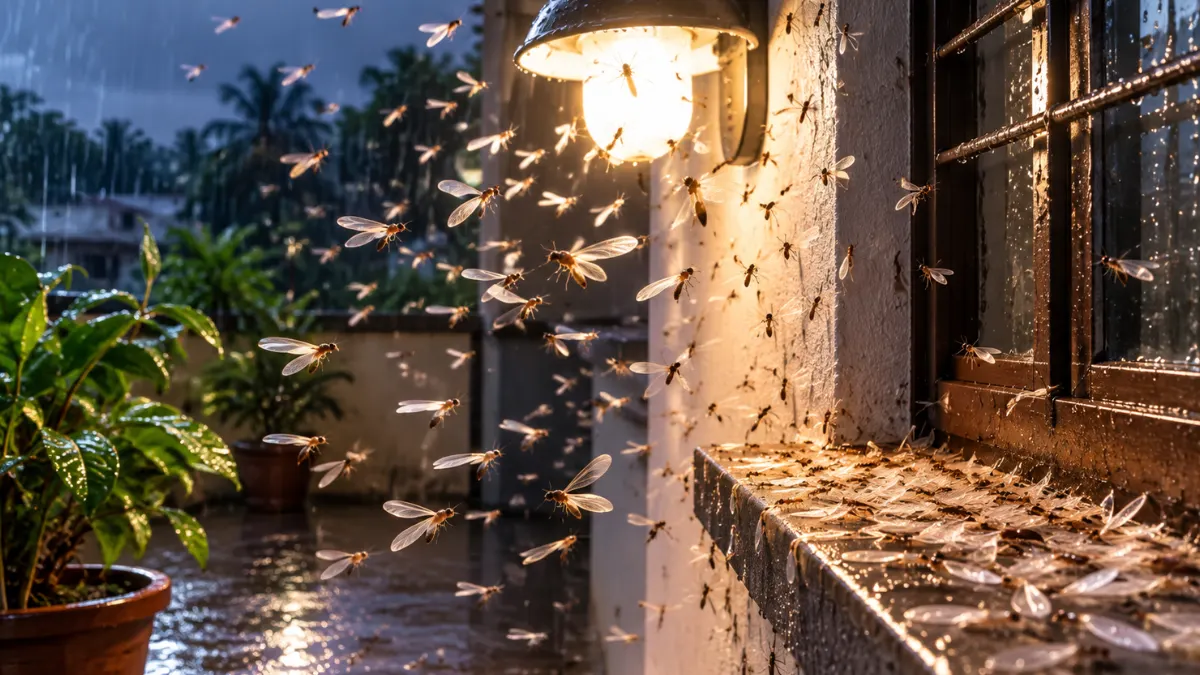

After a period of rain, hundreds of small winged insects can suddenly gather around lights, windows, balconies or outdoor walls. The swarm may be so large that it looks as though the insects appeared from nowhere.
Flying termites often emerge after rain because warm, humid conditions can create a favourable window for reproductive termites to leave mature colonies, find mates, and attempt to establish new colonies. The rain does not create the termites. The winged adults were already developing inside established colonies before they became visible.
These flying termites are reproductive adults commonly called alates or swarmers. Their brief appearance above ground is one stage of a much larger termite life cycle that usually remains hidden in soil, wood, or underground colonies. NC State Extension explains that termite colonies periodically produce these winged reproductive adults specifically so they can disperse, mate, and form new colonies.
Why Do Flying Termites Come Out After Rain?
Rain can change several environmental conditions at once.
The air usually becomes more humid, the soil holds more moisture, and temperatures may become favorable for insects that are vulnerable to drying. These conditions can make it safer for reproductive termites to leave the protected environment of their colony.
Subterranean termites are particularly dependent on moisture. They have soft bodies and can lose water when exposed to dry air. University of Georgia educational material on subterranean termite biology identifies moisture as one of the most important factors affecting their activity and distribution.
Rain itself, however, is not the only factor involved. Temperature, humidity, wind, season, termite species, and the maturity of the colony can all influence when a swarm begins.
This is why termites do not necessarily swarm after every rainfall.
The connection between rain and swarming is well documented for several termite species. Mississippi State University Extension reported in May 2026 that Formosan subterranean termite swarmers often emerge for several hours after sunset following daytime rainfall, when they fly out to find mates and attempt to establish new colonies.
NC State Extension also notes that Eastern subterranean termites commonly swarm on warm days following rain, although the exact timing varies among species.
The familiar sight of flying termites after rain is therefore not a random reaction to wet weather. It is usually the visible reproductive stage of a colony responding to a suitable combination of environmental conditions.
What Are the Flying Termites Actually Doing?
The insects in a termite swarm are not ordinary worker termites that suddenly developed wings.
Termite colonies contain different groups, or castes, that perform different jobs. Workers maintain the colony and obtain food, while soldiers help defend it. Mature colonies also produce reproductive individuals capable of developing wings and leaving the original colony.
Those winged reproductive termites are the swarmers people notice after rain.
Their primary purpose is to disperse and reproduce.
Male and female swarmers leave the colony during a mating flight. After landing, compatible individuals can pair together. They then shed their wings and search for a protected location where they may begin the difficult process of establishing a new colony.
NC State Extension describes this sequence clearly: reproductive termites leave the original nest, form pairs after flight, drop their wings and search for a place suitable for starting a colony.
This also explains an unusual sight that sometimes appears after a swarm: dozens or hundreds of transparent wings scattered across a floor, window ledge, balcony, or outdoor surface.
The termites did not lose their wings accidentally. Wing shedding is a normal part of what happens after the reproductive flight.
Why Do Hundreds of Flying Termites Appear at the Same Time?
A termite colony does not normally send one reproductive termite into the air every few minutes.
Large numbers can emerge within a relatively short period when environmental conditions become suitable.
This synchronized swarming increases the opportunity for reproductive termites from different colonies to encounter potential mates during the relatively brief period when weather conditions support their flight.
The result can look dramatic.
An area may have almost no visible termite activity during the day, yet hundreds or thousands of winged termites may suddenly fill the air that evening.
The termites were not created during the rainfall. The reproductive insects had already matured inside their colonies and were waiting for suitable conditions to emerge.
Colony size also matters. Some termite species form much larger colonies than others and can therefore produce particularly noticeable swarms.
For example, Mississippi State University Extension explains that Formosan subterranean termite colonies can become much larger than colonies of some native subterranean termites, contributing to extremely heavy swarming events.
Why Do Flying Termites Gather Around Lights?
One reason termite swarms become so noticeable is their attraction to artificial light.
This behavior is especially conspicuous among some termite species that swarm after sunset.
Mississippi State University Extension reports that Formosan subterranean termite swarmers are strongly attracted to lights. During heavy swarming periods, they can gather around homes, windows, businesses, sports grounds and other brightly illuminated places.
This means a bright lamp may concentrate flying termites that emerged from colonies somewhere nearby.
The colony does not necessarily sit directly underneath the light.
Some swarmers can also enter buildings because they are moving toward illuminated windows or indoor lighting. Mississippi State University Extension notes that Formosan swarmers may fly or crawl indoors while responding to lights.
The combination of a large synchronized swarm and strong attraction to artificial light can make a relatively brief natural event appear far more dramatic.
Flying Termite or Flying Ant: How Can You Tell the Difference?
Flying ants often appear under similar weather conditions, so people commonly mistake them for termites.
Color alone is not always a reliable way to identify them because different species can look different.
Body shape, wings, and antennae provide better clues.
According to the U.S. Environmental Protection Agency, termite swarmers generally have four wings that are roughly equal in length. Flying ants have front wings that are noticeably longer than their hind wings. Termites also tend to have relatively straight antennae, while ants have distinctly bent or elbowed antennae.
Ant bodies usually have a clearly narrowed or pinched waist. A termite body generally looks more evenly shaped through the middle.
Discarded wings can provide another clue.
NC State Extension notes that termite wings are approximately the same length and size, unlike ant wings.
These differences become particularly useful after a swarm when the insects themselves may already have disappeared but their shed wings remain behind.
Does Seeing Flying Termites Mean Your House Has Termites?
Not automatically.
Where the flying termites came from is more important than simply seeing them.
If the swarm is outdoors, the colony could be somewhere in the surrounding soil, an old tree stump, buried wood, landscape timber, another property, or a wooded area nearby.
NC State Extension specifically explains that termite swarmers seen outdoors can originate from colonies elsewhere in the surrounding area and do not by themselves prove that a nearby house is infested.
A small number of flying termites indoors also does not always prove that a colony is living inside the building. Some may simply enter through windows, doors, ventilation openings or small gaps while moving toward artificial light.
The situation becomes more significant when a large number of swarmers appear to be emerging from inside the structure itself.
Termites coming directly from wall gaps, flooring, wooden structures or other interior locations can justify closer investigation.
NC State Extension states that indoor swarming often indicates termite activity somewhere within or beneath a structure, while outdoor swarmers alone are not evidence that the house itself is infested.
Other signs can strengthen the suspicion, including repeated indoor swarms, accumulations of discarded wings, termite mud tubes or characteristic wood damage.
The U.S. Environmental Protection Agency also identifies termite swarms as one of the common ways people first become aware that termites may be present.
Seeing swarmers should therefore be treated as information rather than automatic proof of structural damage.
Do Flying Termites Damage Wood?
The visible swarmers are primarily reproductive termites.
They are not the members of the colony responsible for most ongoing structural feeding.
Worker termites perform that role.
This distinction explains why simply killing the flying termites around a light does not eliminate an established colony. The majority of the colony may remain hidden underground or inside protected areas.
NC State Extension specifically warns that killing swarmers does not solve an underlying infestation because the swarmers themselves are mainly evidence that a mature termite colony exists somewhere nearby.
The reproductive flight is therefore the most visible part of a system that usually remains concealed.
Why Do Flying Termites Disappear So Quickly?
A huge termite swarm can vanish almost as suddenly as it appeared.
The flying stage is temporary.
Once reproductive termites leave their colony, they need to disperse, locate potential mates and find suitable conditions for attempting to establish a colony.
After successful pairing and landing, they normally shed their wings.
Many swarmers never reach that stage.
Exposure outside the protected colony creates numerous risks. Swarmers can become prey for birds, spiders, reptiles and other insect-eating animals. Others land in unsuitable places, become trapped indoors or die when moisture conditions are inadequate.
NC State Extension notes that swarmers trapped inside buildings frequently die because they cannot obtain the conditions they require.
This is why a place that appeared overwhelmed with winged termites during the evening may look almost normal the next morning.
Only scattered insects and piles of discarded wings may remain.
The disappearance of the swarm does not mean that the original termite colony has disappeared. Most colony members never participated in the flight.
Are Termites Useful in Nature?
Termites can become serious structural or agricultural pests when their feeding conflicts with human activity, but that is only one side of their ecological role.
In natural ecosystems, termites help break down dead plant material and wood.
By consuming cellulose-rich material, they participate in decomposition and nutrient cycling, particularly in tropical and subtropical ecosystems.
Research involving the U.S. Forest Service has shown how significant this role can become. In one subtropical forest experiment, researchers found that termites made a substantial contribution to observed wood decomposition.
India also has extensive termite diversity. The Indian Council of Agricultural Research notes that termites occur across tropical, subtropical and temperate environments and can become important agricultural pests when they attack crops.
The ecological role of termites helps explain why large populations can exist naturally in areas where people encounter only occasional swarms.
Why the Swarm Seems to Come From Nowhere
The dramatic appearance of flying termites after rain becomes easier to understand once the hidden part of their life cycle is considered.
The insects have usually spent their earlier development inside an established colony. When rainfall, humidity, temperature, season and other conditions align, reproductive adults can emerge together and begin their dispersal flight.
Rain does not suddenly produce termites, and the swarm does not necessarily mean that termites have just invaded an area.
Instead, the swarm briefly exposes a biological process that usually happens out of sight.
The winged termites are reproductive adults leaving mature colonies, attempting to find mates and searching for places where a new generation of colonies might begin. Artificial lights can gather them into conspicuous groups, which makes the event appear even more sudden.
Within a short period, most of the flying activity ends.
What looks like an unexpected invasion after rain is therefore one of the few moments when the reproductive cycle of a normally hidden termite colony becomes visible.
Sources
- NC State Extension — Termite Swarmers: What Do They Mean for You?
- NC State Extension — Monitoring and Management of Eastern Subterranean Termites
- Mississippi State University Extension — Protect Property From Heavy Termite Swarms
- Mississippi State University Extension — Formosan Subterranean Termites
- Indian Council of Agricultural Research — Biology and Management of Termites in Field and Fruit Crops
- U.S. Forest Service — Stronger Effects of Termites Than Microbes on Wood Decomposition in a Subtropical Forest

1 thought on “Why does this strange swarm happen immediately after rain and what exactly are those insects doing?”