
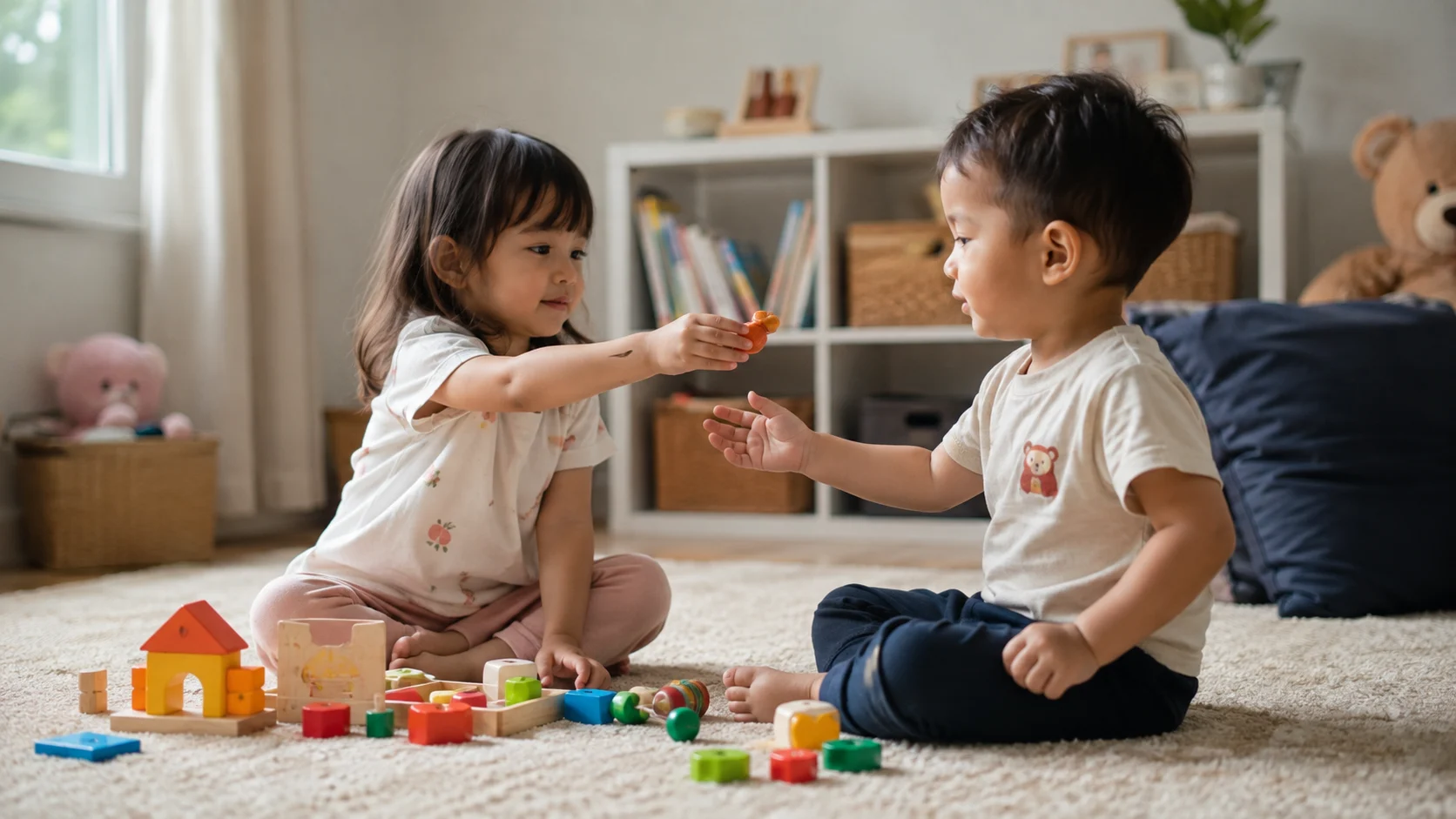

Humans do not appear to be born purely selfish, but research also does not support the opposite idea that people begin life naturally generous and only become selfish because of society.
The more accurate answer is that humans seem to develop with both self-protective and cooperative tendencies. Children can help others surprisingly early, yet they can also become possessive when sharing requires giving up something they value. Family, culture, relationships and experience then shape when those tendencies are expressed and toward whom.
That makes the question less about whether humans are “good” or “selfish” by nature and more about how natural self-interest and cooperation develop together.
Do young children behave selfishly before they are taught to share?
One useful way to study this question is to look at children who are still too young to understand complicated moral rules.
If people were naturally selfish and had to be taught all forms of helpfulness, spontaneous helping should be unusual in very young children.
But researchers have repeatedly observed otherwise.
In a well-known study by Felix Warneken and Michael Tomasello, 18-month-old children watched adults encounter simple problems, such as dropping an object they were trying to reach. Many of the toddlers helped the adult without being promised a reward.
Similar helping has been observed in children as young as 14 months.
These findings do not prove that babies are born morally good. Even a one-year-old has already spent months interacting with parents and caregivers.
Still, they show that young children can notice another person’s goal and sometimes help without needing an obvious personal benefit.
That is difficult to explain if human behavior begins as nothing more than selfishness.
Helping is not the same as giving up something you want
This is where the picture becomes more complicated.
Picking up something another person dropped costs very little. Giving away your favorite toy, food, or reward is different because helping someone else now conflicts with your own interests.
Research suggests that young children often find this kind of generosity more difficult.
That distinction matters because people sometimes use children’s reluctance to share as proof that selfishness is our natural state.
But psychologists separate different kinds of prosocial behavior.
Helping someone achieve a goal, comforting someone who is upset, cooperating on a task, and sharing your own resources are not psychologically identical.
A child can therefore be genuinely helpful while still being very protective of things they value.
That is not necessarily a contradiction. It may simply show that self-interest and concern for others are developing at the same time.
What happens when children from different cultures are compared?
Cross-cultural research gives us one of the strongest clues about where society enters the picture.
In one major study, researchers examined children and adults from six very different societies, including communities in the United States, Central Africa, Namibia, Ecuador, Australia, and Fiji.
Children were given opportunities to benefit another person.
Sometimes generosity cost them very little. In other situations, helping someone meant giving up something they could have kept.
When helping carried little personal cost, prosocial behavior generally increased as children became older.
But when generosity required a real sacrifice, children increasingly began to resemble the adults in their own communities.
This finding is important because it suggests that culture does not create cooperation from nothing.
Some cooperative tendencies appear broadly across childhood.
What society seems to shape more strongly is how people behave when generosity becomes costly.
Children gradually learn questions such as:
- Is sharing expected?
- Who deserves help?
- Should resources be divided equally?
- Is it acceptable to keep more when you earned more?
- Are strangers treated differently from family members?
These rules vary between communities, which helps explain why adult ideas about generosity can differ so much across cultures.
So does upbringing make people selfish?
Upbringing can influence selfish and generous behavior, but it probably does not create either tendency from scratch.
Children learn constantly from the behavior around them.
They notice whether adults share, compete, forgive, cooperate, keep score, help strangers, or protect resources.
They also learn from consequences.
A child who sees generosity appreciated may become more comfortable sharing. A child who repeatedly sees generous people taken advantage of may become more cautious.
Parents also influence how children think about other people’s needs. Warm and responsive parenting has been associated in research with greater empathy and prosocial behavior.
But the relationship is not as simple as “good parenting creates generous children.”
Children have different temperaments, and children themselves influence how parents respond to them.
Even siblings raised in the same home can develop very different attitudes toward sharing, competition, and trust.
Upbringing therefore shapes a tendency rather than writing a personality from a blank page.
Can society teach selfishness too?
Yes.
Society does not only teach kindness.
People also learn competition, status, suspicion, ownership, and the importance of protecting their own interests.
- A school may encourage students to cooperate while also ranking them against one another.
- A workplace may talk about teamwork while rewarding the person who receives the most individual credit.
Families may teach children to share with siblings while warning them to be cautious with outsiders.
This means socialization can strengthen cooperation in one situation and self-protection in another.
A person can therefore become extremely generous toward family members while remaining unwilling to help strangers.
That does not necessarily mean one side of their personality is fake.
Human generosity is often selective.
Why can the same person be generous one day and selfish the next?
Because human behavior changes with context.
Imagine someone who willingly gives a large amount of money to help a close relative but refuses to lend a much smaller amount to someone they barely know.
Calling that person either selfish or generous does not tell us very much.
People consider many things when deciding whether to help:
- how close they are to the other person,
- whether they trust them,
- whether help is likely to be returned,
- how much the sacrifice will cost,
- whether the situation feels fair,
- whether resources feel secure or scarce.
The same person may behave differently when any of these conditions change.
Someone who feels financially secure may share freely. The same person may become highly protective of money after losing a job.
A person may cooperate enthusiastically with people they trust but stop contributing if they believe others are taking advantage of them.
This is one reason human selfishness cannot be understood as a permanent personality setting.
Does scarcity make people more selfish?
Scarcity can make self-protection more important.
When people believe that money, food, time, opportunities, or security are limited, keeping resources can feel more urgent.
This does not mean scarcity automatically turns people selfish. Communities facing hardship can also become highly cooperative, particularly when survival depends on mutual help.
But scarcity changes the calculation.
Giving away something you have plenty of is psychologically different from sharing something you fear you may soon need yourself.
This also helps explain why selfishness sometimes increases during stressful periods without requiring a dramatic change in someone’s moral character.
The surrounding circumstances have changed.
Are humans naturally cooperative, then?
Humans are unusually cooperative compared with many other species, but cooperation and self-interest are not opposites.
For most of human history, surviving alone would have been extremely difficult.
People depended on others for food, childcare, protection, knowledge, hunting, shelter, and support during illness or injury.
That means cooperating with other people could also improve an individual’s own chances of surviving.
Human cooperation therefore does not have to be perfectly selfless in order to be real.
People can care about others while also benefiting from relationships.
A parent can sacrifice enormously for a child. Friends can help one another without calculating repayment. Communities can share resources because everyone benefits from having reliable support.
Human social life often mixes personal interest and genuine concern rather than separating them neatly.
So are humans naturally selfish?
The strongest answer from current research is: humans naturally have self-interested tendencies, but selfishness is only part of the picture.
Young children show that concern for others can appear surprisingly early.
At the same time, children are often protective of their own possessions and become less willing to help when generosity requires a meaningful sacrifice.
As they grow, family and culture increasingly teach them what fairness means, who should be helped, how much sacrifice is expected, and when protecting their own interests is acceptable.
Society therefore does not simply take selfish babies and teach them to become good.
Nor does it take naturally generous children and corrupt them.
It works on a human nature that already contains both impulses.
- That may be why people are capable of remarkable generosity in one situation and obvious selfishness in another.
- The deeper question is not whether humans are born selfish.
It is what makes self-interest or cooperation become stronger in a particular situation.
And the answer usually lies in the interaction between human nature, experience, trust, relationships, culture, and the cost of helping.
