
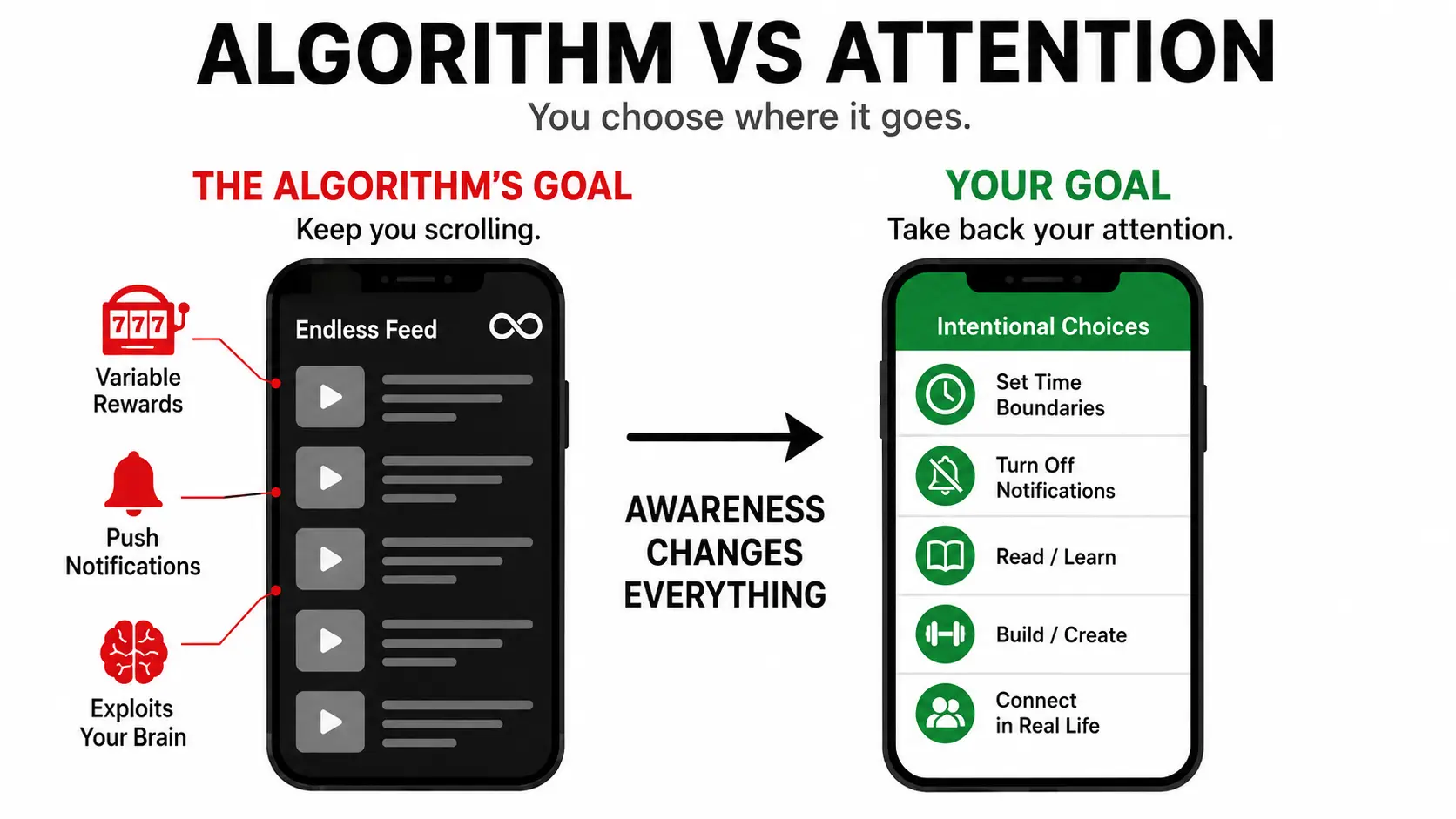

How reward learning, notifications and frictionless feeds compete for your attention — and what actually helps you regain control
You pick up your phone because you want to check one message.
Before putting it down, you notice another notification. That leads to a video. The video leads to another one. Then you check a different app because something new might have happened there.
Eventually you look at the time and realize that the quick check lasted twenty minutes.
It is easy to interpret moments like this as a lack of discipline. The internet offers another explanation too: your brain has supposedly been flooded with dopamine, so you need a “dopamine detox” to reset it. Neither explanation is particularly useful.
Dopamine is not a toxin accumulating inside the brain, and you cannot cleanse yourself of it by avoiding music, conversation, entertainment or tasty food. Harvard Health has specifically addressed this misunderstanding: what became known online as “dopamine fasting” was originally closer to reducing compulsive behaviors and their triggers, not literally fasting from dopamine.
The more interesting question is why a device that we often use without enjoying very much can nevertheless be so difficult to stop checking.
The answer involves dopamine, but also habit, reward learning, interruptions, uncertainty, convenience and the way digital products remove many of the natural stopping points that exist in ordinary life.
Understanding those mechanisms gives us something far more practical than a dopamine detox.
Is Dopamine Really the Reason You Keep Checking Your Phone?
Calling dopamine the brain’s “pleasure chemical” has created a great deal of confusion.
Dopamine certainly participates in reward-related processes, but decades of neuroscience suggest that its role cannot be reduced to simply making us feel pleasure.
Research associated with neuroscientist Kent Berridge has helped distinguish liking something from wanting it. Dopamine appears particularly important to motivation, learning and the tendency to pursue things that have become rewarding or important to us.
That distinction makes everyday phone behaviour easier to understand. You can want to check an app without particularly enjoying what happens afterward.
Think about how often people refresh email when they are not expecting anything important, reopen an app they closed only minutes ago or continue scrolling after the content has stopped being entertaining.
The attraction is not always the reward itself. Sometimes it is the possibility of a reward.
A message could be waiting. Someone could have replied to you. The next post could be funny. There might be new information about something you care about.
That uncertainty matters because the brain is constantly learning which cues predict outcomes worth pursuing.
Neuroscientist Andrew Huberman has helped popularize the distinction between tonic and phasic dopamine activity. In simplified terms, tonic activity refers to more sustained background signaling, while phasic activity refers to relatively brief changes in dopamine signaling around certain events, cues and rewards.
These are genuine concepts in neuroscience. What should be avoided is turning them into an overly neat internet formula in which every exciting experience creates a mathematically equal dopamine crash afterward.
Dopamine signaling is considerably more complicated than that. Modern neuroscience continues to study how dopamine represents prediction errors, motivation, movement, learning and other information rather than treating it as a simple pleasure meter.
Huberman’s broader warning about constantly pursuing intense stimulation may be useful as a behavioral idea, but there is no reason to imagine a bank account in your brain where every TikTok video withdraws an exact amount of tomorrow’s motivation.
Why Does an Unpredictable Feed Keep Pulling You Back?
One of the most important ideas in reward neuroscience is reward prediction error. In simple terms, the brain pays particular attention to differences between what it expected and what actually happened.
If something turns out better than expected, that surprise can become a powerful learning signal. If an expected reward fails to arrive, the brain learns from that too.
The research of Wolfram Schultz and others established an important role for dopamine neurons in this kind of reward-prediction learning, although scientists now know that dopamine signaling does more than one simple computation.
Consider how different that is from reading a familiar page in a book. When you swipe through a feed, you do not know exactly what comes next.
One post might be forgettable. Another might annoy you. The next might be a message from someone you know. A few swipes later, you could find a video so funny or interesting that you send it to several friends.
That uncertainty creates repeated opportunities for learning and anticipation. This is where people often compare social media with slot machines.
The analogy is useful, but only up to a point.
Casinos have long used variable reinforcement, where rewards do not arrive after every action. Social feeds also contain uncertainty and intermittent rewards. But a social-media feed is not literally a slot machine, and there is no evidence that every swipe is governed by exactly the same psychological mechanism as gambling.
People use social platforms to communicate, learn, follow communities, work, relax and maintain relationships. Reducing all of that behavior to one casino mechanism would be misleading.
What researchers have found is more interesting because it does not require exaggeration.
A study published in Nature Communications analyzed more than one million social-media posts from more than 4,000 users. The researchers found that posting behavior showed patterns consistent with reward learning. In a separate experiment, changing the amount of social reward participants received also changed aspects of their subsequent posting behavior.
In other words, likes and other forms of social feedback can influence behaviour in ways predicted by learning theory. That does not mean an algorithm has complete control over you.
It does mean that repeated rewards can help teach you what to check again.
Why Can You Keep Scrolling Even After It Stops Being Enjoyable?
This is one of the stranger parts of excessive digital consumption. If scrolling were simply about pleasure, we would expect people to stop when they stopped enjoying it. Often they do not.
They continue switching between apps, refreshing pages and watching videos while simultaneously feeling bored with what they are doing.
Stanford psychiatrist Dr. Anna Lembke provides one useful way of thinking about this problem through the pleasure-pain balance described in Dopamine Nation.
Her model comes primarily from addiction medicine. She uses a balance or seesaw metaphor to explain how repeated exposure to highly rewarding experiences can produce compensatory processes and how, in addiction, a person may increasingly engage in a behavior not to become euphoric but to escape discomfort.
Stanford describes Lembke’s work in terms of compulsive overconsumption and a pleasure-pain balance that can become disrupted when rewarding stimuli are repeatedly pursued. The important word here is metaphor.
There is not a tiny neurological seesaw measuring every minute you spend on Instagram, and we should not assume that someone who spends too long watching videos has entered the same neurobiological state as someone with a severe substance-use disorder.
Still, the framework captures an experience many people recognize. A behaviour can gradually move from “I really want to do this” toward “I automatically do this whenever I feel bored, uncomfortable or restless.”
Eventually the phone itself can become the fastest available response to almost any empty moment.
Waiting for an elevator?
- Check.
- Standing in a queue?
- Check.
- A difficult paragraph at work?
- Check.
- A conversation pauses for ten seconds?
- Check.
The important change is not necessarily that ordinary life has lost all ability to stimulate your dopamine system. It is that reaching for another stimulus has become extremely easy and deeply practiced.
Are Notifications Actually Damaging Your Attention?
You do not even need to touch your phone for it to interrupt you.
Researchers studying phone notifications have found that receiving a notification can disrupt performance on an attention-demanding task even when participants do not respond to the phone.
More recent experimental work continues to examine how visual and auditory notifications interfere with sustained attention.
This is an important part of the phone problem because many digital interruptions are not decisions that originate with you. The device makes the first move.
A badge appears. The screen lights up. Something vibrates in your pocket. A news app informs you that something happened somewhere in the world. A shopping app tells you about a sale you were not thinking about thirty seconds earlier.
Each one creates a small decision: ignore it or investigate it. That decision has a cognitive cost of its own.
This is why trying to become a person with “stronger willpower” can be less effective than simply reducing how many times the decision has to be made.
What Actually Helps You Use Your Phone Less?
There is no single switch that permanently fixes digital distraction.
A more realistic approach is to make unwanted behaviors slightly less convenient while making deliberate behaviors easier.
1. Remove Notifications That Do Not Deserve Immediate Attention
Start by asking which apps genuinely need permission to interrupt you.
Calls from family may matter immediately. A work message may occasionally matter immediately.
An alert telling you that someone uploaded a new reel probably does not.
Disabling non-essential notifications has been included in behavioral interventions designed to reduce problematic smartphone use, and reducing interruptions also makes sense given what researchers know about the attentional cost of notifications.
You do not have to stop checking these apps. You simply change who initiates the interaction.
Instead of the app summoning you throughout the day, you open it when you have decided that it is time to look.
2. Try Grayscale If Colorful Apps Keep Pulling Your Eye
You may have heard that grayscale works because bright phone icons imitate colorful fruit our ancestors evolved to seek.
That is an appealing story, but there is no need to invent an evolutionary explanation. Researchers have directly tested grayscale.
In a randomized field experiment involving 112 participants, switching smartphones to grayscale produced an immediate and significant reduction in objectively measured screen time compared with a control condition. Interestingly, the researchers did not find that this automatically improved every measure of well-being or academic performance.
That is exactly the sort of modest result we should expect from a useful behavioral tool.
Grayscale does not “reset dopamine.”
It simply makes the screen somewhat less visually attractive, adding a little friction between seeing the phone and becoming absorbed by it.
3. Create Stopping Points Where Apps Give You None
Many offline activities contain natural endings.
A newspaper has a final page. A television episode finishes. A chapter ends. A meal eventually disappears from the plate.
Infinite feeds deliberately remove that kind of obvious endpoint from the interface. You can create one yourself.
Instead of opening a feed with the vague intention of “checking it,” decide what you are going there to do.
- You might check messages and leave.
- You might watch three saved videos.
- You might spend fifteen minutes catching up with a particular community.
The rule does not need to be severe. Its purpose is simply to answer a question that an endless feed never asks on your behalf:
When am I finished?
4. Make Distracting Apps Slightly More Annoying to Reach
A few seconds of friction can be surprisingly useful when a behavior has become automatic.
Move your most distracting apps away from the first home screen. Remove shortcuts. Log out if the app is something you repeatedly open without intending to. Use the website instead of the app for services you want to check less frequently.
One smartphone-use intervention combined tactics such as grayscale, hiding social-media apps, disabling notifications and keeping the phone physically out of reach. Participants showed reductions in problematic smartphone use, although interventions like these should not be interpreted as proof that every individual tactic works equally well for everyone.
The idea is simple: your environment should not make the behavior you are trying to reduce the easiest possible action.
5. Protect the Hour Before Bed — But Forget the Dopamine Story
A common recommendation says you should avoid screens for sixty minutes after waking and sixty minutes before sleeping because otherwise you will supposedly ruin your dopamine baseline. There is not good evidence for that explanation.
You can still choose to keep your morning free of social media if you find that it helps you concentrate, but it should be treated as a behavioral boundary rather than a precise neurological protocol.
The bedtime side has better evidence behind it.
A 2024 National Sleep Foundation consensus review examined hundreds of studies on screens and sleep, while newer systematic reviews have continued to find associations between greater screen exposure and outcomes such as later bedtimes, shorter sleep and insomnia symptoms.
That does not mean every minute of nighttime screen use ruins sleep. Adult research suggests the relationship can be more complicated depending on timing, content and individual circumstances.
A practical rule is therefore better than a neurological promise: if your phone repeatedly keeps you awake longer than you intended, give it a fixed stopping time before bed.
6. Replace Endless Consumption With Activities That End
Simply removing an enjoyable habit creates an empty space. If the only plan is “do not scroll,” boredom makes returning to the phone extremely easy.
Replace open-ended consumption with something specific enough to begin and finite enough to finish.
| When you catch yourself doing this | Try redirecting it toward this |
|---|---|
| Watching travel clips for an hour | Research and plan one realistic local outing |
| Refreshing news repeatedly | Choose one or two specific times to catch up |
| Scrolling friends’ updates without interacting | Send one genuine message or call someone |
| Watching endless short videos | Choose one film, documentary or longer video intentionally |
| Opening your phone whenever work becomes difficult | Finish one small part of the task before checking it |
| Consuming hobby content | Spend twenty minutes actually doing the hobby |
The aim is not to divide life into “good dopamine” and “bad dopamine.”
Watching funny videos can be enjoyable. Games can be enjoyable. Social media can be useful. None of these activities needs to become morally suspicious simply because dopamine participates in motivation and reward.
The distinction that matters more is whether you are choosing the activity or repeatedly discovering that the activity has chosen another twenty minutes for you.
You Do Not Need to Defeat Dopamine to Reclaim Your Attention
There is something reassuring about the idea of a dopamine detox because it offers a clean diagnosis and an equally clean cure. Your dopamine became overstimulated, so remove stimulation until it resets.
Real human behavior is not that tidy.
Dopamine participates in motivation, learning and reward, but it works alongside many other systems. Social rewards can influence behavior. Notifications can interrupt attention. Habits become easier with repetition. Frictionless interfaces make continuing effortless, while uncertainty gives you another reason to check what might appear next.
None of this proves that technology has permanently damaged your brain. It does suggest that attention is easier to protect when you stop treating every interruption as a test of character.
Turn off alerts that do not deserve you immediately. Experiment with grayscale. Make distracting apps less convenient. Decide how an online session will end before you begin it. Give sleep a boundary that scrolling cannot casually cross.
Most importantly, notice the moment before you open an app.
Ask yourself what you came there to do.
If you have an answer, use the technology for that purpose. If you do not, that tiny moment of hesitation may be exactly where your attention starts becoming yours again.
