
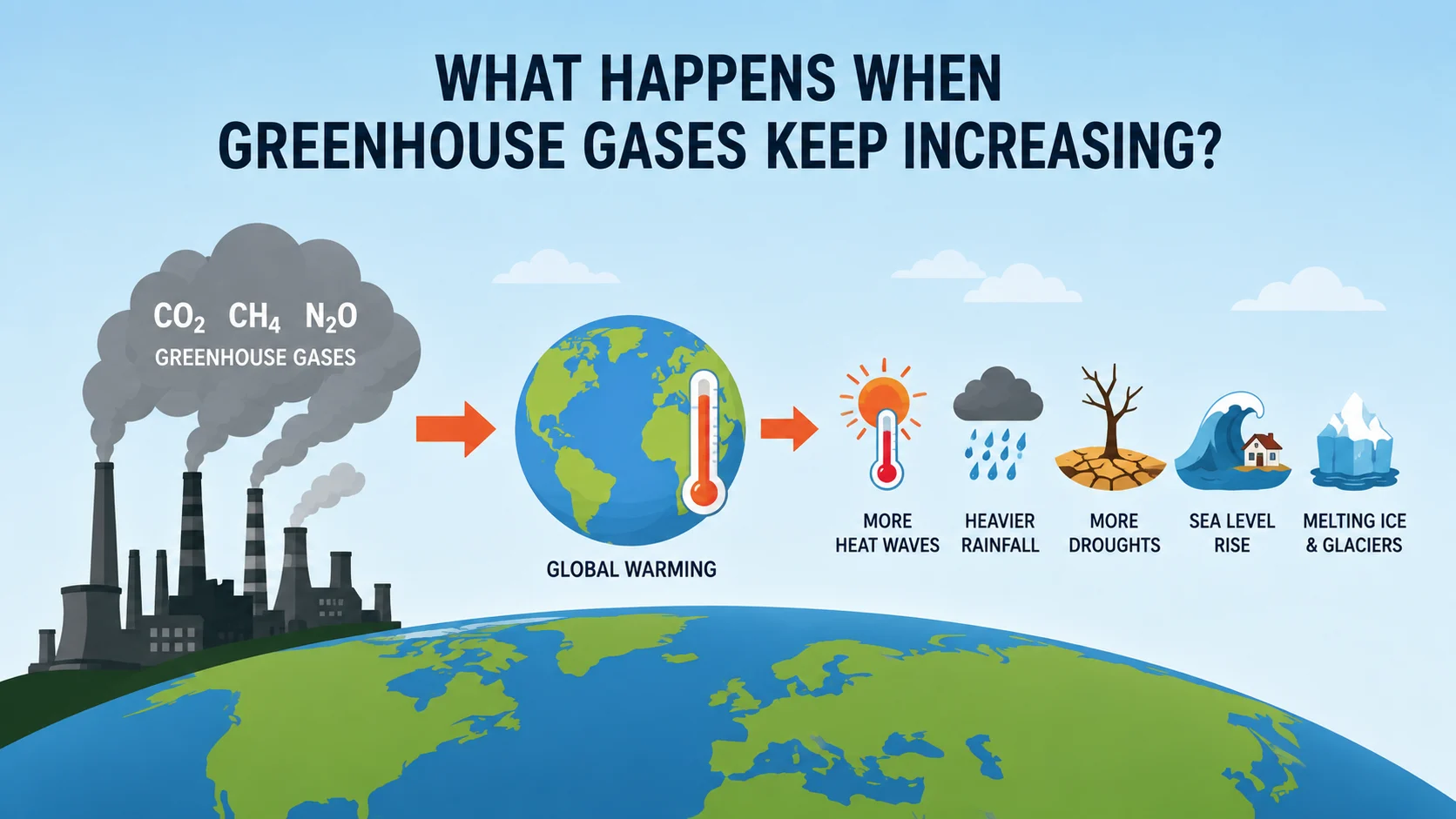

When greenhouse gas levels keep rising, Earth does not simply become a little warmer everywhere. The additional warming changes how heat, water and energy move through the atmosphere, oceans and land, which can affect heat extremes, rainfall, drought risk, ice loss, sea level and ecosystems in different ways around the world.
These effects begin with a change in Earth’s energy balance. Greenhouse gases such as carbon dioxide and methane reduce the rate at which some infrared energy escapes to space. As their concentrations increase, more energy accumulates in the climate system until warming increases the amount of energy leaving Earth again.
The greenhouse effect itself is not something Earth would be better without. It is a natural process that keeps the planet warm enough for the conditions in which modern life developed, as explained in our guide to why Earth needs the greenhouse effect. The concern is the additional warming that occurs when greenhouse gas concentrations continue rising.
What changes first when greenhouse gases increase?
The most direct climate response is warming but most of the additional energy does not remain in the air immediately above us.
The oceans absorb the majority of the excess heat accumulating in the climate system. The IPCC estimated that ocean warming accounted for about 91% of climate-system heating between 1971 and 2018, while smaller shares went into warming the land and atmosphere and melting ice.
This matters because global surface temperature is only one sign of a larger energy imbalance. A warmer ocean, shrinking ice and changing atmospheric temperature can continue influencing climate even when the change in global average air temperature sounds numerically modest.
The warming is also uneven. Land generally responds differently from oceans, high latitudes differently from the tropics and regional weather patterns can either strengthen or offset some local changes. Someone living in one particular city should therefore not expect the local temperature trend to match the global average exactly.
What the global average tells us is that the climate system as a whole is gaining heat.
Why do heat waves become more likely in a warmer climate?
Heat waves offer one of the clearest examples of how a change in the average can alter extremes.
Weather still moves naturally between cooler and hotter conditions from day to day and year to year. When the underlying climate becomes warmer, however, those fluctuations occur around a higher average temperature. A weather pattern that once produced an unusually hot day can therefore produce an even hotter one under warmer background conditions.
The IPCC concludes that hot extremes, including heat waves, have become more frequent and more intense across most land regions since the 1950s and that human influence is the main driver of this overall change. It also finds that additional warming produces further increases in the frequency and intensity of hot extremes.
This does not mean every place warms at the same rate or experiences heat in the same way. Humidity, urban development, vegetation, altitude and local weather patterns all affect how dangerous a heat event becomes.
Cities can face a particular challenge because buildings, roads and other surfaces often retain heat. A hotter background climate combined with the urban heat-island effect can make periods of extreme heat more difficult to manage, especially where buildings and infrastructure were designed for cooler conditions.
How can warming lead to heavier rain in some places and more drought in others?
The water cycle becomes more active as the climate warms but that does not translate into the same rainfall change everywhere.
Warmer conditions increase evaporation from oceans, lakes, soils and vegetation. Warmer air can also contain more water vapor, which means storms can have access to more atmospheric moisture when the right weather conditions develop.
This helps explain why heavy precipitation can become more intense even though some regions also experience increasing drought risk. The IPCC reports that the frequency and intensity of heavy precipitation have increased over much of the land area where observations are sufficient, with human-caused climate change likely the main driver of the observed global pattern.
Drought involves a different combination of influences. Higher temperatures can remove moisture from soils more quickly through evaporation and plant water loss. If rainfall also decreases, becomes less reliable or arrives at different times of year, dry conditions can become more severe.
In some regions, this can produce the seemingly strange situation in which intense rainfall becomes stronger while dry periods between rainfall events also become more problematic. A climate with heavier downpours does not necessarily provide more dependable water for soils, reservoirs or agriculture.
The details vary considerably by region, which is why broad claims that global warming will make everywhere simply “wetter” or “drier” are misleading.
Why are the oceans so important to what happens next?
The oceans slow the rate at which surface temperatures respond because water can absorb and store enormous amounts of heat. That buffering effect is useful in the short term, but the heat does not disappear simply because it enters the ocean.
As seawater warms, it expands. This thermal expansion contributes to global sea-level rise. Warming also contributes to the loss of glaciers and large ice sheets on land, adding more water to the oceans.
The IPCC found that thermal expansion accounted for about half of global mean sea-level rise between 1971 and 2018, with glaciers and ice sheets contributing much of the rest.
Sea-level rise can sound gradual when expressed as a global average, but its practical importance is often seen during high tides and coastal storms. A storm surge beginning from a higher baseline can push water farther inland than a similar event would have in the past.
Local sea level does not rise identically along every coast. Ocean circulation, gravitational effects, sinking or rising land and other regional processes influence what individual communities experience. Nevertheless, the IPCC projects that relative sea level will continue rising along most coastlines during this century.
The ocean also absorbs part of the carbon dioxide released into the atmosphere. That moderates the atmospheric increase somewhat, but dissolved CO₂ changes seawater chemistry and contributes to ocean acidification. This is not the same process as greenhouse warming, although both ultimately arise from increasing carbon dioxide.
What happens to glaciers, snow and ice as temperatures rise?
Ice responds to both temperature and precipitation, so the details differ between glaciers, ice sheets, sea ice and seasonal snow. The broad pattern, however, is that sustained warming makes it more difficult for many frozen parts of the climate system to maintain their previous extent.
Mountain glaciers lose mass when melting and other losses exceed the amount of new ice added through snowfall. The IPCC reports that the widespread retreat of glaciers since the 1950s is unusual in the context of at least the past two thousand years.
Loss of land ice contributes directly to sea-level rise because water that was previously stored on land enters the ocean. Floating sea ice behaves differently because it is already displacing seawater, so its melting has little direct effect on sea level.
Snow and ice also influence the amount of sunlight Earth absorbs. Bright surfaces reflect a relatively large share of incoming solar energy, while darker ocean and land surfaces absorb more of it. When ice or snow disappears and exposes a darker surface beneath, additional solar energy can be absorbed, reinforcing some of the original warming.
Changes in mountain snow and glaciers can also affect freshwater supplies because many river systems depend partly on seasonal snowmelt or glacier melt. The consequences depend heavily on the region and on how much local communities rely on those natural stores of frozen water.
How does continued warming affect ecosystems?
Species are adapted to combinations of temperature, rainfall, seasonal timing, food availability and interactions with other organisms rather than to temperature alone.
When the climate shifts, some species can move toward cooler areas, higher elevations or different depths in the ocean. Others may have nowhere suitable to move, particularly when their habitat is already fragmented by cities, agriculture or other human land use.
Changes in seasonal timing can create additional problems. Flowering, insect emergence, migration and breeding may respond differently to warming, which can alter relationships between species that previously depended on one another appearing at similar times.
Marine ecosystems face their own combination of pressures. Warmer oceans can contribute to marine heat waves and coral bleaching, while carbon dioxide absorbed directly by seawater causes ocean acidification.
Climate change is not the only threat ecosystems face, and it would be misleading to treat every ecological decline as a greenhouse-gas problem. Habitat loss, pollution, overharvesting and invasive species remain major pressures in many places.
The concern is that warming adds another persistent stress. The IPCC concludes that risks to biodiversity and ecosystems generally increase with each additional increment of global warming.
What can these changes mean for food and water?
Food production is particularly sensitive to climate because agriculture depends on suitable temperature ranges, reliable water, soil conditions and the timing of seasons.
Warming does not affect every crop negatively in every location. Some cooler regions can experience longer growing seasons, and higher carbon dioxide concentrations can stimulate photosynthesis in some plants under suitable conditions.
Those potential advantages do not operate in isolation, however. Extreme heat can damage crops during sensitive stages of development, drought can reduce available water, heavy rain can flood fields, and warmer conditions can affect pests and plant diseases.
Water supplies can be influenced by many of the same processes. Changes in rainfall, snowpack, evaporation and glacier melt can alter when and where freshwater becomes available even if the annual amount of precipitation does not change dramatically.
This is why climate risks to food and water tend to be discussed in regional terms rather than as one universal global outcome. The same amount of warming can create very different challenges in an irrigated dry region, a humid tropical area and a cooler agricultural zone.
Does climate change cause every flood, wildfire or hurricane?
An individual extreme event usually develops from several causes, so it is rarely useful to ask whether climate change was the sole cause.
A flood can depend on rainfall, soil moisture, river levels, drainage systems, urban development and local geography. Wildfire risk involves temperature and dryness but also vegetation, ignition sources, winds and land management. Tropical cyclones depend on ocean conditions and atmospheric circulation as well as the broader warming climate.
Climate change can alter some of those background conditions without replacing all the other causes.
For example, warmer air can provide more moisture for heavy rainfall, higher temperatures can increase drying in some regions, and sea-level rise can worsen coastal flooding during storms. NASA notes that human-caused warming is already influencing heat extremes, heavy rain, drought and other forms of extreme weather, although the strength and nature of the relationship differ by event and location.
Modern event-attribution studies therefore tend to ask how climate change altered an event’s likelihood or intensity rather than trying to classify an event as simply “caused by climate change” or “not caused by climate change.”
That distinction produces a much more realistic picture of how a changing climate interacts with ordinary weather.
Why does each additional amount of warming matter?
Climate change does not operate like a switch that suddenly turns dangerous at one exact global temperature.
Different systems have different thresholds and sensitivities. Additional warming can increase the number of days exceeding dangerous heat levels, raise the amount of moisture available during heavy rainfall, add more heat to the oceans and increase long-term ice loss.
The IPCC therefore emphasizes that climate-related risks and projected damages generally rise with each additional increment of global warming. Higher warming levels expose more natural and human systems to greater risks, although the rate of increase differs depending on the impact being considered.
This also means that future outcomes are not fixed. A world that experiences less additional warming does not face exactly the same level of risk as one that warms considerably more.
Greenhouse-gas emissions matter because their cumulative effect influences how much additional warming occurs. Reducing emissions cannot reverse every change immediately, especially where oceans and ice sheets respond slowly, but it can limit the amount of further warming and reduce many future risks compared with higher-emissions pathways.
Why can a small increase in a greenhouse gas lead to such broad effects?
The atmosphere is only one part of an interconnected climate system. Once greenhouse gases alter Earth’s energy balance, the additional energy can affect oceans, ice, rainfall, ecosystems and weather extremes through processes that interact with one another.
Carbon dioxide is a good example because its concentration appears small when compared with nitrogen and oxygen, yet its molecular properties allow it to affect outgoing infrared radiation. If that part of the science seems surprising, our separate explanation of how about 0.04% CO₂ can contribute to global warming looks specifically at why atmospheric percentage alone does not determine a gas’s climate influence.
The consequences of rising greenhouse gases therefore extend beyond a simple increase in the number shown on a thermometer. Continued warming changes the background conditions in which oceans circulate, water evaporates and falls as rain, ice accumulates or melts, and plants, animals and human systems operate.
Those changes are not identical everywhere, and not every flood, drought or storm can be attributed solely to climate change. The broader evidence shows, however, that additional greenhouse-gas-driven warming increases a range of climate risks, with many of those risks becoming larger as warming increases.
