
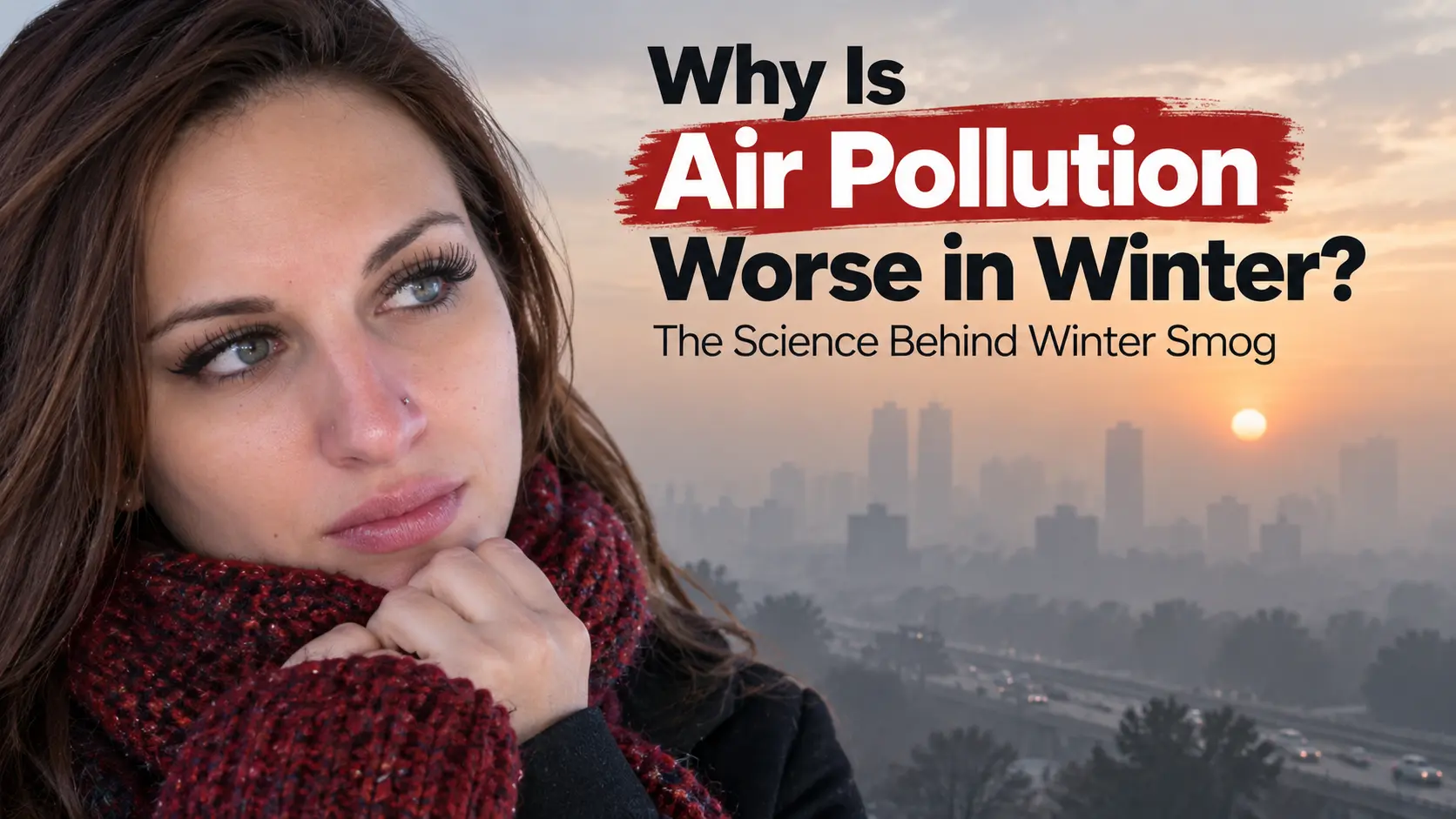

Air pollution often gets worse in winter because the atmosphere becomes less effective at dispersing emissions. Cold, stable air can remain trapped beneath warmer air in a temperature inversion, while weak winds and a shallow mixing layer allow PM2.5, smoke, nitrogen oxides and other pollutants to build up near the ground.
- Temperature inversion: Cold surface air gets trapped beneath warmer air above.
- Stagnant dispersion: Weak winds and limited vertical mixing keep pollutants concentrated close to where people breathe.
The Cold Air Paradox
Winter pollution can seem strange at first. Cars still run, factories still operate and many emission sources continue throughout the year. So why can the air suddenly become much hazier when temperatures fall?
The answer is that air quality depends not only on how much pollution is released but also on how effectively the atmosphere can dilute and transport it.
In warm, sunny weather, the ground heats the air above it. That air rises, helping pollutants mix through a deeper part of the atmosphere. Winter often produces the opposite conditions: weaker surface heating, longer nights, calmer air and a shallower atmospheric boundary layer.
That is one major reason why winter air feels polluted. In places such as the Indo-Gangetic Plain, emissions can remain high throughout the year, but winter weather sharply reduces atmospheric ventilation.
The Atmospheric “Lid”
Under normal daytime conditions, temperature usually decreases with height through the lower atmosphere. Sunlight warms the ground, which then warms the air immediately above it. That warmer air rises and mixes with cooler air higher up, helping disperse pollutants.
A temperature inversion reverses part of this pattern.
Instead of warmer air remaining near the surface, cold, dense air becomes trapped close to the ground beneath a relatively warmer layer above. Because the cold air cannot rise easily through that warmer layer, pollution can accumulate near the surface.
The process can be understood in three steps:
- Normal Daytime Gradient: Sunlight warms the ground. Air near the surface becomes warmer, rises and encourages vertical mixing. Pollutants are spread through a larger volume of air.
- Winter Night Radiational Cooling: Long winter nights allow the ground to lose heat quickly. Air touching the cold surface cools too, while air slightly higher may remain warmer.
- Trapped Boundary Layer: The warmer layer above suppresses upward movement of the colder surface air. Emissions continue entering the atmosphere, but they are now being released into a much smaller volume.
This connection between temperature inversion and air pollution helps explain why AQI is worse in winter in many cities.
An inversion does not create pollution. It traps and concentrates pollution that is already being emitted.
When an inversion persists for many hours, pollutants can continue building until stronger winds, daytime heating, rain or another weather change breaks the stable layer.
This temporary trapping of polluted air near the surface is different from the greenhouse effect that keeps Earth warm. The greenhouse effect involves gases such as carbon dioxide, methane and water vapor absorbing and re-emitting infrared energy, while a temperature inversion is a local atmospheric structure in which warmer air sits above colder surface air and suppresses vertical mixing.
Summer Air vs. Winter Air Dynamics
The difference between summer and winter pollution is largely a difference in atmospheric ventilation. Exact boundary-layer heights vary by location, weather, terrain and time of day, but the seasonal contrast can be large.
| Atmospheric Condition | Summer Dynamics | Winter Dynamics |
|---|---|---|
| Boundary Layer Height | Often high, roughly 1,000–3,000 m during strongly mixed daytime conditions | Can fall to only a few hundred metres during strongly stable pollution episodes |
| Wind Speed & Dispersion | Stronger vertical mixing helps dilute pollutants | Weak winds and stagnation allow pollutants to accumulate |
| Humidity & Particle Growth | Often lower relative humidity in hot, well-mixed conditions | Fog and high humidity can increase particle water uptake and worsen haze |
These values are illustrative, not universal.
What matters for why pollution is worse in winter than summer is that winter can provide a much smaller volume of air in which emissions are diluted.
Why PM2.5 Increases and Smog Forms in Cold Months
PM2.5 refers to airborne particles with diameters of about 2.5 micrometres or smaller. Some are emitted directly from combustion, traffic, industry, fires, and dust, while others form in the atmosphere through chemical reactions.
Winter conditions can increase PM2.5 concentrations because several processes happen at the same time.
The Moisture Factor
Many atmospheric particles are hygroscopic, meaning they absorb water from humid air.
As relative humidity rises, these particles can take up moisture and grow larger. This can dramatically increase the amount of light they scatter, making winter haze appear thicker and more visible.
Fog droplets can also act as tiny liquid environments where dissolved gases undergo chemical reactions. In polluted air, fog is therefore not simply clean water floating in the atmosphere. It can become part of the chemical system that transforms gases into particulate material.
High humidity alone does not create pollution but it can intensify the visible haze and alter particle chemistry.
Chemical Trapping of Vehicle & Biomass Emissions
Vehicles, industry, power generation, biomass burning, household fuels, and agricultural fires release gases such as nitrogen oxides, sulfur compounds, ammonia, volatile organic compounds, and other combustion products.
These gases can react in the atmosphere and form secondary particulate matter, including nitrate, sulfate, and organic aerosol.
Cool temperatures can favor the particle phase for some compounds, while weak dispersion keeps pollutant gases concentrated in the same layer for longer periods.
That allows atmospheric chemistry more time to transform them.
Science Alert: Secondary Organic Aerosols (SOAs)
High humidity should not be treated as a simple switch that automatically creates secondary organic aerosol.
SOA formation depends on VOC chemistry, oxidants, temperature, existing particles, and atmospheric processing. However, humid and foggy conditions can enhance aqueous-phase chemistry and aerosol water uptake, while lower temperatures can affect how some semi-volatile compounds divide between gases and particles.
Winter smog is therefore the result of emissions + atmospheric chemistry + moisture + poor ventilation, not fog alone.
This combination helps explain both why PM2.5 increases in winter and why smog forms in winter.
Why Landlocked Plains Suffer Most
Meteorology does not act alone. Geography can strongly influence how easily polluted air leaves a region.
The Indo-Gangetic Plain is an important example. It contains dense cities, major roads, industries, agriculture, residential combustion, and many other pollution sources. During winter and the post-monsoon season, weak winds, temperature inversions, and shallow boundary layers can make ventilation extremely poor.
Several factors can amplify the problem:
- Himalayan Barrier Effects: The Himalayas influence regional circulation and can limit ventilation toward the north. They do not create an airtight pollution basin, but surrounding topography can contribute to poor dispersion.
- Agricultural Biomass Timing: Post-harvest crop-residue burning in parts of northern India often peaks during October and November, adding smoke during a period when atmospheric dispersion is already weakening.
- Calm Wind Basins and Plains: Weak winds reduce horizontal transport, while shallow boundary layers reduce vertical transport. Pollutants therefore remain concentrated over populated areas for longer.
This is why North India has winter air pollution that cannot be explained by one source alone.
Traffic, industry, agriculture, residential burning, regional transport, geography and winter weather all interact.
Human & Emissions Factor
Weather creates the atmospheric trap, but human activity provides the pollutants that accumulate inside it.
Three sources can become especially important during winter and the post-monsoon period:
- Space Heating & Localized Biomass Burning: In places where wood, coal, crop residue, or other solid fuels are burned for heating, winter can add extra combustion emissions on top of existing traffic and industrial pollution.
- Cold Engine Starts: Vehicle emissions can be higher immediately after startup when the engine and emission-control systems are still cold. This effect varies by vehicle type and pollutant, but low temperatures can increase some VOC, hydrocarbon, and carbon-monoxide emissions.
- Stubble Burning & Agricultural Residue Clearing: Seasonal agricultural fires can release large amounts of smoke over a short period. In northern India, this often overlaps with October–November weather conditions that are becoming increasingly unfavorable for dispersion.
The distinction is important:
Meteorology controls how well pollution disperses. Emissions determine how much pollution enters the atmosphere in the first place.
Understanding Winter Smog Beyond the Surface
Winter air pollution is not simply caused by cold weather. It develops when emissions, stagnant weather, atmospheric chemistry, humidity, and geography combine in a way that keeps pollutants concentrated near the surface.
The Winter Pollution Formula
- High emissions provide PM2.5 and pollutant-forming gases.
- Low mixing height and weak winds reduce the volume of air available for dilution.
- Temperature inversions suppress vertical movement and trap polluted air near the ground.
Simplified conceptual model:
This is not a literal atmospheric equation but it captures the basic mechanism clearly.
Cold weather itself is not pollution. The real problem begins when a stable winter atmosphere acts like a lid over areas where large amounts of pollutants are already being released.
That is the core reason why air pollution is worse in winter—and why the same city can have relatively clear air one week and dense smog the next even though many of its everyday emission sources have not changed dramatically.

1 thought on “Scientific Reasons Air Pollution Gets Worse in Winter In India”