
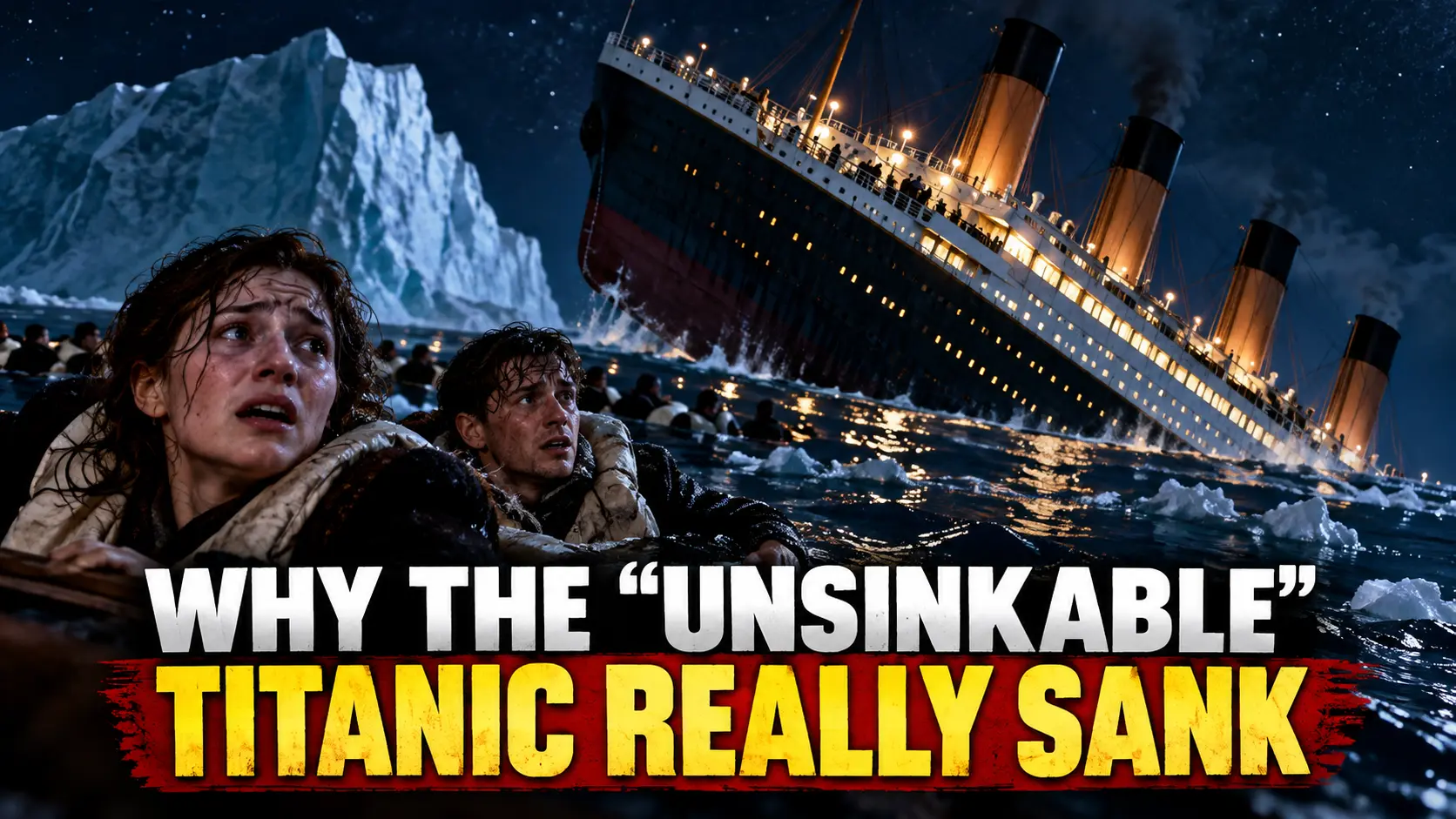

When RMS Titanic left Southampton on April 10, 1912, it represented everything people admired about the modern age. It was enormous, luxurious and technologically impressive, with elegant dining rooms, electric lighting, powerful engines and a system of watertight compartments designed to make the ship remarkably safe.
Four days later, that confidence was shattered. Late on the night of April 14, Titanic struck an iceberg in the North Atlantic and less than three hours later, at about 2:20 a.m. on April 15, the ship disappeared beneath the ocean. More than 1,500 passengers and crew lost their lives.
The iceberg caused the physical damage, but the disaster was not simply the result of bad luck or an unavoidable encounter with nature. A series of decisions and safety weaknesses made the consequences far worse, including high speed in an ice region, inadequate lifeboat capacity and serious communication failures.
Titanic had received warnings about ice before the collision. Some lifeboats later left with empty seats, while a nearby ship saw rockets but failed to understand the emergency quickly enough. The disaster became a powerful example of how advanced technology can still fail when human systems around it are not prepared for the unexpected.
Titanic’s Final Hours
The most important events of the Titanic disaster unfolded in roughly two hours and forty minutes. During that short period, the ship moved from what seemed like a manageable collision to an irreversible catastrophe.
| Time | Event | What Happened |
|---|---|---|
| Just before 11:40 PM | Iceberg spotted | Lookouts finally saw an iceberg directly ahead. The night was extremely dark and the sea unusually calm, making ice more difficult to identify from a distance. |
| 11:40 PM | Collision | The crew attempted to avoid the iceberg, but Titanic was too close. The iceberg scraped along the starboard side and opened multiple sections of the hull to flooding. |
| Around midnight | Extent of damage becomes clear | Officers and shipbuilder Thomas Andrews examined the damage. It soon became clear that Titanic could not remain afloat. |
| Around 12:15 AM | Distress messages begin | Titanic’s wireless operators started transmitting CQD and later SOS distress calls to nearby ships. |
| Around 12:45 AM | First lifeboat lowered | Evacuation was underway, but several early lifeboats left with unused seats. |
| 2:20 AM | Titanic disappears | After the bow sank deeper and the hull broke apart, Titanic slipped beneath the North Atlantic. |
Titanic’s watertight compartment system was one of the reasons the ship was considered exceptionally safe. The vessel could survive flooding in a limited number of compartments but the iceberg damaged too many sections of the ship at once.
As water entered the forward compartments, the bow gradually sank lower. The tops of the watertight bulkheads did not extend high enough to completely isolate every flooded section as the ship tilted forward, allowing water to spill progressively from one compartment into the next.
At that point, the ship’s pumps could slow the flooding but could not save the vessel. Once the forward compartments were overwhelmed, Titanic’s fate was effectively sealed.
1. Ice Warnings Ignored
One of the most important questions surrounding the disaster is why Titanic continued travelling so quickly through an area where other ships had reported ice. Throughout April 14, several wireless messages warned of icebergs and large areas of field ice in the North Atlantic.
Some warnings reached Captain Edward Smith and other officers. Other messages were handled by Titanic’s wireless operators, who were also busy transmitting private passenger communications.
Wireless communication was still relatively new aboard passenger liners. Operators were employed primarily to send and receive commercial messages for passengers, although they also passed navigational information to the bridge.
One particularly important warning came from the Mesaba, which reported heavy pack ice and numerous large icebergs in Titanic’s path. Evidence suggests that this message did not reach the bridge before the collision.
Despite the growing number of reports, Titanic continued travelling at roughly 21 to 22 knots. Later investigations criticized the decision to maintain such speed in an area where ice had been reported.
However, one popular Titanic story deserves correction. Titanic was not racing across the Atlantic in an attempt to break a speed record and there is little solid evidence supporting that claim.
Titanic was not designed to compete directly with the fastest Atlantic liners of the period. White Star Line generally promoted comfort and luxury rather than pure speed.
The more realistic explanation is arguably more revealing. At the time, maintaining speed in clear weather despite receiving ice warnings was not considered as extraordinary as it would be today, because experienced captains often expected lookouts to detect dangerous ice in time.
On the night Titanic sank, those assumptions failed. The sea was unusually calm, there were few waves breaking around the iceberg and there was no bright moon to illuminate the horizon.
The iceberg therefore blended into the dark background until Titanic was extremely close. By the time the lookout spotted it, there was very little time left to react.
2. The Nearby SS Californian Failure
Another disturbing part of the Titanic story involves the SS Californian. The ship had stopped for the night because its crew had encountered heavy ice.
Titanic’s wireless operator had communicated with Californian earlier that evening. However, Californian’s only wireless operator eventually turned off his equipment and went to sleep.
When Titanic began transmitting distress messages after midnight, Californian was no longer listening. This became especially important because officers aboard the ship later saw lights and rockets from another vessel on the horizon.
Titanic was firing rockets as distress signals. Californian’s officers reported the rockets to Captain Stanley Lord but no urgent rescue operation followed.
Popular retellings sometimes claim the crew thought Titanic’s rockets were simply fireworks from a party. The real evidence is less clear than that dramatic version suggests.
What is clear is that the rockets were not treated with the urgency the situation required. Officers attempted to communicate with the distant ship using a Morse lamp, but they received no clear response.
Californian’s wireless operator was not immediately awakened to investigate. Only later did the crew learn that Titanic had sunk.
Exactly how far Californian was from Titanic remains debated. Contemporary investigations concluded that the ship was likely close enough that a faster response might have made a difference, although historians continue to discuss the precise distance and circumstances.
The episode remains one of the most important communication failures linked to the disaster. It shows how uncertainty and delayed interpretation of warning signs can have serious consequences during an emergency.
3. Titanic Did Not Have Enough Lifeboats
The most obvious safety weakness aboard Titanic was painfully simple: there were not enough lifeboat spaces for every passenger and crew member. Titanic carried 20 lifeboats with a combined capacity of approximately 1,178 people.
More than 2,200 passengers and crew were aboard the ship. Even if every lifeboat had been filled to its maximum rated capacity, hundreds of people would still have had no place in a boat.
Surprisingly, Titanic was not violating the British lifeboat regulations of the time. The problem was that the regulations were outdated and had not kept pace with the rapidly increasing size of passenger ships.
Lifeboat requirements were partly based on a ship’s tonnage and had been written during an era when vessels were far smaller. Titanic actually carried more lifeboat capacity than the minimum regulations required but the legal standard was still inadequate for the number of people aboard.
The shortage became even more tragic because some early lifeboats were lowered without being filled. Several factors contributed to this, including passenger reluctance, confusion and uncertainty about the boats’ carrying capacity.
At first, many passengers struggled to believe the ship was actually sinking. Titanic still appeared stable, its lights remained on and moving from a massive illuminated liner into a small open boat suspended above a freezing ocean did not feel safer.
Some crew members were also uncertain about how much weight the lifeboats could safely carry while being lowered from the upper decks. As a result, several boats left with unused spaces.
As the seriousness of the situation became undeniable, attitudes changed. By then, the ship was sinking more rapidly, panic was increasing and there were no longer enough boats remaining.
The lifeboat shortage transformed a serious maritime accident into a catastrophe. It remains one of the clearest examples of regulations failing to keep pace with technological progress.
4. Emergency Evacuation Problems
Titanic’s crew did not simply stand still after seeing the iceberg. First Officer William Murdoch reacted almost immediately and ordered the ship to turn while action was also taken with the engines.
The problem was distance. Titanic was travelling quickly, the iceberg had been detected very late, and a ship more than 260 metres long could not instantly change direction.
The collision occurred only seconds after the iceberg was spotted. For that reason, the popular claim that Titanic sank because the crew became confused over steering commands is too simplistic.
The larger problems appeared after the collision. Emergency preparation aboard the ship was far from ideal and a lifeboat drill that had been expected on April 14 did not take place.
Historical testimony confirms that the scheduled drill was omitted, although the surviving evidence does not firmly establish that Captain Smith personally cancelled it or why it was missed. That distinction matters because the documented failures are serious enough without adding uncertain claims.
Many passengers did not immediately understand the evacuation instructions. Some remained inside the ship, while others were reluctant to enter lifeboats because they still believed Titanic was safer.
Crew members had to uncover the boats, swing them outward, organize passengers and lower them over the side while the ship slowly changed angle beneath their feet. This was a difficult process even under ideal conditions.
The first lifeboat was lowered roughly an hour after the iceberg strike. Eventually, the crew managed to launch nearly all of Titanic’s usable lifeboats before the ship disappeared.
The evacuation still failed to use the available capacity efficiently. Early boats carried empty seats while hundreds of people later found themselves trapped aboard a sinking ship.
It was not one single mistake that caused this outcome. Inadequate preparation, limited lifeboat capacity, passenger disbelief, uncertainty among crew members and rapidly worsening conditions all contributed to the tragedy.
Titanic’s “Unsinkable” Reputation
Titanic was often described as practically unsinkable before the disaster, although the exact phrase has sometimes been exaggerated in later retellings. The more important issue was the wider culture of confidence surrounding the ship.
Titanic and her sister ships represented a major achievement in engineering. Watertight compartments, remotely operated doors, powerful pumps and massive steel construction made the vessel appear extraordinarily secure.
That confidence may also have shaped how people reacted after the collision. Some passengers initially hesitated to leave because the ship beneath them still looked safer than a lifeboat.
Even after the collision, the situation did not immediately look catastrophic from the upper decks. There was no dramatic explosion, the lights remained on and the ship sank gradually at first.
That made the danger difficult for many passengers to accept. By the time the scale of the emergency became obvious, valuable evacuation time had already disappeared.
Discovery of the Titanic Wreck
For decades after the sinking, nobody knew exactly where Titanic rested. The wreck lay thousands of metres below the North Atlantic, beyond the practical reach of early twentieth-century exploration technology.
That changed in 1985 when a joint American-French expedition led by Robert Ballard and Jean-Louis Michel located Titanic on the seabed. The wreck was found on September 1 at a depth of roughly 3,800 metres.
The discovery also provided important physical evidence about Titanic’s final moments. For years, witnesses and researchers had debated whether the ship actually broke apart while sinking.
The wreck settled that question. Titanic’s bow and stern were found separated from each other on the ocean floor, surrounded by a large debris field containing pieces of the ship and personal objects from passengers and crew.
The bow remains relatively recognizable today. The stern suffered far more violent structural damage during its descent to the seabed and is considerably more fragmented.
Is the Titanic Wreck Disappearing?
Titanic is slowly deteriorating after spending more than a century on the ocean floor. Salt water, deep-ocean currents, chemical reactions and microorganisms are all contributing to the gradual breakdown of the wreck.
One of the most distinctive features covering parts of the ship is known as a rusticle. These formations resemble underwater icicles and are associated with microorganisms that interact with the iron in the wreck.
This has produced a popular claim that metal-eating bacteria will completely consume Titanic within only a few years. That prediction is too certain.
Scientists know the wreck is deteriorating and some sections have already collapsed. However, predicting exactly when recognizable parts of Titanic will disappear is extremely difficult.
Biological activity is only one factor affecting the wreck. Corrosion, structural stress, ocean conditions, the age of the metal and natural deterioration are all contributing to its gradual collapse.
Titanic will continue changing over time. There is no scientifically reliable countdown to a specific year when the entire wreck will suddenly vanish.
Real Lesson of Titanic
More than a century later, Titanic remains one of the world’s most famous disasters because its story still feels surprisingly modern. The ship represented confidence in technological progress and was one of the largest and most impressive machines of its era.
Its designers had created sophisticated safety systems for the period, but the disaster revealed weaknesses outside the machinery itself. Ice warnings did not produce enough caution, lifeboat regulations had not kept pace with ship size and a nearby vessel failed to understand the importance of Titanic’s distress signals.
Some available lifeboat seats were also left empty, while emergency preparation was imperfect. None of these problems alone explains the entire disaster.
Together, however, they created the conditions in which an iceberg strike became one of history’s deadliest peacetime maritime disasters. Titanic’s legacy is therefore not simply that no ship is truly unsinkable.
The deeper lesson is that technology can reduce risk, but it cannot replace judgment, communication, preparation and sensible safety rules. Even the most impressive engineering remains dependent on the people and systems responsible for using it safely.
