

Nitrogen is naturally present in soil, air, plants, animals and water, so small amounts of nitrogen in a river, lake or groundwater supply are not automatically a sign of pollution. Problems begin when human activities add more reactive nitrogen than plants, soils, microorganisms and aquatic systems can naturally absorb or transform.
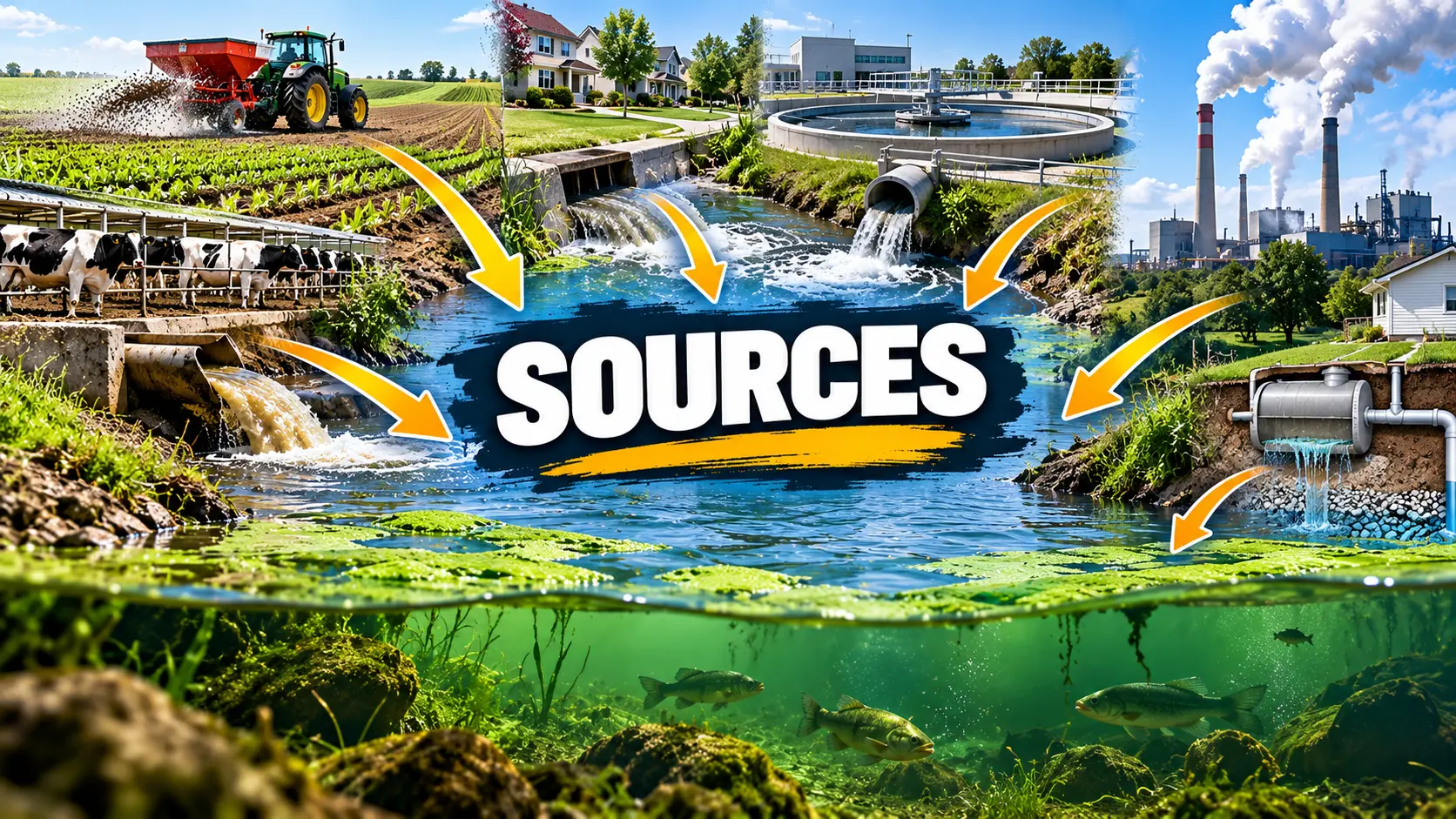
So, where does nitrogen in water come from? In most cases, it reaches waterways through a combination of agricultural runoff, animal waste, wastewater, septic systems, urban drainage, industrial activity and atmospheric deposition.
Some of these sources enter water through an identifiable discharge, while others are spread across entire landscapes and move with rainfall, irrigation, drainage, or groundwater flow.
7 Common Sources of Nitrogen in Water
- Synthetic crop fertilizers — excess nitrogen can wash from fields or leach through soil into groundwater.
- Livestock waste and runoff — manure can release ammonium, nitrate and organic nitrogen.
- Municipal wastewater discharge — treated effluent may still contain nitrogen compounds.
- Failing or inadequate septic systems — wastewater nitrogen can move through soil toward groundwater.
- Lawn fertilizers and urban runoff — rain can carry nutrients from developed areas into storm drains and streams.
- Industrial effluents — some manufacturing and processing wastewater contains nitrogen-rich compounds.
- Atmospheric deposition — nitrogen compounds released into the air can return to land and water through rain or dry deposition.
The route matters because nitrogen pollution is easier to control when its source is understood. A leaking septic system, a fertilized field and a wastewater outfall can all raise nitrogen levels but each requires a different response.
Point vs. Nonpoint Sources
Nitrogen generally reaches water through two broad pathways: point sources and nonpoint sources.
A point source comes from an identifiable discharge, such as a wastewater pipe or certain industrial outlets. Because the source can be located directly, it is often easier to monitor and regulate.
A nonpoint source is more diffuse. Instead of coming from one pipe, nitrogen moves across or through the landscape with rainfall, irrigation, drainage, groundwater movement or atmospheric deposition.
Agricultural fields, residential lawns and broad urban areas can all contribute nonpoint pollution. This is one reason nitrate contamination can be difficult to trace, especially when several sources overlap within the same watershed.
Agricultural Sources
Agriculture is one of the most important human sources of nitrogen entering water, particularly in areas dominated by crop production or intensive livestock farming. Nitrogen is added deliberately because crops need it but plants do not always absorb everything that is applied.
Rainfall, irrigation, fertilizer timing, soil conditions, crop demand and drainage all influence how much nitrogen remains in the soil and how much is eventually lost to nearby water.
1. Synthetic Crop Fertilizers
Nitrogen fertilizers provide crops with nutrients needed for growth. After application, nitrogen may be present in forms such as ammonium or nitrate and crops absorb much of it through their roots.
Problems develop when more nitrogen is available than plants can use. Nitrate is especially important because it dissolves easily in water and can move downward through soil with rainfall or irrigation.
Once nitrate passes below the root zone, it may eventually reach groundwater, private wells, springs or groundwater-fed streams. Nitrogen can also leave fields through surface runoff or agricultural drainage systems.
The amount lost depends on factors such as application rate, timing, soil type, rainfall, irrigation and crop uptake. Fertilizer use does not automatically cause pollution but poor timing or excessive application can increase the risk significantly.
2. Livestock Waste and Runoff
Animal manure contains nitrogen because livestock excrete nitrogen that was originally present in their feed. Depending on storage conditions and environmental processes, manure can contain organic nitrogen, ammonium, ammonia and nitrate.
When manure is properly stored and applied to farmland at rates crops can use, much of its nutrient value can be recycled. Problems develop when excessive amounts are applied, storage systems leak or rainfall carries manure-contaminated material toward nearby streams and rivers.
Large livestock operations can concentrate substantial quantities of manure in a small area. Lagoons, storage areas, feedlots and land-application fields therefore need careful management to prevent nitrogen losses.
Nitrogen from manure can also move downward through soil and contaminate groundwater, which makes the problem less visible than obvious surface runoff.
Urban and Residential Pathways
Nitrogen pollution is not limited to farms. Cities, suburbs, towns and individual homes can release nitrogen through wastewater, septic systems, lawn fertilizer, stormwater and other everyday activities.
Urban watersheds are often complicated because many small sources can operate at the same time. Rain can carry nutrients from lawns and streets while wastewater and septic systems contribute additional nitrogen through separate pathways.
3. Municipal Wastewater Discharge
Human waste naturally contains nitrogen. When sewage reaches a wastewater treatment plant, biological and chemical processes remove or transform part of that nitrogen before the water is discharged.
However, conventional treatment does not always remove all nitrogen. Depending on the treatment process, the final effluent may still contain nitrate, ammonium, nitrite, organic nitrogen or a mixture of these forms.
Facilities with advanced nutrient-removal systems can reduce nitrogen more effectively before discharge. Even properly treated wastewater may still contribute nitrogen to rivers, lakes or coastal waters if nutrient removal is limited.
This is why treated wastewater should not automatically be assumed to be nitrogen-free.
4. Failing Septic Systems
Homes that are not connected to centralized sewer systems often rely on septic tanks and drain fields. Household wastewater enters the septic tank, solids settle and the remaining liquid moves into the surrounding soil for further treatment.
Nitrogen behaves differently from many solids and pathogens. Much of the nitrogen in wastewater begins in organic or ammonium forms and can later be converted into nitrate as it moves through oxygen-rich soil.
Because nitrate moves easily with groundwater, it can travel beyond the drain field and eventually reach wells, springs, lakes, streams or coastal waters.
A septic system does not necessarily have to be visibly overflowing before it contributes nitrogen to groundwater. Conventional systems are designed to treat household wastewater but they are not always designed for advanced nitrogen removal.
5. Residential Lawn Fertilizers and Urban Runoff
Residential lawns and gardens can become nitrogen sources when more fertilizer is applied than grass or plants can use. Excess nitrogen may remain on the surface or move through the soil after rainfall or irrigation.
In developed areas, rain often runs quickly across roads, roofs, driveways, sidewalks, parking areas and compacted ground. Stormwater can collect nutrients along the way before entering storm drains, ditches, streams, ponds or rivers.
Lawn fertilizer is only part of the problem. Pet waste, decomposing plant material, soil erosion, leaking sewer infrastructure and nitrogen deposited from the air can also contribute to urban runoff.
Reducing unnecessary fertilizer use and slowing stormwater runoff can therefore help limit nitrogen losses from residential areas.
Industrial and Atmospheric Contributors
Agriculture and wastewater receive much of the attention but nitrogen can also enter water through industrial processes and through the atmosphere.
The importance of these pathways varies by location. A watershed near intensive manufacturing may have a very different nitrogen profile from a remote lake receiving most of its added nitrogen through atmospheric deposition.
6. Industrial Effluents and Manufacturing
Some industries generate wastewater containing nitrogen compounds. Examples can include food processing, fertilizer manufacturing, chemical production, petroleum-related operations and other facilities that use or generate nitrogen-containing materials.
The form of nitrogen depends on the process. Wastewater may contain ammonia, nitrate, nitrite, organic nitrogen or other nitrogen compounds.
Where these discharges are not adequately treated, they can increase nitrogen concentrations in nearby surface water. Industrial nitrogen pollution is therefore highly site-specific and depends on the process, treatment system and discharge practices involved.
7. Fossil Fuel Combustion and Atmospheric Deposition
Nitrogen can also reach water through the air. Vehicles, power generation, industrial combustion and other high-temperature processes release nitrogen oxides, or NOₓ, into the atmosphere.
These compounds can undergo chemical reactions and later return to Earth’s surface. Some arrive through wet deposition, carried by rain, snow or fog, while others settle directly through dry deposition.
Once deposited on land, nitrogen may be absorbed by plants and soil or later washed into waterways. Nitrogen can also be deposited directly onto lakes, reservoirs, estuaries and coastal waters.
This pathway shows how air pollution and water pollution can be connected. A nitrogen compound released far from a water body may eventually become part of that water system through atmospheric transport and deposition.
What Happens Once Nitrogen Enters the Water?
Once nitrogen reaches water, it does not remain in one fixed chemical form. It continues moving through the nitrogen cycle.
Organic nitrogen from manure, sewage, plant material and other biological waste can be converted into ammonium. Under oxygen-rich conditions, microorganisms can then convert ammonium into nitrite and nitrate through a process called nitrification.
Nitrate can be absorbed by algae and plants, transported downstream, carried into groundwater, or transformed again by microorganisms. Under low-oxygen conditions, denitrifying bacteria can convert nitrate into gaseous nitrogen forms that return to the atmosphere.
These transformations matter because different nitrogen compounds behave differently. Nitrate is highly mobile in water, while ammonia can be directly toxic to aquatic organisms at sufficiently high concentrations under certain conditions.
When too much biologically available nitrogen enters an aquatic system, it can also stimulate excessive plant and algal growth. That is where the source problem becomes a water-quality problem, which is explained in detail in why excess nitrogen harms water quality.
How to Stop and Filter Out Nitrogen Discharges
The best way to reduce nitrogen pollution is usually to control it as close to the source as possible.
On farms, this can mean improving fertilizer timing, matching application rates to crop needs, managing manure carefully, maintaining vegetated buffer strips and reducing runoff or nutrient movement below the root zone.
In towns and residential areas, better septic maintenance, improved stormwater control, careful lawn fertilization and functioning sewer systems can reduce nitrogen losses. Wastewater and industrial facilities can also use treatment processes designed to remove more nitrogen before discharge.
Once nitrogen has already contaminated a water supply, pond, wastewater stream, or other water system, the correct treatment depends on the nitrogen form and the type of water involved. Readers looking for practical treatment options can continue to how to remove excess nitrogen from water for a detailed look at removal and filtration methods.
Nitrogen does not enter water through one single pathway. It moves through farms, homes, cities, industries, groundwater, wastewater systems and even the atmosphere, so identifying the source is the first step toward solving the problem effectively.

1 thought on “How Does Nitrogen Get Into Water? 7 Common Sources”