
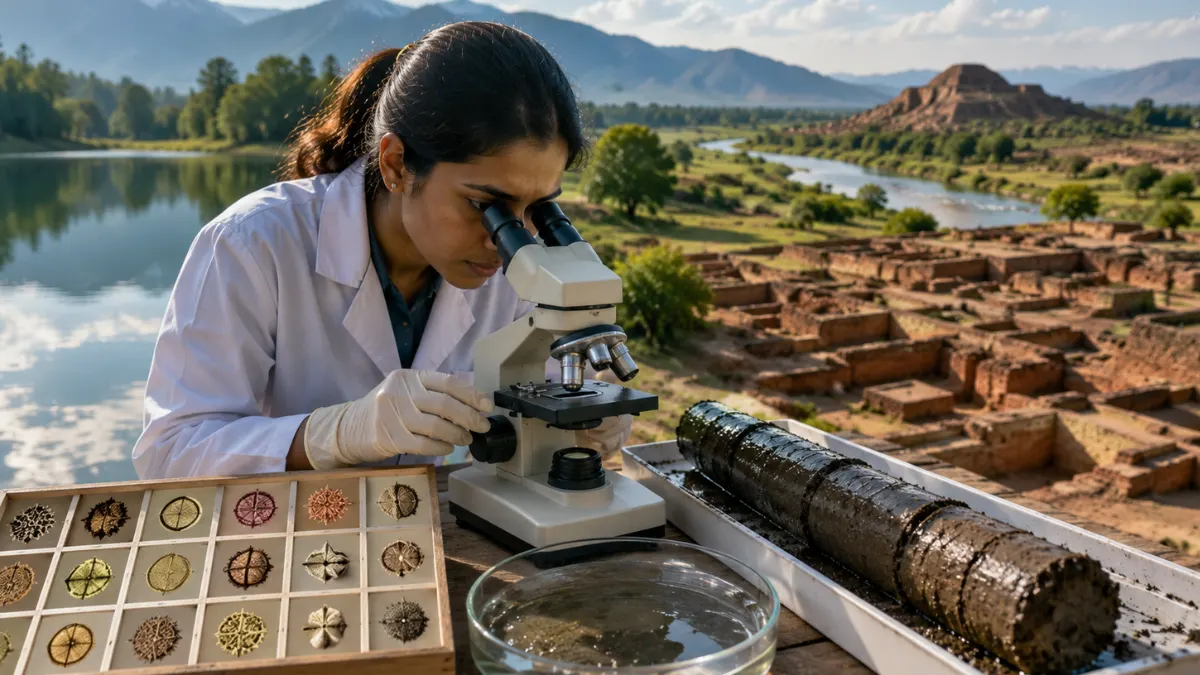

Ancient pollen preserved in Himalayan lake sediment can help scientists reconstruct how India’s monsoon behaved thousands of years ago. A new pollen record from Deoria Tal in Uttarakhand shows a period of substantial monsoon variability and an abrupt dry climatic episode around the same broad period in which Harappan settlements were undergoing major changes.
The evidence does not prove that weakening rainfall single-handedly caused the Harappan Civilization to decline. Instead, it adds a biological climate record to archaeological, river and sediment evidence suggesting that reduced and less reliable water availability placed pressure on communities during a long period of social and environmental transformation.
Researchers from the Birbal Sahni Institute of Palaeosciences and collaborating institutions reconstructed about 5,200 years of vegetation and monsoon history from a sediment core recovered from Deoria Tal in the Garhwal Himalaya. Their study analysed 55 pollen samples and used multiple radiocarbon dates to establish when different parts of the lake sediment accumulated.
The unusual part of this research is not simply that ancient pollen survived. It is how microscopic grains buried in mud can become evidence of environmental conditions that existed long before India had weather stations or written rainfall records.
How Does Pollen Become a Record of Ancient Climate?
Plants release enormous quantities of pollen into the environment. Some grains settle onto soil, while others are carried by wind or water into lakes and wetlands. When pollen reaches a lake bottom and becomes buried by new sediment, it can remain preserved for thousands of years under suitable conditions.
Pollen survives particularly well because its outer wall contains sporopollenin, a highly resistant material. The grain also retains microscopic characteristics that allow specialists to distinguish many plant groups from one another.
A lake therefore accumulates more than mud. As new sediment settles over older layers, it can preserve successive samples of the vegetation growing around the surrounding landscape.
Scientists extract a sediment core and examine pollen at different depths. If the types and proportions of pollen change through the core, those differences show that the vegetation surrounding the lake also changed.
Climate enters the picture because plants do not all respond to moisture and temperature in the same way. Some vegetation communities thrive under wetter conditions, while others become more competitive when conditions are cooler, drier or more variable.
Palaeoecologists therefore study the whole pollen assemblage rather than treating one grain as a direct measurement of rainfall. The Department of Science and Technology’s account of the Deoria Tal research describes pollen and spores as established tools for reconstructing past vegetation and hydroclimate.
Pollen is not an ancient rain gauge. It preserves the way vegetation responded to environmental change, allowing scientists to infer climate when the pollen record is interpreted alongside other evidence.
What Did Scientists Find Inside Deoria Tal?
The Deoria Tal sediment core preserves roughly 5,200 years of vegetation history. During the older portion of the record, forests around the lake contained substantial pine together with broad-leaved and other coniferous vegetation, while changes in the pollen assemblage indicated variations in Indian Summer Monsoon conditions through time.
The period between approximately 4,400 and 4,000 calendar years before present attracted particular attention because the vegetation record became more variable. Researchers identified an abrupt increase in the ratio of oak to pine pollen at around 4,250 years before present.
That shift occurred close to an independently identified short-lived dry climatic episode in earlier sedimentary and elemental evidence from Deoria Tal. Researchers relate this period to the widely studied 4.2 ka climatic event, a term used for a major climatic disturbance identified around 4,200 years ago in a number of palaeoclimate archives.
The 4.2 ka event should not be imagined as one perfectly uniform global drought occurring everywhere at exactly the same time. Its timing, expression and severity varied among regions, and scientists continue to examine how strongly individual records are connected. At Deoria Tal, the important finding is that different forms of evidence from the same lake point toward a pronounced hydroclimatic disturbance during this broad interval.
An earlier Deoria Tal hydroclimate reconstruction also identified evidence of lower lake levels and centennial-scale drying around this period. The newer pollen analysis adds vegetation response to that existing sedimentary evidence.
Together, these records make the lake useful for understanding how the northern Indian monsoon environment changed during the middle to late Holocene.
Why Are Oak and Pine Pollen Useful?
The oak-to-pine change is interesting because the two tree groups respond differently to environmental conditions in Himalayan forests, but the ratio needs to be interpreted carefully.
It would be misleading to assume that more oak always represents one specific amount of rainfall or that pine automatically signals drought. Forest composition is influenced by moisture, temperature, altitude, competition and other ecological factors.
Researchers therefore examine changes in oak and pine together with other trees, herbs, ferns, marsh plants and independent environmental indicators.
At Deoria Tal, the abrupt oak-to-pine ratio change around 4,250 years before present became significant because it appeared during a broader period of unstable monsoon conditions and corresponded with previously identified sediment evidence for drying.
This agreement between different proxies is important. Palaeoclimate reconstructions become stronger when pollen, sediment chemistry, lake-level indicators or other independent evidence point toward a similar environmental change.
The finding is therefore more informative than simply saying that scientists discovered ancient oak and pine pollen. The changing proportions help reveal how the vegetation surrounding the lake responded while the regional climate was changing.
How Do Scientists Know How Old the Pollen Is?
Depth alone cannot tell researchers that a particular pollen grain is 4,000 or 5,000 years old. Scientists need an independent way to build a timeline through the sediment.
The Deoria Tal researchers used ten accelerator mass spectrometry radiocarbon dates obtained from preserved Trapa seed cases found within the core. Trapa is the plant group that includes water chestnuts.
Radiocarbon dating works because living organisms contain carbon-14 while they are alive. After biological material dies, the radioactive carbon gradually decays at a predictable rate. Measuring how much remains allows scientists to estimate when the organism lived.
Samples from several depths provide chronological anchor points. Researchers can then construct an age-depth model to estimate the ages of sediment and pollen between those dated levels.
This step is essential when comparing climate evidence with archaeological change. Without a reliable chronology, a vegetation shift and a change in human settlements might appear related even if they occurred centuries apart.
The Deoria Tal chronology allows researchers to place the pronounced pollen change around 4,250 calendar years before present and compare it with other palaeoclimate records from the same broad period.
How Could a Weaker Monsoon Affect Harappan Settlements?
Harappan communities depended on access to freshwater for farming and everyday life, so changes in rainfall and river behaviour could create serious pressure without producing an instantaneous civilizational collapse.
A weaker or increasingly unreliable monsoon can affect several parts of the water system at once. Lower rainfall may reduce soil moisture, groundwater recharge and river discharge, while changes in seasonal flooding can alter the amount of water and fertile sediment reaching agricultural land.
The effect also depends on where people live. A settlement with access to a dependable river, groundwater source or alternative crops may cope differently from one located in a region where water becomes progressively less reliable.
Recent independent evidence strengthens the case for prolonged water stress. A 2025 study of river drought during the Harappan transformation reconstructed repeated severe droughts affecting the Indus basin between roughly 4,400 and 3,400 years before present. The researchers found that prolonged reductions in river flow coincided with regional rainfall deficits and declining freshwater availability.
The study argues that worsening water availability may have contributed to population dispersal from major Harappan centres, while emphasizing that the transformation involved climatic, social and economic pressures rather than one environmental trigger.
This distinction is essential. Harappan populations did not simply vanish when rainfall weakened. Archaeological evidence indicates changes in settlement patterns, agriculture and the prominence of large urban centres over an extended period.
Communities could respond by relocating, changing crops or adapting how they obtained and managed water. Dependence on reliable waterways was not unique to Harappan society; many of India’s major rivers influenced where civilizations and settlements developed because they supplied water, fertile floodplains and routes connecting communities.
The pollen evidence fits into this wider story by showing that substantial monsoon instability occurred during a period when water availability was becoming an increasingly important constraint in parts of the Harappan world.
Did the 4.2 ka Event Cause Harappan Decline?
The evidence does not support reducing Harappan decline to a single climatic event.
The Mature Harappan urban system changed over centuries, and different settlements experienced that transformation in different ways. Climate could influence food production, rivers and freshwater availability, but societies also respond through technology, trade, migration, crop choices and social organization.
The 4.2 ka climatic disturbance is therefore better viewed as part of a longer environmental story rather than a switch that suddenly ended the civilization.
The Deoria Tal record shows an abrupt climatic disturbance within a broader period of monsoon variability. The river-drought evidence from the Indus basin, meanwhile, indicates that severe water shortages recurred over a much longer interval.
When these records are compared with archaeology, they support the possibility that declining water reliability added persistent pressure to Harappan communities and encouraged adaptation or population redistribution in some regions.
They do not demonstrate that every settlement declined for the same reason or at the same moment.
This is also why describing the process as a transformation can sometimes be more accurate than imagining a single dramatic collapse. Large urban centres lost importance and settlement patterns changed, but Harappan populations and cultural traditions continued in different forms.
What Can the Deoria Tal Pollen Actually Prove?
The geographic limitation of the pollen record is important. Deoria Tal is one lake in the Garhwal Himalaya, not a rainfall station for the entire Harappan world.
Its sediment preserves environmental conditions recorded at that particular location. Scientists cannot take a pollen change in Uttarakhand and assume that every settlement across the Indus, Ghaggar-Hakra and neighbouring regions experienced exactly the same rainfall at exactly the same time.
This is why palaeoclimate researchers compare records from multiple sources. Lake sediments can be examined alongside cave deposits, river records, marine sediments, archaeological evidence and climate simulations to identify broader patterns and regional differences.
The new pollen record is valuable because it adds another well-dated line of evidence to that larger reconstruction. Its vegetation changes indicate substantial monsoon variability, including an abrupt disturbance close to 4,200 years ago, while independent evidence from other regions shows prolonged problems with rainfall and river water during the wider Harappan transformation.
The pollen therefore cannot identify why an individual Harappan city changed, prove where a particular family migrated or establish one universal cause of urban decline. What it can do is reveal how vegetation responded to changing monsoon conditions during a period when other evidence shows growing water stress across important parts of northern and northwestern South Asia.
That is why microscopic pollen buried in a Himalayan lake matters to archaeology. It does not solve the Harappan story by itself, but it preserves an environmental record that helps scientists understand one of the pressures acting on communities as the ancient urban system gradually changed.
