
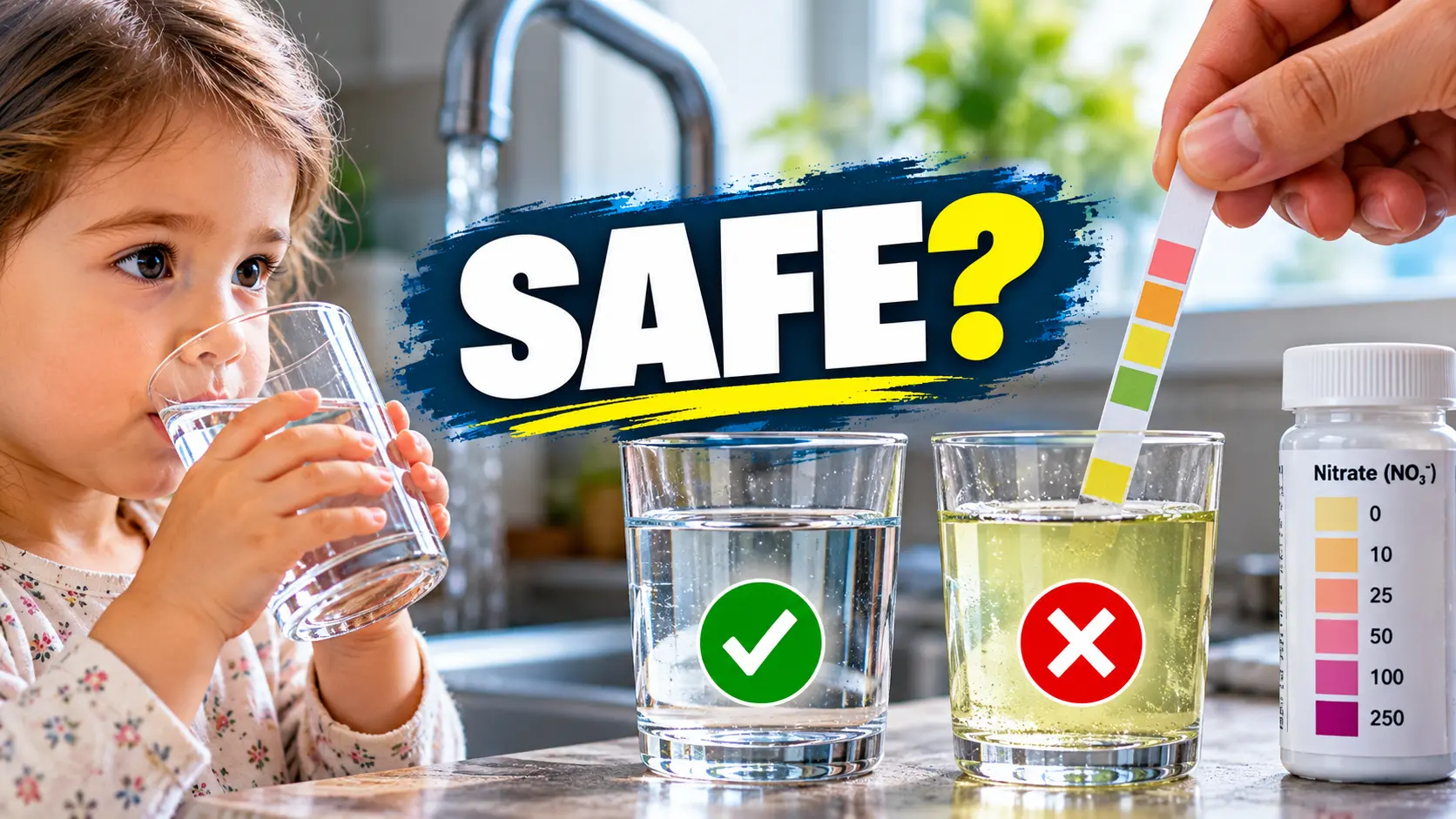

Nitrogen in water is not automatically dangerous. Molecular nitrogen gas (N₂), the same form of nitrogen that makes up most of Earth’s atmosphere, can naturally dissolve in water and is not the main concern when people ask whether nitrogen in drinking water is safe.
The important drinking-water contaminants are reactive nitrogen compounds, particularly nitrate (NO₃⁻) and nitrite (NO₂⁻). At excessive concentrations, these compounds can create health risks, with bottle-fed infants under six months among the most sensitive groups.
For U.S. public drinking water, the EPA maximum contaminant level is 10 mg/L for nitrate measured as nitrogen (NO₃-N) and 1 mg/L for nitrite measured as nitrogen (NO₂-N). WHO’s current guideline values are 50 mg/L as nitrate ion and 3 mg/L as nitrite ion. The numbers use different reporting conventions and should not be compared directly without accounting for those units.
EPA’s values are enforceable standards for regulated U.S. public water systems. WHO’s values are international health-based guideline values that countries can use when developing their own drinking-water standards.
Nitrate and Nitrite Drinking-Water Levels
| Parameter | U.S. EPA Maximum Contaminant Level | WHO Guideline Value | Main Health Concern / Interpretation |
|---|---|---|---|
| Nitrate | 10 mg/L as nitrogen (NO₃-N) | 50 mg/L as nitrate ion (NO₃⁻) | Excessive exposure can contribute to methemoglobinemia, especially in susceptible infants |
| Nitrite | 1 mg/L as nitrogen (NO₂-N) | 3 mg/L as nitrite ion (NO₂⁻) | Directly contributes to methemoglobin formation and impaired oxygen transport |
| Nitrate + nitrite | 10 mg/L combined as nitrogen | Sum of each concentration-to-guideline ratio should not exceed 1 | Combined exposure must also remain within the applicable standard |
WHO’s 2026 guidance states that its nitrate and nitrite guideline values are designed to protect against methemoglobinemia in the most sensitive population and also be protective for the wider population. Its nitrate guideline also accounts for thyroid effects in the sensitive subgroup.
Gas vs. Compounds
The word nitrogen can be confusing because nitrogen exists in several chemical forms. Nitrogen gas, nitrate, nitrite, ammonia, ammonium and organic nitrogen are chemically different and do not have identical effects on drinking water or the human body.
Molecular nitrogen gas, or N₂, is naturally present in the atmosphere and can dissolve in water. Under ordinary drinking-water conditions, this dissolved gas is not the contaminant that nitrate and nitrite drinking-water standards are designed to control.
The greater drinking-water concern is reactive nitrogen, particularly nitrate and nitrite. These compounds can reach groundwater and surface water through fertilizer losses, animal manure, sewage, septic systems, wastewater and other sources.
What Is Nitrate-Nitrogen (NO₃-N)?
Nitrate contains one nitrogen atom and three oxygen atoms. When a laboratory reports nitrate-nitrogen or NO₃-N, the result expresses only the nitrogen portion of the nitrate compound rather than the total mass of the complete nitrate ion.
This distinction matters when comparing test results with standards. A reading of 10 mg/L as nitrate-nitrogen does not mean the same thing as 10 mg/L measured as the complete nitrate ion.
WHO provides a conversion factor showing that 1 mg/L as nitrate ion equals about 0.226 mg/L as nitrate-nitrogen. Its guideline of 50 mg/L as nitrate ion therefore corresponds to roughly 11.3 mg/L when expressed as nitrate-nitrogen.
The U.S. EPA standard of 10 mg/L nitrate as nitrogen and the WHO guideline of 50 mg/L as nitrate ion are therefore much closer chemically than the numbers 10 and 50 initially appear.
What Is Nitrite-Nitrogen (NO₂-N)?
Nitrite contains one nitrogen atom and two oxygen atoms. It can form naturally as microorganisms transform nitrogen between different chemical states and may also appear in drinking-water distribution systems under certain conditions.
When nitrite is reported as NO₂-N, only the nitrogen portion is being measured. WHO states that 1 mg/L as nitrite ion is equivalent to approximately 0.304 mg/L as nitrite-nitrogen.
WHO’s guideline of 3 mg/L as nitrite ion is therefore approximately 0.9 mg/L when expressed as nitrite-nitrogen, which is close to the EPA maximum contaminant level of 1 mg/L as nitrogen.
Understanding this distinction is essential before deciding whether a laboratory result is acceptable.
Official Water Quality Standards and Thresholds
In the United States, nitrate and nitrite are regulated contaminants in public drinking-water systems. EPA’s maximum contaminant levels are 10 mg/L for nitrate as nitrogen, 1 mg/L for nitrite as nitrogen and 10 mg/L for nitrate plus nitrite combined as nitrogen.
These are regulatory limits rather than a promise that every exposure below the number carries exactly zero risk or that every exposure slightly above it produces immediate illness. Health effects depend on concentration, duration of exposure, individual susceptibility and other circumstances.
WHO’s latest drinking-water guidelines, released in June 2026, retain health-based guideline values of 50 mg/L for nitrate measured as nitrate ion and 3 mg/L for nitrite measured as nitrite ion. WHO also states that when both are present, the sum of each measured concentration divided by its respective guideline value should not exceed 1.
National regulations can differ, so a household water result should ultimately be compared with the legal or public-health standard that applies in that location.
Understanding mg/L and ppm
Water-test reports frequently express nitrate and nitrite concentrations in milligrams per liter (mg/L). This means the number of milligrams of the measured substance contained in one liter of water.
For dilute water solutions, 1 mg/L is approximately equivalent to 1 part per million, or ppm. This is why drinking-water information often uses mg/L and ppm almost interchangeably.
The more important detail is whether a report expresses the concentration as nitrogen or as the complete nitrate or nitrite ion. Comparing numbers without checking this distinction can make a normal result appear much higher or lower than it really is.
If a laboratory report is unclear, the laboratory or relevant water authority should be asked which reporting convention it uses before the result is compared with a regulatory limit.
What Happens When Safe Limits Are Exceeded?
The major established health concern from excessive nitrate and nitrite exposure in drinking water involves their effect on the blood’s ability to transport oxygen.
After nitrate is consumed, part of it can be converted into nitrite. Nitrite can then react with hemoglobin to form methemoglobin, a form of hemoglobin that cannot carry oxygen as efficiently as normal hemoglobin.
The amount of risk depends on the concentration, amount of contaminated water consumed, duration of exposure, age and individual susceptibility. Infants are particularly important because their physiology makes them more vulnerable to this effect.
Infant Risk: Methemoglobinemia (“Blue Baby Syndrome”)
Bottle-fed infants under six months are considered the most sensitive population for excessive nitrate exposure in drinking water. Formula prepared with contaminated water can provide a substantial nitrate exposure relative to an infant’s body weight.
When enough hemoglobin is converted to methemoglobin, the blood becomes less effective at delivering oxygen to tissues. Severe cases can cause shortness of breath and a bluish or greyish appearance of the skin, which led to the common term blue baby syndrome. EPA identifies this acute effect as the primary basis for its nitrate and nitrite drinking-water standards.
Suspected methemoglobinemia is a medical emergency. Water known to exceed the applicable nitrate standard should not be used to prepare infant formula unless an appropriate health or water authority has confirmed that it is safe.
Microbial contamination can also increase risk in infants, so nitrate should not be considered in isolation when evaluating private-well water used for infant feeding. WHO specifically emphasizes the importance of microbiologically safe water for bottle-fed infants when nitrate is present near the guideline value.
Risks for Pregnant Women and Vulnerable Populations
Pregnancy is another situation in which water quality deserves extra attention, particularly for households relying on private wells. CDC recommends additional well testing when someone in the household becomes pregnant rather than waiting only for the next routine annual test.
Research has examined relationships between nitrate exposure and thyroid function, pregnancy outcomes and other health effects. These questions are scientifically complex and individual studies do not justify assuming that nitrate exposure at compliant drinking-water concentrations will necessarily cause thyroid or pregnancy problems.
WHO’s current guideline nevertheless takes sensitive populations into account. Its 50 mg/L nitrate guideline is described as protective against methemoglobinemia and thyroid effects in bottle-fed infants, the most sensitive subgroup considered and consequently protective of other population groups.
Pregnant people or anyone with a medical condition who receives an elevated nitrate or nitrite result should follow local public-health guidance and seek appropriate medical advice rather than trying to determine individual health risk from the laboratory number alone.
Chronic Exposure Concerns in Adults
The best-established drinking-water concern remains methemoglobinemia, particularly in susceptible infants. Scientists have also investigated possible associations between long-term nitrate exposure and outcomes involving thyroid function, reproductive health, gastrointestinal processes and certain cancers.
Evidence for these longer-term outcomes is more complicated than the evidence for infant methemoglobinemia. Exposure can also come from food and studies must account for diet, other contaminants, individual susceptibility and differences in how nitrate exposure is measured.
For readers, the practical message is straightforward: nitrate and nitrite should be kept within applicable drinking-water standards without treating every possible long-term association as a proven effect of ordinary exposure.
High concentrations may also indicate a wider environmental problem. Fertilizer, manure, sewage, and other nitrogen sources that contaminate drinking-water supplies can also contribute to nutrient enrichment in rivers and lakes, which is why the broader ecological consequences are explained in why excess nitrogen harms water quality.
How to Test Your Water for Safe Nitrogen Levels
Nitrate and nitrite cannot be reliably detected by looking at, smelling, or tasting water. A private well can produce clear, normal-tasting water and still contain an elevated nitrate concentration.
For U.S. private wells, CDC recommends testing nitrate at least once every year, together with other basic water-quality parameters. It also recommends additional testing after flooding or land disturbances near the well, after repairs to the well system, when the water changes in taste, colour or smell, when someone becomes pregnant or when a child starts living in the household.
Certified laboratory testing is preferable when the result will determine whether water is suitable for drinking. Home nitrate test strips can be useful as screening tools but a concerning or borderline result should be confirmed through an appropriate laboratory.
Always check how the result is reported. A laboratory value labelled NO₃-N should not be compared directly with a limit stated as NO₃⁻ without converting between the two reporting systems.
Municipal Water Supplies
Households receiving water from a regulated public water system usually do not need to arrange nitrate monitoring in the same way as private-well owners. The water supplier is responsible for testing regulated contaminants and meeting applicable legal standards.
In the United States, customers can review their utility’s Consumer Confidence Report, commonly called an annual water-quality report, to see information about regulated contaminants detected in the supply.
If nitrate or nitrite appears in the report, look at both the concentration and its reporting unit before comparing it with the EPA maximum contaminant level.
Private Wells
Private wells require more direct responsibility from the property owner. U.S. federal public drinking-water rules that regulate public systems do not generally regulate individually owned private wells, so owners must arrange appropriate testing themselves.
Annual nitrate testing is particularly important where wells are near agricultural fertilizer use, livestock operations, septic systems, wastewater sources, flooded areas or other potential sources of nitrogen contamination.
Local health or environmental authorities can also recommend additional contaminants to test based on land use, geology and known water-quality problems in the area.
What Should You Do If Your Water Exceeds Safe Limits?
If a reliable test shows nitrate or nitrite above the applicable drinking-water standard, do not assume that ordinary household boiling will solve the problem.
Boiling does not remove nitrate. As water evaporates, nitrate remains behind and its concentration can actually increase. EPA specifically warns that boiling nitrate-contaminated water can make the nitrate concentration higher rather than safer.
For drinking, cooking or preparing infant formula, use a confirmed safe alternative water source while the contamination is being investigated. This is especially important for infants because they are the population most vulnerable to nitrate-related methemoglobinemia.
Standard activated-carbon pitcher filters should not automatically be assumed to remove nitrate either. EPA guidance notes that ordinary activated-carbon filters are not effective nitrate-removal systems.
Treatment technologies that can be appropriate for nitrate include reverse osmosis and ion exchange, while other treatment approaches may be suitable for larger systems. The equipment must be specifically designed and certified for the contaminant being treated, installed correctly and maintained according to its specifications.
Readers who already have a high test result can continue to how to remove excess nitrogen from water for a detailed comparison of treatment methods and where each option is appropriate.
Treatment should also be paired with source investigation whenever possible. A filter may reduce nitrate at a kitchen tap but it does not repair a leaking septic system, correct excessive fertilizer losses or stop another ongoing contamination source.

2 thoughts on “How to Read Nitrate and Nitrite Levels in Drinking Water”