
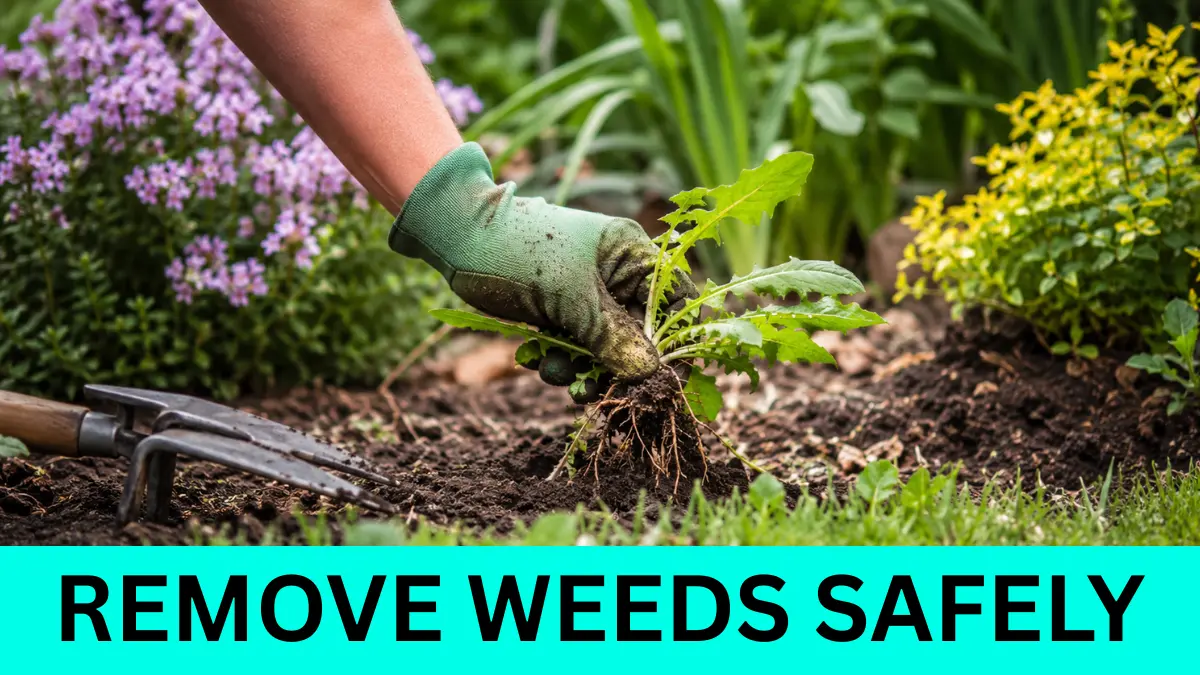

Removing weeds without harming plants or grass requires a targeted method. The lowest-risk approach is to identify where the weed is growing, remove young weeds physically, suppress new seedlings and use a correctly labelled selective treatment only when manual control is impractical.
Common homemade sprays made with vinegar, salt or dish detergent are not selective. They can damage flowers, vegetables, lawn grass and other desirable plants when the liquid touches them.
The correct method depends on whether the weed is growing in a flower bed, vegetable garden, lawn, paving crack or near established trees and shrubs.
| Where the weed is growing | Lowest-risk first method | What to avoid |
|---|---|---|
| Between flowers or vegetables | Pull from damp soil using a narrow hand tool | Vinegar, salt and broad spraying |
| In open garden soil | Shallow hoeing while weeds are young | Deep cultivation near plant roots |
| In lawn grass | Manual removal and stronger turf growth | Non-selective sprays |
| Between paving stones | Pulling or carefully directed hot water | Runoff towards lawns or beds |
| Around shrubs or trees | Hand removal followed by suitable mulch | Digging that damages shallow roots |
| Deep-rooted perennial weed | Repeated root removal or a locally labelled treatment | Cutting it once and assuming it is dead |
What Kills Weeds Without Harming Nearby Plants?
No spray can automatically recognise which plant a gardener wants to keep. A non-selective treatment damages any susceptible green plant tissue it reaches.
Hand-pulling or digging is therefore the most controlled first option when a weed grows close to a wanted plant. It allows the gardener to remove the unwanted plant without exposing the surrounding foliage and soil to a chemical or homemade mixture.
Pull weeds after rainfall or light watering, when the soil is moist but not waterlogged. Grip the weed near its base and pull steadily. A narrow hand fork or weeding tool can loosen the root without disturbing a large area of soil.
Young annual weeds are usually easier to control because they have smaller root systems. Established perennial weeds may grow again from taproots, rhizomes, underground stems or remaining root fragments, so repeated removal may be necessary. Iowa State University Extension recommends early hand-pulling and shallow cultivation, particularly before weeds produce seeds.
The weed should also be removed before it flowers. Preventing seed production does not immediately kill every established weed, but it can stop one plant from creating a much larger infestation in later seasons.
How Can Weeds Be Removed From Flower Beds Safely?
Hand removal works best when weeds grow between flowers, vegetables or other closely spaced plants.
Place one hand on the soil around the wanted plant to hold it steady. Use the other hand to pull the weed slowly. This reduces the risk of lifting a young flower or vegetable plant along with the weed.
For a weed with a deep taproot, insert a narrow tool vertically beside the root and loosen the surrounding soil. Pulling only the visible leaves may leave the crown or root underground, allowing the plant to return.
Small weed seedlings in open spaces can be removed with a shallow hoe. Scrape just below the soil surface rather than digging deeply. Deep cultivation can damage the shallow roots of garden plants and bring buried weed seeds closer to the surface, where light and moisture may encourage germination.
When a weed is growing directly against the stem of a delicate plant, forceful pulling may cause more harm than leaving a small part of the root. Cut the weed at ground level and remove each new shoot as it appears. Repeated removal of top growth can gradually weaken some perennial weeds, although it may not eliminate an extensive root system quickly.
Regular inspection makes weed control easier. Removing small seedlings every week causes less soil disturbance than waiting until several weeds become large, deeply rooted and intertwined with the wanted plants.
How Do You Remove Weeds Without Killing Grass?
A small number of lawn weeds can often be removed manually.
Water the area first if the soil is dry. Use a long-handled weed puller or narrow digging tool for plants with taproots. Remove the crown and as much of the root as possible without creating a large bare patch.
Fill substantial holes with suitable soil after removing the weed. Repair the area with grass seed or turf that matches the existing lawn when necessary. Open soil creates an opportunity for new weed seeds to germinate.
A dense, healthy lawn competes more effectively with weeds than thin or damaged turf. Correct mowing height, suitable watering, appropriate grass selection and repair of bare areas can reduce the space and resources available to unwanted plants. The University of Minnesota recommends identifying the conditions that favour weeds before relying on herbicides alone.
Some selective lawn herbicides can control certain broadleaf weeds without damaging compatible turfgrass when used exactly as labelled. However, they cannot distinguish between an unwanted broadleaf weed and a desirable broadleaf flower, vegetable, shrub or tree.
Exposure can severely damage nearby garden plants, particularly where their roots extend into the treated lawn. A product labelled for one grass species or weed may also be unsuitable for another.
Never apply a lawn treatment around edible plants unless the complete product label specifically permits that use. Product registrations and approved applications differ by country, plant species and location.
Are Vinegar, Salt and Dish Soap Safe Around Plants?
Homemade weed-killer mixtures are commonly promoted as natural alternatives, but familiar household ingredients are not automatically selective, harmless or environmentally safe.
Vinegar
Vinegar contains acetic acid, which damages plant tissue on contact. It can burn the leaves of a weed, but it can also burn nearby flowers, vegetables and grass.
Contact damage does not always kill the weed’s root system. An established perennial may turn brown above the soil and later produce new shoots from surviving roots.
Household vinegar contains a relatively low concentration of acetic acid. Stronger horticultural vinegar products can be corrosive and may carry serious safety warnings. They should not be treated like ordinary kitchen vinegar. UConn Extension describes vinegar-based weed treatments as non-selective and warns that they damage desirable plants they contact.
Salt
Salt can remove water from plant tissue, but it does not remain limited to the visible weed.
Repeated use can increase salt levels in the surrounding soil. That accumulation may affect nearby plants and interfere with their ability to absorb water and nutrients.
Salt is therefore unsuitable for lawns, flower beds, vegetable gardens, tree-root areas and locations where plants may be grown later. UConn Extension warns that salt from repeated homemade treatments can build up and harm desirable vegetation.
Dish detergent
Dish detergent does not make vinegar or salt selective. It commonly acts as a spreading agent, helping a mixture coat and remain on leaves.
That increased contact can affect wanted plants as easily as it affects weeds. Household detergents may also contain fragrances, preservatives, antibacterial ingredients and other additives that were not designed or tested for garden weed control.
Penn State Extension warns that homemade remedies often lack tested application rates, plant-safety instructions, first-aid directions and reliable environmental precautions. Detergent-containing mixtures can also injure plant foliage.
For these reasons, a vinegar, salt and dish-detergent mixture should not be recommended as a safe way to remove weeds near plants or grass.
Can Boiling Water Kill Weeds Safely?
Boiling water can damage newly emerged weeds in paving cracks and other isolated hard-surface areas where no wanted vegetation is nearby.
It is non-selective. It can injure any leaves or roots it reaches, and established perennial weeds may regrow from underground parts that survive the heat.
Boiling water also creates a serious burn risk during carrying and pouring. It should not be used near children, pets, lawn edges, flower beds, exposed tree roots or slopes where hot runoff could reach desirable vegetation.
Iowa State University Extension limits boiling-water control mainly to situations where nearby plants will not be exposed and warns that it kills wanted and unwanted plants alike.
Pulling remains the safer first choice when a weed can be removed physically.
How Can Weeds Between Paving Stones Be Removed?
Weeds between paving stones often grow in soil, dust and organic debris collected inside the joints.
Start by pulling the plant after rainfall or light watering. Use a narrow paving or crack-weeding tool to loosen remaining roots, then remove accumulated soil and plant debris from the joint.
Repairing damaged joints or gaps can reduce places where new seeds settle and germinate. Hot water may be considered for tiny seedlings only when there is no risk to nearby plants or people.
Do not apply salt to paving if runoff can flow into lawns, garden soil, tree-root zones, drains or waterways.
How Does Mulch Prevent Weeds?
Mulch limits the light available at the soil surface and creates a physical barrier that makes it more difficult for many weed seedlings to emerge.
Remove existing weeds before applying mulch. A normal mulch layer can suppress new seedlings, but it may not kill an established perennial weed with a deep root system or underground stems.
Apply approximately 5 to 10 centimetres of suitable organic mulch, adjusting the depth for the material, climate and planting. Wood chips or shredded bark may suit ornamental beds, while clean straw or another appropriate material may suit some vegetable gardens.
Keep mulch away from plant crowns, stems and tree trunks. Mulch piled directly against plant tissue can hold excess moisture and contribute to disease or pest problems.
Organic mulch breaks down over time, so thin areas may need replenishment. Weeds that germinate in decomposed material on top should be removed while they are small.
University of Minnesota Extension recommends removing existing weeds first, applying mulch at a depth of approximately 2 to 4 inches and maintaining clear space around stems and trunks.
Dense planting can also help cover bare soil and reduce the light available to weeds. UC Integrated Pest Management recommends combining competitive plants, mulch and early hand removal rather than depending on one method alone.
Why Do Weeds Keep Returning?
Repeated weed growth usually has one or more underlying causes:
- Part of the root or crown remains underground.
- Creeping roots or underground stems are entering from another area.
- Mature weeds previously released seeds.
- Bare soil provides space for germination.
- Mulch has become too thin.
- Lawn grass is weak because of shade, compaction, poor drainage or unsuitable maintenance.
- New seeds arrive through wind, animals, footwear, compost or garden materials.
Removing the visible plant treats the immediate problem. Preventing regrowth requires attention to its root system, seed production and the conditions around it.
Check frequently for new seedlings, remove weeds before flowering, cover bare garden soil and repair weak lawn areas. These combined practices form a more dependable long-term strategy than repeatedly spraying every weed that appears.
When Should a Labelled Weed-Control Product Be Considered?
A labelled weed-control product may be considered when a correctly identified weed has spread beyond practical hand removal or when a persistent perennial cannot be controlled adequately through physical methods.
Before using any product:
- Identify the weed.
- Confirm that the label lists the weed.
- Confirm that the label permits use in the exact location.
- Check whether the surrounding plants and grass species are compatible.
- Follow the stated quantity and application method.
- Wear the protective equipment required by the label.
- Observe instructions concerning children, pets, edible plants and re-entry.
- Avoid conditions that could cause spray drift or runoff.
- Keep the product in its original labelled container.
- Follow local storage and disposal requirements.
Using more than the labelled amount does not make a treatment safer or more effective. It may damage plants, people, animals or the environment.
In the United States, the Environmental Protection Agency advises users to identify the problem first, choose a product labelled for that problem and follow all instructions covering application, protective equipment, storage and first aid. Readers elsewhere should follow the complete local label and regulations applicable in their country.
The Safest Approach for Most Gardens
The safest weed-removal plan begins with the location.
Pull or dig weeds growing close to flowers, vegetables, shrubs and trees. Use shallow hoeing for young seedlings in open soil. Remove isolated lawn weeds manually and improve the health of weak turf. Reserve hot water for small weeds in isolated paving cracks.
Avoid vinegar, salt and detergent mixtures near any wanted vegetation. They are non-selective, may provide incomplete root control and can create risks that are not obvious from the word “homemade.”
After removing the existing weeds, prevent the next outbreak by covering bare soil, applying suitable mulch, maintaining dense grass and removing new seedlings before they produce seeds.
