
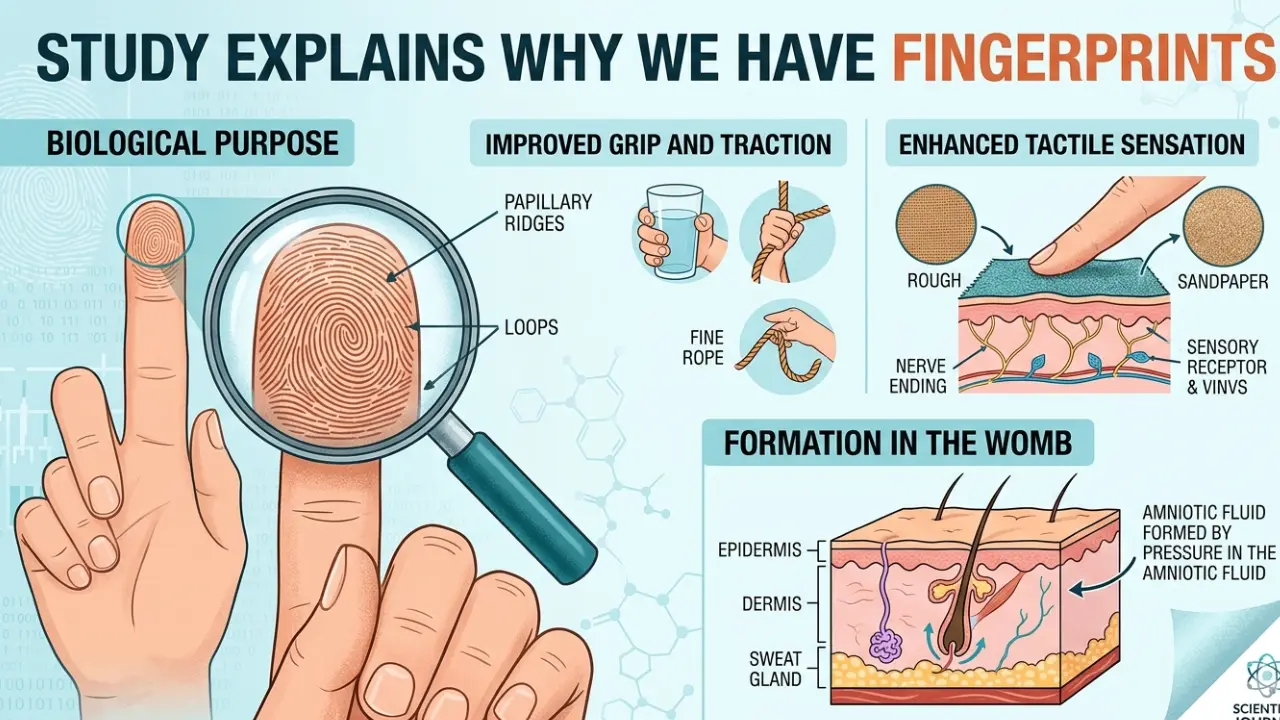

Humans have fingerprints to improve grip, enhance touch sensitivity and regulate moisture on the skin. Scientific studies show that the ridged patterns help detect textures and prevent slipping, making everyday tasks easier. Their unique patterns are a natural result of biological development.
1. Improve Grip Efficiency
One of the most widely supported explanations is that fingerprints help improve grip. Rather than having completely smooth skin, the ridged structure on our fingertips creates a functional surface that interacts more effectively with objects. This becomes especially important in daily tasks where precision and control are required, such as holding a glass, using tools or even typing on a device.
How this works
The ridges and valleys in fingerprints increase friction between the skin and objects. Instead of full flat contact, the patterned surface creates multiple contact points that adapt to different textures. This improves stability when holding objects, particularly those that are smooth, wet or slightly oily. Additionally, the ridges help channel moisture (like sweat) away from the contact surface preventing excessive slipperiness while still maintaining enough grip.
Key points:
- Enhances grip on various textures
- Helps prevent objects from slipping
- Useful in both dry and slightly moist conditions
- Improves control when handling delicate or small objects
- Supports everyday tasks like writing, holding, and lifting
2. They Enhance Touch Sensitivity
Fingerprints are closely linked to how we perceive touch.
Scientific explanation
The ridged patterns amplify vibrations when your fingers move across surfaces. These vibrations are detected by nerve endings, improving your ability to sense fine details.
Important points:
- Improves texture detection
- Enhances sensitivity to small changes
- Supports precise hand movements
3. Sweat Distribution for Better Function
Fingerprints also play a critical role in how sweat is distributed across the skin, which directly affects how effectively your fingers interact with objects. Instead of sweat spreading randomly, the ridge patterns guide its movement in a controlled way. This ensures that your fingertips maintain optimal contact with surfaces, improving both grip and tactile performance during everyday activities.
Why this matters
Sweat pores are aligned along the ridges of fingerprints, allowing moisture to be released in a structured pattern. This prevents the skin from becoming too dry or overly wet. A small amount of moisture actually improves grip by increasing friction, but too much can cause slipping. Fingerprints help maintain this balance by channelling sweat efficiently across the surface ensuring stable and reliable contact.
Key points:
- Controls moisture levels
- Prevents excessive slipperiness
- Supports consistent grip
- Helps maintain optimal friction during use
- Improves handling in humid or sweaty conditions
4. Biological By-product
While fingerprints are unique to each individual, uniqueness itself may not be their primary function.
What research suggests
The patterns form during fetal development based on genetic and environmental factors in the womb. Their uniqueness is likely a result of complex biological processes rather than a specific evolutionary goal.
Important points:
- Formed before birth
- Influenced by multiple factors
- Uniqueness is incidental
5. Aid in Fine Motor Skills
Fingerprints contribute significantly to fine motor skills by improving the precision and coordination of hand movements. The ridged structure of the skin enhances tactile feedback, allowing your brain to better interpret how objects feel and respond accordingly. This added sensory input plays a crucial role in performing tasks that require accuracy, steadiness and controlled motion.
Practical impact
Tasks like writing, typing, buttoning clothes or handling small objects depend on precise finger control. Fingerprints help by increasing sensitivity to pressure and texture, allowing you to adjust your grip and movements in real time. This makes actions smoother and more accurate, especially when dealing with delicate or detailed work.
Key points:
- Supports precision tasks
- Improves control in hand movements
- Helps in everyday activities
- Enhances coordination between touch and movement
- Enables better handling of small or delicate objects
6. Help Detect Surface Changes
Fingerprints allow your fingers to respond quickly to changes in surface texture.
Why this is useful
When touching an object, the ridges create micro-vibrations that help detect roughness, smoothness or irregularities.
Important points:
- Improves environmental awareness
- Helps identify materials
- Enhances tactile feedback
7. Evolutionary Advantage
From an evolutionary perspective, fingerprints likely provided practical benefits.
Bigger picture
Better grip, improved touch sensitivity and enhanced control would have been useful for survival tasks like handling tools, climbing or gathering food.
Key points:
- Supports survival-related activities
- Improves interaction with environment
- Enhances efficiency in manual tasks
What Science Now Suggests
Research in Biology indicates that fingerprints are multifunctional. They are not just for identification but play a role in grip, touch and interaction with objects.
Why This Matters in Everyday Life
Fingerprints influence how you interact with the world every day—from holding a phone to writing or using tools. Understanding their purpose highlights how small biological features can have significant functional value.
Continue Exploring

3 thoughts on “Study Explains Why We Have Fingerprints”