
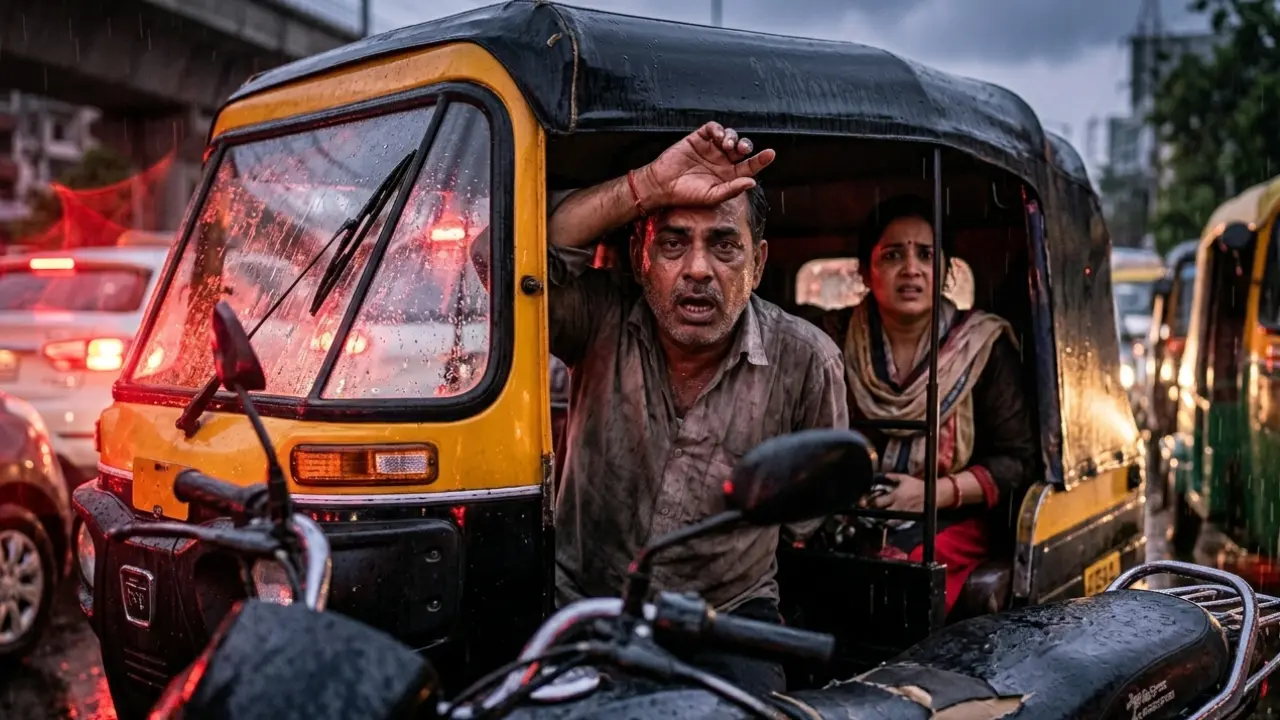

Every year across India, the same strange urban phenomenon repeats itself.
The weather forecast mentions possible rain. Dark clouds gather. Humidity rises. Temperatures remain unbearable. People wait desperately for relief from the exhausting summer heat.
Yet before a single drop of rain actually touches the road, something dramatic begins happening across major cities like Mumbai, Bengaluru, Delhi and Gurgaon.
Traffic suddenly slows to a crawl.
Ride-hailing prices explode.
Food delivery apps enter surge mode.
Power cuts begin appearing randomly.
Office commuters panic.
Drainage fears return instantly.
Social media fills with weather anxiety and commute warnings.
It feels irrational at first. Why does the possibility of rain already destabilize urban systems before monsoon has even officially arrived?
The answer goes far deeper than potholes or waterlogging alone.
India’s “pre-monsoon meltdown” is caused by a layered combination of:
- Psychological anticipation
- Urban overstimulation
- Infrastructure fragility
- Extreme population density
- Heat exhaustion
- Commuter panic behavior
- Weak drainage systems
- And something many urban planners quietly call First Rain Friction
The result is a uniquely Indian urban experience where cities begin emotionally and structurally reacting to monsoon before the rain itself fully begins.
1. Scarcity Panic Is Growing
The moment the sky darkens, a collective survival instinct kicks into overdrive for millions of commuters. In Indian cities, commuting is already a daily battle; add the threat of a monsoon deluge and it becomes an all-out race against time.
- The Mass Exodus: Office workers, school vans and delivery executives all hit the road at the exact same millisecond to “beat the rain.”
- The Modality Shift: Two-wheeler riders (who make up a massive percentage of Indian road users) desperately try to reach safety or look for underpasses to park under. Simultaneously, people who usually take autos or metro walks scramble to book cabs.
This sudden, exponential spike in road volume instantly overwhelms a city’s carrying capacity. It is a self-fulfilling prophecy: everyone rushes to avoid being stuck in traffic, thereby creating the very traffic they feared.
2. “First Rain Friction”
Have you ever noticed how cars seem to skid and minor accidents spike during the very first drizzle? There is a scientific reason for this.
During the blistering summer months, Indian roads accumulate a thick layer of rubber dust, leaked engine oil, grease, and uncollected civic dust.
Summer Accumulation (Oil + Dust) + First Few Drops of Rain = A Teflon-Slick Surface
When the first few drops of rain fall, they do not wash this grime away; instead, they mix with the oil to create a highly slippery, invisible film.
Drivers, sensing the impending downpour, actually speed up right when they should be slowing down. The resulting minor fender-benders, skidding scooters and brake-checking buses instantly block crucial choke points, paralyzing kilometres of traffic behind them.
3. Civic Ritual That Fails
Every year, municipal corporations promise that drains have been “desilted” ahead of schedule. Yet, the first 10 minutes of rain prove otherwise.
The real issue is not just that the drains are clogged; it is when and how they are cleaned.
| The Civic Timeline | What Actually Happens | The Result |
| April – May | Municipalities dig up silt from the drains and leave it on the side of the road to “dry.” | Sidewalks and road shoulders are lined with piles of black sludge. |
| Early June | The first pre-monsoon winds and light showers hit. | The dried silt washes right back into the drains they were just pulled out of. |
Because the debris is rarely transported away immediately, the very first shower undoes months of municipal work in a matter of minutes, causing instant waterlogging before the heavy monsoon even begins.
4. Pre-Emptive Power Cuts
Why does the electricity go out the moment a cool breeze blows? It feels like a cruel joke, but it is actually a desperate safety measure by power distribution companies (DISCOMs).
Our urban power infrastructure is a chaotic web of overhead cables, unpruned tree branches and exposed transformers.
- Strong pre-monsoon winds cause tree branches to snap onto live wires.
- To prevent electrocution, explosions or widespread grid damage, power companies initiate pre-emptive load shedding.
When the power goes out, traffic signals die. When traffic signals die, Indian intersections devolve into a multi-directional game of chicken, locking up major arterial roads entirely.
5. Losing Natural Drainage
Indian cities have a severe case of “hydro-phobia“—we have built over every natural mechanism the earth has to absorb water.
In the past, the first few rains of the season would simply soak into the ground, replenishing the water table. Today, thanks to relentless concreting, asphalt paving and the destruction of urban wetlands (like Bengaluru’s lakes or Mumbai’s mangroves), our cities have a 0% absorption rate.
Every square inch of a modern Indian city is impermeable. Therefore, 100% of the first rainfall instantly becomes surface runoff, rushing toward already-choked storm drains. The street does not just flood; it becomes a river.
The Bottom Line
The pre-monsoon paralysis of Indian cities is not a natural disaster—it is an annual, man-made logistical failure. It is the price we pay for reactionary urban planning, a lack of inter-departmental coordination (between traffic, electricity and civic bodies) and a commuter psychology driven by collective anxiety.
Until our cities treat water as an asset to be managed rather than a nuisance to be drained through concrete, the first cloud of the season will continue to hold millions of us hostage.
How long does your daily commute increase by during the first rains? Let us know in the comments below!
