
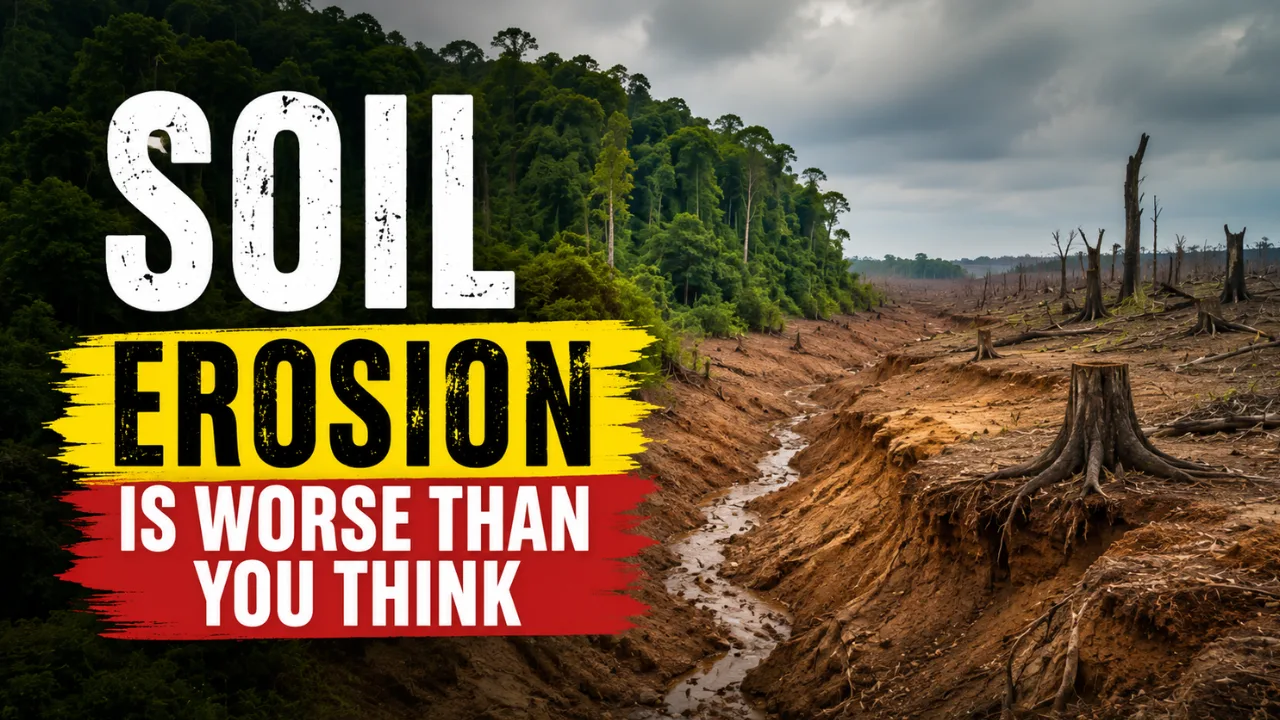

Soil erosion damages land because it removes the fertile upper layer that supports plant growth, stores water, supplies nutrients and protects the ground from further degradation. When wind or water carries this layer away, the land becomes less productive, waterways collect sediment, flooding risk increases and ecosystems lose stability.
The most serious problem is not the movement of soil itself. The real damage comes from losing topsoil faster than natural processes can rebuild it.
Topsoil supports agriculture, forests, grasslands, wildlife, and freshwater systems. Once erosion removes it, landowners often need years of restoration work to recover even part of its original quality.
What Soil Erosion Actually Removes
Soil erosion does not remove ordinary dirt with no value. It removes the most biologically active and productive section of the ground.
The upper soil layer contains:
- Organic matter
- Plant nutrients
- Beneficial microorganisms
- Fine mineral particles
- Moisture
- Root networks
- Decomposing plant material
These elements work together to support healthy vegetation.
When erosion strips away this layer, the remaining ground often contains less organic matter, fewer nutrients, weaker structure, and lower water-holding capacity.
This is why even a shallow loss of soil can cause a major decline in land quality.
Soil erosion also connects to wider environmental changes, including the 9 reasons the ice caps are melting so fast and how rising temperatures affect land, water and ecosystems worldwide.
Soil Erosion Reduces Agricultural Productivity
Farming depends on fertile soil. Crops cannot maintain strong growth when erosion steadily removes the nutrients and organic matter around their roots.
Crop yields begin to decline
Plants need stable access to water, oxygen and nutrients. Erosion disrupts all three.
The remaining soil may become shallower, harder and less fertile. Crop roots then struggle to spread through the ground and reach sufficient moisture.
This commonly leads to:
- Slower plant growth
- Weak root development
- Lower crop yields
- Greater sensitivity to drought
- Higher risk of crop failure
Farmers may try to replace lost nutrients with fertilizer, but fertilizer cannot fully restore natural soil structure, organic matter, or microbial activity.
Production costs increase
Eroded fields often require additional fertilizer, irrigation, soil amendments, and land management.
Farmers may also need to repair gullies, reshape damaged slopes, or install erosion-control systems.
These expenses reduce profitability and can increase the cost of food production.
Severe erosion can make farmland unusable
Repeated erosion can expose compacted subsoil, gravel, or rock.
At that stage, the land may no longer support dependable crop production without major restoration.
In dry regions, continued soil loss can contribute to desertification, where once-productive land becomes increasingly barren.
Deforestation also leaves large areas of soil exposed to heavy rain, which is why understanding the 11 main reasons rainforests are being destroyed helps explain how soil erosion begins and spreads so quickly.
Soil Erosion Weakens the Land’s Ability to Hold Water
Healthy soil absorbs rainfall and stores moisture for future plant use.
Organic matter and stable soil structure create small spaces that allow water to move into the ground. Erosion destroys this system.
More water runs across the surface
When erosion removes topsoil, the exposed ground often becomes compacted or crusted.
Rainwater cannot enter compacted soil easily. Instead, it flows across the surface.
This runoff carries additional soil away and increases the speed of future erosion.
Plants face greater water stress
A field may receive normal rainfall but still experience dry conditions if the soil cannot absorb and retain water.
Crops and native plants then become more vulnerable during periods of limited rainfall.
This creates a damaging cycle:
- Erosion removes topsoil.
- The ground holds less water.
- Plants grow poorly.
- Vegetation cover becomes thinner.
- Wind and rainfall remove even more soil.
Without intervention, each stage increases the severity of the next.
Soil Erosion Increases Flood Risk
Erosion contributes to flooding in two major ways.
First, degraded soil absorbs less rainfall. Second, eroded sediment reduces the capacity of rivers, drains, and reservoirs.
Runoff reaches waterways faster
Vegetated land slows rainfall and allows water to enter the ground.
Bare and eroded land sends water rapidly toward streams, roads, drains, and low-lying areas.
During heavy rainfall, this concentrated runoff can overwhelm drainage systems and increase local flooding.
Sediment makes rivers and drains shallower
Water carries eroded soil into rivers, lakes, reservoirs, and drainage channels.
The sediment eventually settles at the bottom.
As sediment accumulates, waterways become shallower and hold less water. This increases the likelihood that they will overflow during storms.
Flooding causes further erosion
Floodwater removes soil from riverbanks, fields, road edges, and slopes.
As a result, soil erosion can worsen flooding, while flooding creates additional erosion.
This feedback cycle places communities, farmland, roads, and buildings at greater risk.
Soil Erosion Pollutes Rivers and Lakes
Eroded soil often enters freshwater systems.
This sediment changes water quality and damages aquatic habitats.
Sediment makes water cloudy
Fine soil particles remain suspended in water and reduce clarity.
Cloudy water blocks sunlight from reaching aquatic plants. These plants need light for photosynthesis and provide food, oxygen, and shelter for other organisms.
When plant growth declines, the wider aquatic ecosystem can also weaken.
Sediment damages fish habitat
Many fish lay eggs in gravel beds.
Fine sediment can cover these beds, reduce oxygen movement, and lower egg survival.
Sediment can also bury habitats used by insects, shellfish, and other small organisms that form part of the aquatic food chain.
Runoff carries pollutants
Soil particles can transport:
- Fertilizers
- Pesticides
- Animal waste
- Industrial residue
- Oil
- Heavy metals
- Disease-causing organisms
When these substances enter rivers and lakes, they can contaminate drinking water sources and increase treatment costs.
Nutrient-rich runoff can also encourage excessive algae growth. When algae die and decompose, they reduce oxygen levels in the water and can harm fish and other aquatic life.
Soil Erosion Damages Biodiversity
Healthy soil supports a large network of organisms.
Bacteria, fungi, insects, worms, plants, birds, mammals, and reptiles all depend directly or indirectly on stable soil conditions.
Soil organisms lose their habitat
The upper soil layer contains the highest concentration of biological activity.
Erosion removes microorganisms and small animals that decompose organic material, recycle nutrients, and maintain soil structure.
Without these organisms, the soil becomes less fertile and less capable of supporting plant growth.
Plant diversity declines
Native plants need suitable soil depth, moisture, and nutrients.
As erosion degrades these conditions, sensitive plant species may disappear.
Hardy or invasive species may then replace them, reducing ecological diversity.
Animals lose food and shelter
When vegetation declines, animals lose nesting areas, shade, food sources, and protection from predators.
The effect extends across the food chain because many species depend on plants or soil organisms for survival.
Understanding the importance of biodiversity also helps explain why protecting soil matters. Soil forms the physical foundation of many land-based ecosystems.
Soil Erosion Can Damage Homes, Roads and Infrastructure
Erosion creates structural risks when it removes soil from slopes, foundations, roadsides, and drainage systems.
Foundations can lose support
Flowing water can gradually remove soil around buildings.
This may cause:
- Uneven settling
- Cracks in walls
- Foundation movement
- Damage to pipes
- Structural instability
Property owners may not notice the problem until visible damage appears.
Slopes can become unstable
Roots help bind soil together.
When vegetation disappears and erosion weakens the slope, the risk of landslides or soil collapse increases.
Heavy rainfall can saturate loose soil and trigger sudden movement.
Roads and bridges face greater pressure
Erosion can wash away road shoulders, block culverts, damage embankments, and weaken bridge supports.
Sediment can also clog urban drainage systems, increasing flood damage and maintenance costs.
Wind Erosion Reduces Air Quality
Wind erosion occurs when dry, loose, and exposed soil particles enter the air.
This problem becomes more severe when land loses vegetation or moisture.
Dust reduces visibility
Strong winds can create dust clouds that reduce visibility on roads and at airports.
Low visibility increases the risk of accidents and disrupts transportation.
Dust affects respiratory health
Fine particles can irritate the eyes, throat, and lungs.
People with asthma, allergies, or existing respiratory conditions may experience stronger symptoms during dusty periods.
Airborne soil can also carry pollen, fungal spores, pesticide residue, and other contaminants.
Soil Erosion Removes Carbon From the Land
Healthy soil stores carbon in organic matter.
Plants remove carbon dioxide from the atmosphere and transfer part of that carbon into the soil through roots and decaying material.
Erosion disrupts this storage system.
When soil loses organic matter, the land holds less carbon and becomes less fertile.
Some eroded carbon enters waterways, while some returns to the atmosphere during decomposition.
Protecting soil therefore supports both land productivity and long-term carbon storage.
Soil Forms Much More Slowly Than It Disappears
Soil formation requires the gradual breakdown of rock, accumulation of organic matter, movement of water, and activity of living organisms.
This process can take hundreds or thousands of years.
A single storm, flood, or period of strong wind can remove soil that took generations to develop.
This difference between the rate of soil formation and the rate of soil loss makes severe erosion difficult to reverse.
Landowners can improve damaged soil, but they cannot quickly recreate the original topsoil.
Main Causes of Severe Soil Erosion
Natural forces move soil, but human activity often accelerates the process.
Deforestation
Trees protect the ground through their roots, leaves, branches, and fallen organic material.
Roots stabilize the soil, while the tree canopy reduces the force of rainfall.
When people remove forests, the exposed ground becomes far more vulnerable to runoff and wind.
Overgrazing
Livestock can remove too much vegetation when they graze repeatedly in the same area.
Their hooves may also compact the soil.
Compacted, bare ground absorbs less water and erodes more quickly.
Intensive Farming
Frequent ploughing can break down soil structure and leave fields exposed.
Planting crops up and down slopes can also create channels that carry water and soil downhill.
Fields without crop residue, mulch, or cover crops face a higher erosion risk.
Construction
Construction work removes vegetation and loosens soil.
Without proper drainage, sediment barriers, and ground cover, rain can carry large amounts of soil into nearby roads and waterways.
Wildfires
Wildfires remove plants, roots, and protective surface material.
After a fire, rainfall can move rapidly across the exposed land and cause severe erosion, debris flows, and mudslides.
Mining and Land Clearing
Mining, quarrying, and large-scale land clearing disturb the soil profile and remove vegetation.
These activities can create long-term erosion unless land managers restore the site properly.
How Soil Erosion Can Be Controlled
Effective erosion control depends on reducing the force of water and wind while keeping the soil covered.
Maintain Vegetation Cover
Grass, crops, shrubs, and trees protect soil from direct rainfall and strong wind.
Roots hold soil particles together and create channels that improve water absorption.
Use Cover Crops
Farmers plant cover crops between main growing seasons.
These plants protect bare fields, reduce runoff, add organic matter, and support soil organisms.
Apply Mulch
Mulch covers exposed soil and reduces the impact of rain.
It also slows moisture loss and helps control surface temperature.
Practise Contour Farming
Contour farming follows the natural shape of a slope.
Planting across the slope slows runoff and reduces the amount of soil that water carries downhill.
Build Terraces
Terraces divide steep land into flatter sections.
They reduce the speed of flowing water and give rainfall more time to enter the soil.
Protect Riverbanks
Trees, grasses, and other plants stabilize riverbanks.
Their roots reduce bank collapse and help filter sediment before it reaches the water.
Manage Grazing
Rotational grazing allows vegetation to recover.
Controlling the number of animals in one area also prevents excessive plant loss and soil compaction.
Control Construction Sediment
Construction sites can use:
- Silt fences
- Sediment basins
- Drainage channels
- Temporary ground cover
- Retaining barriers
- Stabilized entry points
These controls reduce the amount of loose soil that leaves the site.
Restore Organic Matter
Compost, crop residue, manure, and other organic materials improve soil structure.
Higher organic matter helps the soil absorb water, resist compaction, and support biological activity.
Can Eroded Soil Recover?
Soil can recover when enough of the original layer remains and landowners stop further erosion.
Recovery usually requires:
- Restoring vegetation
- Adding organic matter
- Improving drainage
- Reducing soil disturbance
- Controlling livestock
- Rebuilding soil structure
- Preventing additional runoff
Severely eroded land may take decades to regain productivity.
Some damage may remain permanent when erosion exposes rock or removes most of the soil profile.
Prevention therefore costs less and produces better results than large-scale restoration.
Why Soil Erosion Is a Serious Long-Term Problem
Soil erosion affects far more than the appearance of the land.
It reduces food production, increases farming costs, weakens water security, damages freshwater systems, raises flood risk, harms biodiversity, and threatens infrastructure.
The damage becomes more difficult to control once the land loses vegetation and organic matter.
Healthy soil supports agriculture, ecosystems, clean water, and human settlements. Protecting it requires careful farming, responsible construction, vegetation management, and effective control of water runoff.
Soil may appear abundant, but productive topsoil remains a limited natural resource. Once erosion removes it, nature cannot replace it within a normal human lifetime.
Frequently Asked Questions
Why is soil erosion considered harmful?
Soil erosion removes fertile topsoil, reduces plant growth, increases runoff, pollutes water, and weakens the stability of land.
How does soil erosion affect farming?
It removes nutrients, organic matter, and soil depth. Crops then develop weaker roots, produce lower yields, and require more fertilizer and irrigation.
Can soil erosion cause flooding?
Yes. Eroded soil absorbs less rainfall, which increases runoff. Sediment also reduces the capacity of rivers, reservoirs, and drainage channels.
How does soil erosion pollute water?
Runoff carries soil into streams and lakes. The sediment may also transport fertilizer, pesticides, waste, and other pollutants.
Why does deforestation cause soil erosion?
Tree roots hold the soil in place, while leaves and fallen material reduce the force of rainfall. Removing trees exposes the ground to wind and water.
