
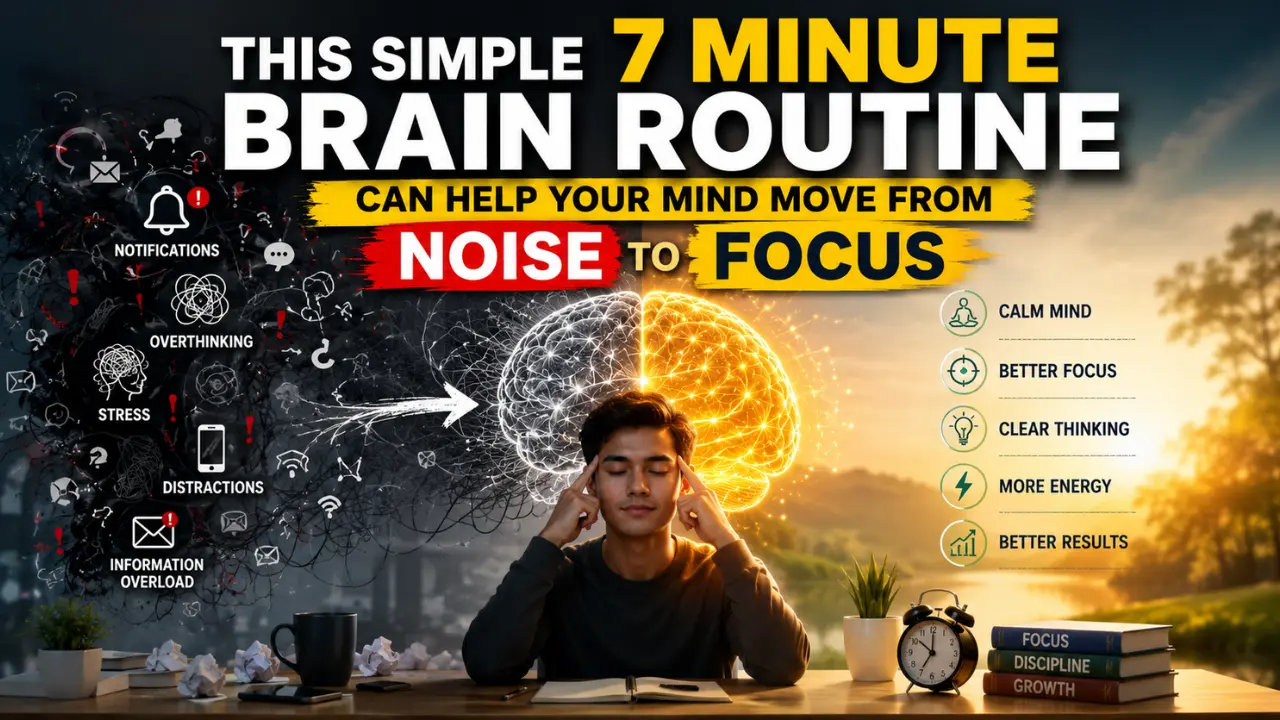

The 7 minute brain exercise is usually described as a short mental routine that helps the mind become more focused, alert, and organized before work, study, writing, reading, or decision-making. It is not one single official exercise followed by everyone. Different people use the phrase in different ways, but the basic idea is simple: give your brain seven minutes of structured attention instead of letting it stay scattered.
Many people hear the phrase and expect something mysterious, as if seven minutes can unlock hidden intelligence or create instant genius. That is not the right way to understand it. A short brain exercise can be useful but it should be treated as a mental warm-up, not a miracle method.
A 7 minute brain exercise is a short routine that may include breathing, memory recall, mental math, word practice, observation, visualization, and focus setting. It works by moving the brain from passive or distracted attention into a more active, organized state.
The value of this exercise is not that it changes your whole brain in seven minutes. Its value is that it gives your mind a clear starting point. When the brain is tired, distracted, or overloaded, a short structured routine can help you reset your attention before doing something important.
What Is the 7 Minute Brain Exercise?
The 7 minute brain exercise is best understood as a quick mental warm-up. Just as the body may need a few minutes to warm up before physical activity, the mind can benefit from a short routine before deep thinking.
A good 7 minute brain exercise does not need complicated tools, expensive apps, or unrealistic promises. It can be done with simple mental tasks that wake up attention, memory, observation, language, and planning.
The routine may include slow breathing, recalling information, solving simple mental problems, noticing details around you, using words actively, visualizing a task, and deciding what to focus on next.
Main Purpose
The main purpose is to shift your brain from scattered attention to directed attention. This matters because many people begin work or study while their mind is still half-connected to notifications, scrolling, worries, unfinished tasks, or random thoughts.
A short brain exercise gives the mind a bridge between distraction and focus. It does not solve every mental problem, but it can make the first step into focused work easier.
To understand the deeper abilities behind attention, recall, visualization and learning, you can read this guide on why the brain is so powerful.
How Does the 7 Minute Brain Exercise Work?
The 7 minute brain exercise works by giving your brain a small sequence of tasks instead of leaving it in an unorganized state. Each minute targets a slightly different mental function, such as breathing control, recall, working memory, attention, language, imagination, or intention.
When you move through these tasks, your brain is not doing one magical thing. It is practicing several ordinary but useful abilities in a short time.
Breathing helps the body settle. Memory recall wakes up stored information. Mental math activates working memory. Word practice engages language. Observation pulls attention into the present moment. Visualization helps the brain prepare for action. Focus setting tells the mind what to do next.
Why Structure Helps
Structure matters because the distracted mind often does not know where to begin. If you simply tell yourself to focus, your brain may still drift. But if you give it a clear seven-minute sequence, the mind has something specific to follow.
This is why the exercise can feel helpful. It reduces the blank, scattered feeling that often comes before work. Instead of waiting for motivation, you guide the brain through small steps that prepare attention.
Simple 7 Minute Brain Exercise Routine
This routine is designed to be simple, realistic, and safe. You can do it before studying, writing, working, reading, planning, or any task that needs clear thinking.
You do not need to complete it perfectly. The goal is not perfection. The goal is to give your brain seven minutes of directed attention.
Minute 1: Slow Breathing
Start with slow breathing for one minute. Sit comfortably, keep your body still and breathe in a controlled way. You can breathe in through your nose, pause briefly, and breathe out slowly.
The purpose is not to enter a deep meditation state. The purpose is to reduce immediate restlessness and help the body settle before mental work.
When breathing slows down, your attention has a chance to move away from pressure and distraction. This first minute creates a calmer base for the rest of the exercise.
What this trains: Calm attention, body awareness and mental preparation.
Minute 2: Memory Recall
For the second minute, recall something specific without checking your phone or notes. You can remember what you did yesterday, summarize a page you read, recall a conversation, or list the main tasks you completed earlier in the day.
This trains your brain to retrieve information instead of only consuming new information. Retrieval is important because memory becomes stronger when you practice bringing information back into awareness.
A simple example is to ask yourself, “What are three useful things I learned yesterday?” or “What did I do after lunch yesterday?” The details do not need to be perfect. The effort to recall is the exercise.
What this trains: Memory recall, attention to detail, and mental organization.
Minute 3: Mental Math
For the third minute, do simple mental math. This does not need to be difficult. You can count backward from 100 by 7, add small numbers, multiply basic numbers, or calculate something from daily life.
For example, you can try 100, 93, 86, 79, 72, and continue slowly. You can also calculate how many hours are left in your workday or estimate a small budget.
Mental math wakes up working memory because you have to hold information in your mind while changing it. This is useful because many thinking tasks require the brain to hold and process information at the same time.
What this trains: Working memory, concentration, and mental flexibility.
Minute 4: Word Challenge
For the fourth minute, choose one category and list as many words as you can from that category. You can choose fruits, countries, animals, emotions, tools, colors, cities, professions, or any topic that makes your brain search actively.
For example, if the category is “emotions,” you may list calm, fear, anger, hope, sadness, joy, guilt, confidence, and curiosity. If the category is “tools,” you may list hammer, drill, saw, wrench, screwdriver, pliers, and tape measure.
This exercise activates language, memory, and quick association. It is simple, but it forces the brain to search, connect, and produce words instead of passively receiving information.
What this trains: Language, association, recall speed, and verbal fluency.
Minute 5: Observation Exercise
For the fifth minute, look around and notice five specific details in your environment. Do not only say, “chair” or “wall.” Try to notice details such as the shadow under a table, the texture of a notebook, the sound of a fan, the color difference on a wall, or the position of an object you usually ignore.
This brings your attention into the present moment. Many people spend much of the day thinking about the past, worrying about the future, or jumping between digital inputs. Observation helps the brain reconnect with what is actually in front of it.
This minute is especially useful if you feel mentally scattered because it trains attention without requiring heavy thinking.
What this trains: Present-moment awareness, visual attention, and detail recognition.
Minute 6: Visualization
For the sixth minute, mentally picture the next task you need to do. If you are going to study, imagine opening the material, reading the first section, and writing notes. If you are going to write, imagine the first paragraph, the main point, and the order of your ideas. If you are going to clean, imagine the first area you will organize.
Visualization is not magic. It works because the brain often performs better when the next step is clear. When you mentally rehearse an action, you reduce the uncertainty that can make starting difficult.
The goal is to create a simple mental picture of what you will do next, not a fantasy about perfect success.
What this trains: Planning, mental rehearsal, task preparation, and direction.
Minute 7: Focus Intention
For the final minute, choose one clear task to do immediately after the exercise. Do not choose five tasks. Do not make a large plan. Pick one next action.
For example, you might decide, “I will write the first 200 words,” “I will read three pages,” “I will reply to one important email,” or “I will clean the desk for ten minutes.”
This final step is important because a brain exercise should lead into action. If you finish the routine and return to scrolling, the mental reset is wasted. The exercise works best when it becomes the doorway into focused work.
What this trains: Decision-making, task clarity, and directed attention.
If you want to go beyond a quick mental warm-up, you can read how to use your brain power more effectively through better sleep, focus, learning and routine.
What Can a 7 Minute Brain Exercise Help With?
A 7 minute brain exercise can help when your mind feels scattered, passive, sleepy, or overloaded. It gives your brain a short structure to follow before beginning a task.
It may help you feel more ready to study, write, work, read, or think through a decision. It may also help you move away from passive screen use and into active thinking.
Practical Benefits
- Better starting focus: The routine gives your mind a clear transition from distraction to attention.
- Improved mental readiness: Short recall, math and word tasks can wake up active thinking.
- Less scattered attention: Breathing and observation can reduce the feeling of mental rushing.
- Clearer next step: The final minute helps you choose one action instead of staying stuck in planning.
- Better task entry: Visualization can make starting feel easier because the brain already knows what comes next.
These benefits are realistic. They do not mean the exercise will change your intelligence in one session. They mean the exercise may help your brain enter a more useful state before work.
What the 7 Minute Brain Exercise Cannot Do
The 7 minute brain exercise should not be promoted as a cure, a medical treatment, or an instant intelligence booster. It is a simple mental warm-up, and its benefits should be understood within that limit.
It cannot cure serious memory problems. It cannot replace sleep. It cannot treat anxiety, depression, ADHD, dementia, or neurological illness. It cannot guarantee sharper intelligence or permanent brain change after one session.
If someone has sudden confusion, serious memory loss, repeated brain fog, seizures, head injury, extreme anxiety, depression, or major sleep problems, they should speak with a qualified health professional. A short exercise may support daily focus, but it should not replace proper care when symptoms are serious.
Why This Limit Matters
Clear limits make the routine more trustworthy. When people expect a miracle, they often become disappointed. When they treat the routine as a simple tool, they can use it properly.
A 7 minute brain exercise works best as preparation, not as a cure. It helps you begin, reset, and focus. It does not replace the deeper foundations of health, learning, rest, and professional support when needed.
Who Should Try a 7 Minute Brain Exercise?
A 7 minute brain exercise can be useful for people who need a quick mental reset before a task. It is especially helpful when the goal is to move from distraction into structured attention.
Students can use it before study sessions. Writers can use it before drafting. Remote workers can use it before deep work. Readers can use it before long reading. Content creators can use it before planning. Anyone who feels mentally scattered can use it before beginning one important task.
It is also useful for people who struggle with starting. Sometimes the hardest part is not the work itself, but the transition into the work. A short routine gives the brain a simple entry point.
When Is the Best Time to Do It?
The best time to do the 7 minute brain exercise is when you need your mind to become active, focused, and organized. It works best before a specific task, not randomly throughout the day.
You can do it before studying, before writing, before office work, before reading something difficult, before a meeting, before planning your day, after too much scrolling, or during a midday mental slump.
It can also be useful before making a decision, especially if your mind feels crowded. The breathing, recall, observation, and focus steps can help you slow down enough to think more clearly.
Best Timing Rule
Use the routine when you are about to do something that needs attention. The exercise should not become another form of procrastination. Its purpose is to prepare the brain for action.
How Often Should You Do the 7 Minute Brain Exercise?
You can do it once a day, or only when you need a reset. There is no need to force it many times a day. The routine is most useful when it helps you begin important work with a clearer mind.
If you use it daily, keep it simple. Do not make it complicated with too many rules. The routine should feel like a warm-up, not another heavy responsibility.
Over time, the biggest value may come from consistency. When your brain learns that this short routine leads into focused work, it can become easier to shift into concentration.
A Shorter Version for Busy Days
If you do not have seven full minutes, you can use a three-minute version. This is not as complete, but it can still help when your mind feels scattered.
Minute 1: Slow breathing.
Minute 2: Recall three things you need to do or three things you learned recently.
Minute 3: Choose one task and begin immediately.
This shorter version keeps the most important structure: calm the mind, activate memory, and direct attention toward one action.
How Does It Work in Real Life?
Imagine someone has been scrolling for thirty minutes and now needs to study. Their mind is not ready for deep attention. It is still expecting fast stimulation, quick images, and constant novelty.
A 7 minute brain exercise gives that person a transition. Breathing slows the body. Recall activates memory. Mental math wakes up working attention. A word challenge engages language. Observation brings attention into the present. Visualization prepares the next task. Focus intention gives the brain one clear direction.
By the end of the routine, the person may not feel completely transformed, but the brain has moved from passive consumption to active attention. That shift is the real purpose.
The same pattern can help before writing, reading, planning, or work. The routine gives the mind a short path from scattered thought to useful action.

1 thought on “What Is the 7 Minute Brain Exercise and How Does It Work?”