
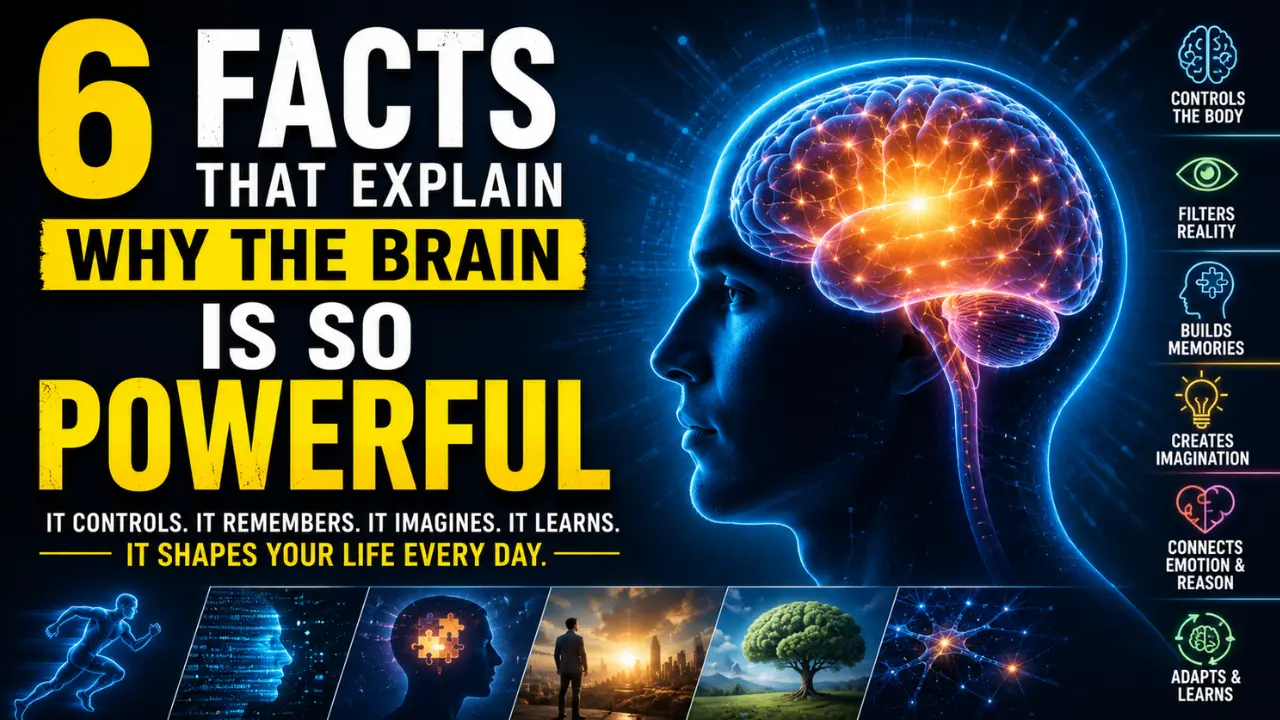

Many people think the brain is powerful because it can think, calculate, remember, and solve problems. That is true, but it is only a small part of the full picture. The brain is not just a thinking organ. It is the control centre that helps the body move, respond, feel, learn, imagine, decide and adapt to the world.
The human brain is powerful because it manages many layers of life at the same time. It receives information from the senses, filters what matters, stores experience as memory, connects emotions with decisions, creates pictures of things that do not exist yet, and changes through learning and repetition.
The brain is so powerful because it controls the body, filters huge amounts of information, stores experience as memory, creates imagination, connects emotion with reasoning, and adapts through learning. Its power is not only intelligence, but the way it coordinates almost everything that makes human life possible.
This is why the brain cannot be understood only as a place where thoughts happen. Its real power is seen in how quietly and continuously it supports your entire experience of being alive.
Why Is the Brain So Powerful?
The brain is powerful because it does not do only one job. A heart mainly pumps blood. The lungs mainly support breathing. The stomach mainly helps digest food. These organs are extremely important, but the brain has a wider role because it coordinates, interprets, and responds across the whole body.
More Than a Thinking Organ
The brain helps you read words on a page, recognize a familiar face, move your hand, balance while walking, hear a sound, feel fear, remember a lesson, imagine tomorrow, and choose what to do next. Many of these things happen so naturally that you do not notice how much work is taking place behind them.
The brain’s power is also seen in its ability to connect different kinds of information. It does not treat sight, sound, memory, emotion, and decision-making as completely separate experiences. It brings them together so you can understand what is happening and respond in a meaningful way.
Simple Example: When you hear someone calling your name, the brain does not only process sound. It recognizes language, connects the voice to memory, checks whether the situation needs attention, and prepares you to respond. Something that feels simple on the outside is actually the result of many mental and physical systems working together.
That ability to coordinate many processes at once is one of the main reasons the brain is so powerful.
The brain’s ability to change through learning also explains why daily habits matter so much. If you want to understand the practical side of this topic, you can read this guide on how to unlock 100% of your brain power in a realistic way.
1. Brain Controls the Body
One of the clearest facts about the brain is that it helps control the body even when your conscious attention is somewhere else. You do not need to think carefully about every step while walking, every small movement while speaking, or every adjustment your body makes to keep balance. The brain and nervous system manage much of this coordination in the background.
Body’s Central Command System
This does not mean the brain works alone. The spinal cord, nerves, muscles, organs, hormones, and other body systems also play important roles. But the brain remains the central command system that helps organize movement, sensation, reaction, and body awareness.
When you pick up a glass of water, your brain helps judge distance, guide your hand, control grip strength, coordinate your eyes and muscles, and adjust your movement before you spill it. You may experience this as one simple action, but it requires timing, prediction, sensory feedback, and motor control.
The same is true when you speak. Your brain helps choose words, arrange them in order, control the mouth and tongue, manage tone, and listen to what you are saying. You do not consciously control every small part of this process because the brain has already learned how to coordinate it.
Why This Makes the Brain Powerful: The brain does not only help you think about action. It helps turn intention into movement, speech, reaction, and physical coordination.
2. Brain Filters Reality
The brain receives huge amounts of information from the eyes, ears, skin, nose, tongue, muscles, joints, and internal body signals. If all of this information reached your conscious mind equally at the same time, life would feel overwhelming. You would not be able to focus on a conversation, read a sentence, cross a road, or complete a simple task without being flooded by details.
Your Brain Chooses What Matters First
The brain protects you from overload by filtering reality. It selects what seems important, reduces what is less urgent, and helps your attention move toward what matters in the moment.
This is why you can ignore background noise while reading, but quickly notice a sudden loud sound. It is why you may not feel your clothes touching your skin all day, but you immediately notice a sharp pain. It is also why your name can catch your attention in a crowded place, even when many other voices are present.
The brain does not simply record the world like a camera. It interprets the world. It decides what to highlight, what to ignore, what to connect with memory, and what may need a response.
Conscious Attention Is Limited
This filtering ability makes the brain powerful because conscious attention is limited. You cannot focus on everything at once, so the brain helps build a usable version of reality. It gives your mind enough information to function without forcing you to carry every detail.
Most people think seeing and hearing are simple processes, but the brain is constantly organizing those signals into meaning. You do not only see shapes and colours; you recognize objects, faces, movement, danger, distance, and emotional expressions. You do not only hear sound; you recognize words, tone, rhythm, warning, and familiarity.
Why This Makes the Brain Powerful: The brain helps you live in a complex world without being crushed by the amount of information around you. It selects, organizes, and interprets reality so you can respond with meaning.
3. Brain Turns Experience Into Memory
Memory is one of the most important reasons the brain is so powerful. Without memory, life would lose continuity. You would not know who you are, what you have learned, who you love, what hurt you, what helped you, or what choices shaped your past.
Memory Is More Than Remembering Facts
Memory is not only about remembering facts from school. It includes personal experiences, familiar faces, language, habits, emotional lessons, physical skills, and the meaning you attach to events. The brain uses memory to connect your past with your present and future.
There are different kinds of memory working in daily life:
- Facts and knowledge: These include names, dates, places, ideas, meanings, and information you have learned.
- Personal memories: These include moments from childhood, conversations, failures, achievements, relationships, and meaningful events.
- Skill memory: This helps you walk, write, type, ride a bicycle, cook, play a sport, or use a tool through practice.
- Emotional memory: This connects certain people, places, sounds, or situations with safety, fear, joy, pain, comfort, or warning.
This makes the brain powerful because it does not only store information. It uses memory to guide behaviour.
Memory Guides Future Choices
If you touched something hot in the past, memory helps you avoid danger later. If you practiced a skill many times, memory helps your body perform it with less effort. If someone betrayed your trust, memory may make you more cautious. If someone treated you with kindness, memory helps create attachment and confidence.
Memory also supports identity. Your sense of self depends heavily on what you remember about your life, your values, your relationships, your struggles, and your growth. The brain helps turn scattered experiences into a personal story.
Why This Makes the Brain Powerful: Memory is deeper than storage. The brain uses the past to help you understand the present and prepare for what may come next.
4. Brain Can Imagine What Does Not Exist Yet
One of the most remarkable facts about the brain is its ability to imagine. The brain is not limited to what is directly in front of the eyes. It can picture the future, create stories, design solutions, build plans, and mentally test possibilities before anything happens in the real world.
Imagination Is Not Just Fantasy
Imagination is connected to planning, problem-solving, creativity, invention, moral reflection, and decision-making. Before a house is built, someone imagines the design. Before a business is started, someone imagines the idea. Before a book is written, someone imagines the message. Before a person makes a serious choice, the brain may imagine possible outcomes.
The brain can simulate situations that are not currently happening. You can think about a conversation before it takes place. You can imagine the result of a mistake before making it. You can picture a goal that does not yet exist. You can mentally rehearse a speech, a journey, a meeting, or a difficult decision.
Brain Can Test Possibilities Before Action
This makes the brain powerful because it allows humans to go beyond immediate reaction. Animals and humans both respond to the present world, but the human brain has a highly developed ability to create meaning, symbols, plans, stories, and future possibilities.
Imagination also helps people learn from situations they have not directly experienced. A person can hear a story and understand a lesson. They can read about someone else’s mistake and avoid repeating it. They can imagine danger and prepare for it. They can imagine improvement and work toward it.
Why This Makes the Brain Powerful: The power of imagination is not that it escapes reality, but that it helps shape reality. Many things humans create first existed as mental pictures, questions, designs, hopes, or solutions inside the brain.
5. Brain Connects Emotion With Reason
A powerful brain is not only logical. Human decisions are rarely made by pure calculation alone. The brain connects reason, memory, emotion, desire, fear, values, and past experience before guiding a choice.
Emotion Is Part of Human Judgment
Emotions are often misunderstood. Many people think emotion is the enemy of clear thinking, but emotion can also provide useful information. Fear can warn you about danger. Sadness can show that something matters. Guilt can push you to repair harm. Hope can motivate you to continue. Love can shape loyalty, sacrifice, and commitment.
The problem begins when emotion overwhelms reason or when reason ignores emotional truth. A balanced brain does not remove emotion; it learns how to connect emotion with judgment.
For example, when you make a financial decision, your brain may compare numbers, remember past mistakes, feel anxiety about risk, imagine future results, and consider what matters most to you. When you decide whether to trust someone, your brain may combine their words, facial expression, past behavior, your emotional response, and your previous experiences with similar people.
Brain Weighs Meaning
This combination is one reason the brain is powerful. It does not only ask whether something is true. It also considers whether something is safe, valuable, familiar, risky, meaningful, or worth pursuing.
The brain’s decision-making system is deeply connected to meaning. Humans do not make choices only to survive. They also make choices based on identity, relationships, goals, beliefs, fear, hope, and responsibility.
Why This Makes the Brain Powerful: A calculator can process numbers, but the brain can weigh meaning. It can connect facts with feelings, memory with risk, and short-term pressure with long-term consequences.
6. Brain Can Change Through Learning and Repetition
The brain is powerful because it is not completely fixed. It can change through learning, practice, experience, and repetition. This ability is often called neuroplasticity, which simply means the brain can adjust and strengthen patterns over time.
Brain Strengthens What It Repeats
This does not mean a person can become anything instantly or change every part of the mind overnight. Brain change is usually gradual. It depends on repetition, attention, practice, environment, and time. But the fact that the brain can adapt at all is one of its most important strengths.
When you practice a skill, the brain strengthens the connections involved in that skill. When you repeat a habit, the brain becomes more familiar with that pattern. When you learn a new language, instrument, tool, or subject, the brain has to build and strengthen new pathways. When you change behavior consistently, the brain slowly adjusts to the new routine.
This is why practice matters. At first, a new skill feels difficult because the brain has not yet built strong pathways for it. Over time, the same action becomes smoother, faster, and more natural. What once required full attention can become easier because the brain has adapted.
Learning Shows the Brain’s Adaptability
You can see this in ordinary life. A child learning to write must think carefully about every letter. A beginner learning to drive feels overwhelmed by mirrors, pedals, steering, signals, and road awareness. A new speaker may struggle to find words. But with repetition, the brain organizes these actions more efficiently.
This ability to learn from experience makes the brain different from a simple machine. A machine follows instructions. The brain can change its responses based on practice, feedback, failure, and new information.
The brain’s adaptability is also why habits become powerful. Repeated actions shape the brain, whether those actions are helpful or harmful. This means the brain is always being trained by what a person repeatedly does, thinks, practices, and pays attention to.
Why This Makes the Brain Powerful: The brain does not only carry the past; it can also adjust for the future. Its ability to adapt is one of the clearest signs of its power.
What Makes the Human Brain Different?
The human brain is not powerful because it does one thing perfectly. It is powerful because it brings many abilities together into one living system. It can control the body, interpret signals, create memory, imagine possibilities, manage emotion, make decisions, and learn from experience.
Self-Awareness Adds Another Layer
This combination allows humans to do things that go far beyond simple reaction. People can build cultures, create languages, write books, design cities, solve scientific problems, make art, reflect on morality, remember history, and plan for generations ahead.
The human brain also gives people the ability to think about their own thinking. You can question your motives, review your decisions, regret a mistake, change your plan, imagine a better version of yourself, and choose a different response next time. This self-awareness adds another layer to brain power because it allows growth, reflection, and responsibility.
The brain is not only important because it makes people intelligent. It is important because it makes human experience possible in the first place.
Real Power of the Brain Is Bigger Than Thinking
The brain is powerful because it does far more than produce thoughts. It manages the body, filters reality, stores memory, creates imagination, connects emotion with reason, and changes through learning. These abilities work together so smoothly that most people only notice them when something becomes difficult.
Everyday life depends on the brain’s hidden work. Reading a sentence, recognizing a face, avoiding danger, learning a skill, feeling love, making a choice, remembering the past, and planning the future all depend on the brain’s ability to coordinate many systems at once.
This is why the brain deserves to be understood with more depth. Its power is not magical, and it is not only about intelligence. Its power is seen in the way it turns body signals, memories, emotions, ideas, and experiences into meaningful human life.
The brain is powerful because it helps you live, understand, remember, imagine, choose, and grow. That is what makes it one of the most remarkable parts of the human body.

3 thoughts on “6 Facts That Explain Why the Brain Is So Powerful”