
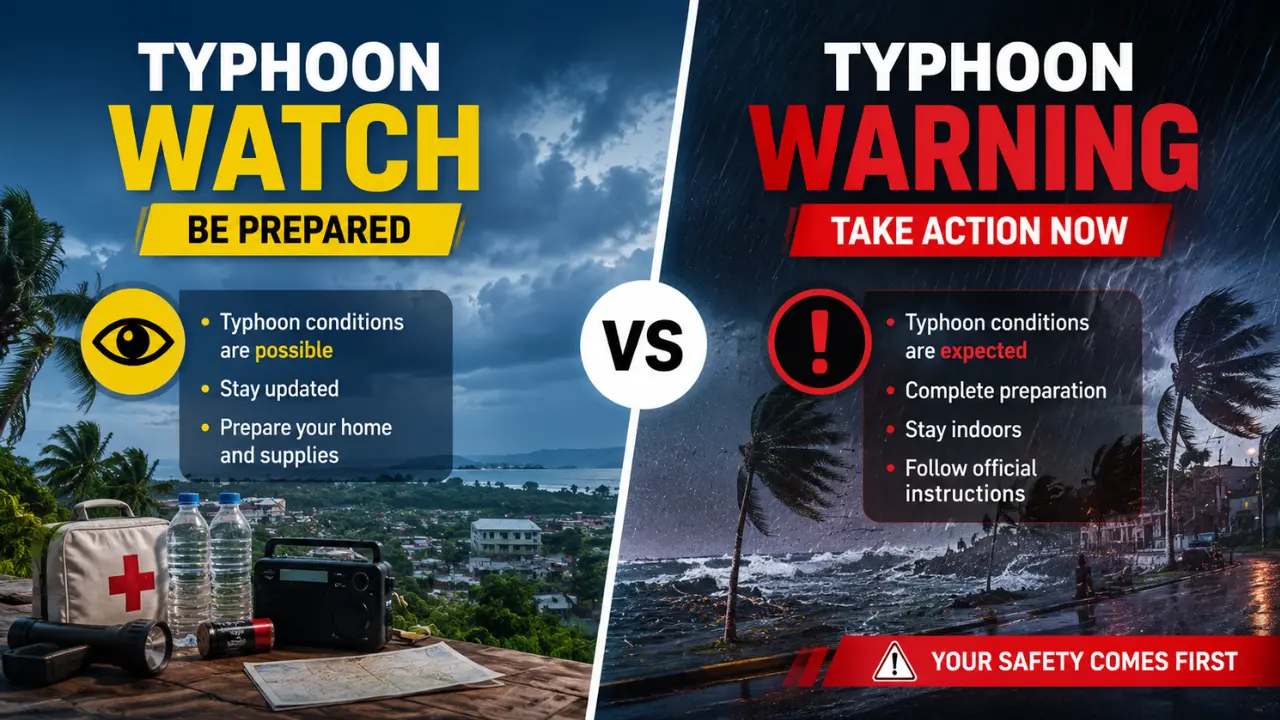

A typhoon watch and a typhoon warning do not mean the same thing, and misunderstanding the difference can lead people to prepare too late. During a fast-changing storm, these alert words are not just weather language. They are timing signals that tell families when to get ready, when to finish preparation, and when outdoor movement may soon become unsafe.
A typhoon watch means typhoon conditions are possible in the affected area, while a typhoon warning means typhoon conditions are expected. The National Weather Service explains tropical cyclone watches and warnings as official alerts issued ahead of dangerous tropical weather, and these alerts are designed to give people time to act before conditions become too dangerous for preparation.
Why People Confuse a Watch and a Warning
Many people hear the word “watch” and think it means nothing serious has started yet. That can be a dangerous mistake because a watch is not a casual update. It means the risk is real enough that people should begin serious preparation.
A warning carries stronger urgency because the dangerous conditions are expected, not only possible. By the time a typhoon warning is issued, families should not be starting from zero. They should already be securing homes, checking supplies, protecting documents, charging devices, and deciding whether their home is safe enough to stay in.
The difference is easiest to understand this way: a watch is the preparation window, and a warning is the action window. If people wait for the warning before doing basic preparation, they may lose valuable time.
A small north or south movement can change the wind and rain threat, which is why Guam’s risk if Bavi shifts closer needs careful attention.
What a Typhoon Watch Really Means
A typhoon watch means that typhoon-force winds may affect the area if the storm continues on a dangerous path. It does not guarantee that the eye will pass directly overhead, and it does not mean every location will get the same level of wind. It means the threat is close enough and serious enough that people should prepare.
During a watch, residents should not panic, but they should also not ignore the alert. This is the time to review the forecast, check official updates, secure loose outdoor items, prepare food and water, refill medication, charge phones and power banks, and think about shelter options.
The practical value of a watch is time. It gives families a chance to act while roads are still safer, stores are still reachable, and weather conditions have not yet reached their most dangerous stage.
What a Typhoon Warning Really Means
A typhoon warning means typhoon conditions are expected in the warning area. At this point, the storm is no longer a distant possibility. The threat has moved into a more urgent stage, and preparation should be completed before damaging winds arrive.
When a warning is issued, people should not wait for the sky to look frightening. The weather outside may still appear manageable for a while, especially before the outer bands fully arrive. But official warnings are based on the storm’s forecast path, wind field, timing, and expected hazards, not only on what one neighborhood sees at that moment.
A warning should push families to finish securing property, avoid unnecessary travel, move to shelter if needed, and stay updated through official sources. The goal is to be safely indoors before conditions become dangerous.
Why Warnings Are Issued Before the Worst Weather Arrives
Warnings are issued before the worst weather arrives because preparation becomes harder once strong winds begin. Outdoor work becomes dangerous, roads can flood, stores may close, power can fail, and emergency response may become limited.
The National Weather Service explains that tropical cyclone public advisories are issued frequently when watches or warnings are in effect, because forecast information changes as the storm moves and new data becomes available. This is why people should follow the latest official advisory rather than relying on one old screenshot or a post from several hours earlier.
A warning is not meant to describe only the current weather outside. It is meant to describe expected danger soon enough for people to act.
Tropical Storm Warning vs Typhoon Warning
A tropical storm warning and a typhoon warning are different because they refer to different wind ranges. A tropical storm warning points to tropical-storm-force conditions, while a typhoon warning points to stronger typhoon-force conditions.
The National Weather Service defines tropical storm conditions as sustained winds from 39 to 73 mph, while hurricane or typhoon conditions begin when sustained winds reach 74 mph or higher. For readers in the western Pacific, a typhoon is the same type of storm system called a hurricane in the Atlantic, but the regional name is different.
This distinction matters because wind strength changes the level of expected damage. Tropical-storm-force winds can still break branches, throw loose objects, cause power outages, and make roads unsafe. Typhoon-force winds bring a higher risk of structural damage, dangerous debris, roof failure, and longer disruption.
Why a Flood Watch Can Matter Even if the Wind Is Not Extreme
A typhoon is not only a wind event. Flood watches and flood warnings matter because heavy rain can create danger even in areas that avoid the strongest eyewall winds.
Ready.gov warns people not to drive or walk through floodwater and uses the safety rule “turn around, don’t drown,” because flooded roads and walkways can hide serious hazards. This is important during typhoons because heavy rain can flood low roads, overwhelm drainage, loosen soil, and create mudslide risk.
A flood watch means flooding is possible, so residents in low-lying areas should prepare before water rises. A flood warning means flooding is happening or expected, so people should avoid flood-prone roads and follow emergency instructions.
Readers following the latest warnings should also understand what to do before Super Typhoon Bavi reaches Guam so they are not waiting until the final hours.
Why High Surf and Coastal Warnings Should Not Be Ignored
High surf, coastal flood, and storm surge warnings can be just as serious as wind alerts. During a typhoon, the ocean can become dangerous before the storm center arrives and may remain dangerous after the strongest winds pass.
The National Weather Service says a storm surge warning means there is a danger of life-threatening flooding within the warning area, while a storm surge watch means there is a possibility of life-threatening flooding. Even when an island avoids the worst wind core, exposed beaches, reefs, marinas, coastal roads, and low-lying shoreline areas can still face dangerous water.
People should not go to the coast to watch waves, take videos, check boats, or retrieve gear once coastal warnings are active. Water-related warnings should be treated as life-safety alerts, not as background weather information.
Why One Island May Have a Warning While Another Has a Watch
Typhoon alerts can differ from island to island because the storm’s track, size, wind field, and forecast uncertainty affect each location differently. One island may be closer to the expected center, while another may be far enough away to face only possible conditions at that advisory time.
This does not mean the safer-looking island should ignore the storm. A watch can become a warning if the track shifts, the storm grows, or the forecast confidence increases. Guam Homeland Security has repeatedly reminded the public in past tropical cyclone advisories that conditions and watches can change when the system’s track or threat changes.
The safest approach is to treat watches as early action signals and warnings as urgent completion signals. Waiting for all islands to have the same alert can leave people unprepared.
How to Read a Typhoon Advisory Without Getting Confused
A typhoon advisory should be read in a simple order. First, check the issue time. A storm update from several hours ago may already be outdated. Second, check your exact location because warnings can differ between Guam, Rota, Tinian, Saipan, and other islands. Third, check the hazard type because wind, rain, coastal flooding, and surf may each have separate alerts.
Then read the timing. The most important question is not only where the storm center is now, but when dangerous conditions are expected to begin where you live. A family needs to know when outdoor preparation should stop, not only when the eye may pass closest.
Finally, look for official action language. Phrases like “complete preparations,” “move to shelter,” “avoid travel,” “stay away from the coast,” and “follow local officials” matter because they translate the forecast into practical safety decisions.
What People Should Do During a Typhoon Watch
During a typhoon watch, the best response is serious preparation without panic. Residents should use the time to secure homes, gather emergency supplies, check family communication plans, refill medicine, protect documents, and prepare for possible power loss.
This is also the right time to decide whether the home is safe enough. A weak roof, temporary structure, flood-prone location, coastal exposure, damaged windows, or medical dependence can make staying home riskier. If a move to a stronger shelter may be needed, that decision should be made before the warning stage becomes urgent.
The watch stage is the time to reduce stress later. The more work finished during a watch, the less dangerous last-minute action is needed during a warning.
What People Should Do During a Typhoon Warning
During a typhoon warning, preparation should move from planning to completion. Outdoor objects should already be secured or brought inside. Windows and doors should be protected. Phones, power banks, radios, flashlights, and medical devices should be charged. Important documents should be placed in waterproof protection.
Families should avoid unnecessary driving once weather conditions begin to worsen. If officials open shelters or advise certain residents to relocate, people in weak or flood-prone homes should act early. The goal is to be in a safe place before winds, rain, and road conditions make movement dangerous.
A warning is not the time to shop casually, visit the beach, check a boat, or wait for more certainty. It is the time to finish safety steps.
Why Old Alerts Can Be Dangerous
Old alerts can be dangerous because they may describe a storm before it strengthened, shifted, slowed down, or moved closer. A post saying “no warning is in effect” may have been accurate when published but misleading after a later advisory upgrades the alert.
This is why storm content should always include “as of” wording with the date and advisory time. Readers should also check the newest official update before making decisions. The National Weather Service Guam tropical cyclone page provides official regional tropical cyclone information and related forecast products for Guam and surrounding areas.
A storm update is only useful when it is current. During a fast-changing typhoon, yesterday’s accurate information can become today’s unsafe advice.
Why Official Sources Should Come Before Social Media
Social media can help spread warnings quickly, but it can also spread screenshots without context, old model runs, dramatic videos from other storms, and unverified claims. During a typhoon, people should treat official sources as the first layer of trust.
For Guam and the Marianas, official weather and emergency sources are more reliable than random reposts because they issue location-specific alerts, warning language, timing, and safety guidance. Ready.gov also advises people to get local alerts, make a plan, gather supplies, and know where to go if asked to evacuate.
A useful rule is simple: if a post does not show the source, location, date, and time, do not use it for safety decisions.
Lesson About Typhoon Watches and Warnings
The main lesson is that a typhoon watch is not a reason to relax, and a typhoon warning is not a reason to start preparing late. A watch means the threat is possible and preparation should begin. A warning means the threat is expected and preparation should be completed.
The difference matters because typhoons close the safe preparation window quickly. Wind, rain, flooding, coastal water, road hazards, and power outages can make ordinary tasks dangerous once conditions worsen.
People who understand alert language make better decisions. They know when to prepare, when to stop traveling, when to avoid the coast, when to move to shelter, and when to trust official updates over rumors. In a typhoon, understanding the warning language is not a technical detail. It is part of staying safe.
