
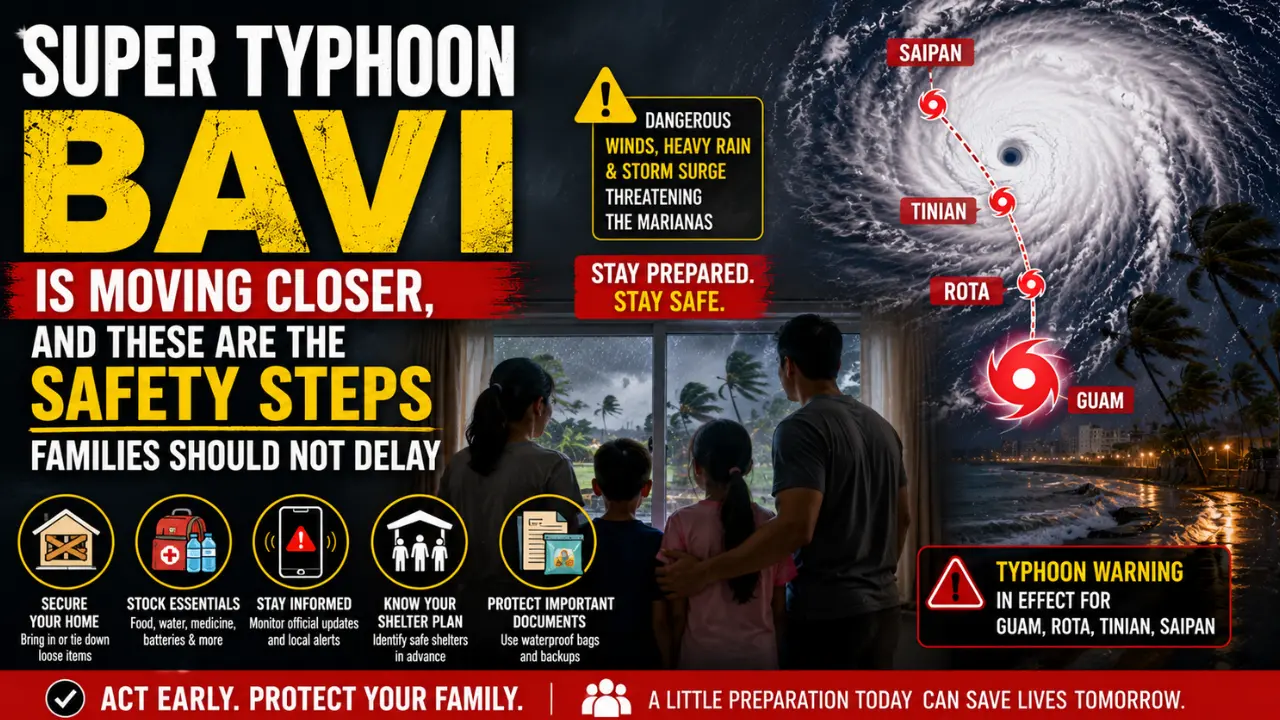

Super Typhoon Bavi is not the kind of storm people should watch casually from a distance. For Guam, Rota, Tinian, Saipan and nearby islands, the main question is no longer only where the centre will pass, but whether families, homes, vehicles, documents, food supplies and shelter plans are ready before conditions become dangerous.
As of early July 2026, official agencies across Guam and the Northern Mariana Islands have been warning residents to prepare for serious impacts from Bavi, including damaging winds, heavy rainfall, flooding, dangerous surf, and possible coastal inundation. Guam Homeland Security said Guam had already entered a state of emergency and Condition of Readiness 3 on July 3, while later advisories announced emergency shelter openings as the storm threat increased.
Why Bavi Preparation Matters Before the Worst Winds Arrive
The most important thing to understand about Super Typhoon Bavi is that preparation becomes harder before the eye arrives. Roads can flood, stores can close, gas lines can grow, loose objects can start flying and emergency responders may not be able to move freely once winds become dangerous.
That is why officials have repeatedly advised residents to act early. Guam Homeland Security’s advisory urged people to review household emergency plans, prepare food and water for several days, secure outdoor items, protect important documents, clear drainage areas, and check on elderly or disabled neighbours before the storm worsens.
This is also why the storm should not be judged only by its category. A powerful typhoon creates several overlapping dangers at once. Wind can damage roofs and windows, rain can flood low areas, waves can make coastal roads unsafe, and power outages can turn a short emergency into a longer household survival problem.
For a focused breakdown of Guam’s risk from Super Typhoon Bavi, the storm’s path, wind field and possible flooding impacts need to be understood together.
Secure the Home Before Winds Become Dangerous
The first priority before Bavi reaches its strongest conditions is to reduce anything that can become airborne. Outdoor furniture, trash bins, garden tools, signs, toys, plywood scraps, loose roofing materials, and small decorations can become dangerous in typhoon-force winds.
Home preparation should begin outside and then move inside. Windows, shutters, doors, garage doors, and weak roof areas should be checked as early as possible. Guam Homeland Security advised residents to secure outdoor items, clear loose debris and protect windows and doors before conditions deteriorate.
Inside the home, families should choose the safest room before the storm arrives. A strong interior room away from windows is usually safer than a room facing the ocean, an exposed hillside, or an area with large trees. If the home is weak, flood-prone, under temporary repair or not built to handle strong winds, staying there may become more dangerous than moving to a stronger shelter.
Prepare Food, Water, Medicine and Power Backup
A super typhoon can damage more than buildings. It can interrupt electricity, water supply, mobile service, road access, fuel availability, and basic shopping. This is why emergency supplies should not be prepared only for the hours of landfall, but for the days after the storm.
A practical household kit should include drinking water, ready-to-eat food, medication, first aid items, flashlights, batteries, power banks, hygiene items, baby supplies if needed, pet supplies if allowed in the shelter plan, cash, and copies of important documents. Guam Homeland Security specifically advised residents to prepare enough food and water for 7 to 10 days, including medication, disinfectant supplies and pet supplies.
Phones and power banks should be fully charged before the strongest winds arrive. People should also download important contact numbers, maps, insurance documents, medical records and emergency alerts because internet access may become unreliable after the storm.
Know When to Leave a Weak Structure
One of the most important decisions during a typhoon is knowing when a home is not safe enough. People living in temporary shelters, damaged homes, low-lying areas, metal-roof structures, or buildings still under repair should not wait until winds become severe to decide where to go.
In the Northern Mariana Islands, shelters on Saipan, Tinian, and Rota were opened before Bavi’s expected impacts, and residents in temporary STRONG tents or under temporary roof repairs were strongly urged to relocate because those structures were not designed to withstand tropical storm or typhoon-force winds.
This is an important lesson for every storm-prone community. A shelter decision should be based on the strength of the structure, flood risk, health needs, and whether the household can safely remain there without power, water or outside help. Waiting too long can turn a safe relocation into a dangerous journey.
Do Not Underestimate Flooding
Many people focus on wind during a super typhoon, but flooding can become just as dangerous. Heavy rain can overwhelm drains, rivers, streams, low roads, and poor drainage areas. If rainfall continues for many hours, even familiar roads can become unsafe.
Guam Homeland Security warned that Bavi could bring 6 to 12 inches of rain to Guam, with locally higher amounts possible, and that rainfall near the storm centre could approach much higher totals, increasing the risk of flash floods and mudslides.
The safest approach is to avoid driving through flooded roads. Water depth is often difficult to judge during heavy rain, and road surfaces may be damaged underneath. Floodwater can also hide debris, sharp objects, open drains and electrical hazards.
Residents in flood-prone areas should move important belongings to higher places, keep documents in waterproof bags, and avoid sleeping in rooms where water could enter quickly. If local authorities advise moving to safer ground, that advice should be followed before the storm is at full strength.
Stay Away From Beaches, Reefs and Marinas
Bavi is also a marine and coastal danger. Strong typhoon winds can push water toward shore, produce dangerous wave runup, damage vessels, and create life-threatening surf. Coastal areas may become unsafe before the storm centre reaches land.
The U.S. Coast Guard warned residents and mariners to stay out of the water, secure small vessels and water sports equipment and avoid depending on emergency responders once conditions deteriorate. The Coast Guard also explained that some response assets are secured or moved before the storm so they can return for rescue and recovery once it is safe.
This matters because many people make dangerous mistakes near the coast during storms. They go to take photos, check boats, watch waves, or retrieve property too late. During a super typhoon, the ocean can become violent long before the eye reaches the island.
No photo, boat, board, fishing gear, or loose equipment is worth a rescue attempt during typhoon conditions. Marine preparation should be finished early, and people should stay inland and sheltered as conditions worsen.
Have More Than One Way to Receive Alerts
During a major storm, depending on one phone app or one social media page is not enough. Power outages, weak mobile signal, internet disruption, and platform delays can all interrupt updates.
Residents should follow official sources such as the National Weather Service Guam, Guam Homeland Security/Office of Civil Defence, CNMI emergency management authorities, and local government announcements. The U.S. Coast Guard also warned that social media should not be used as a distress channel and said emergency calls should go through proper emergency communication methods.
A battery-powered radio, charged phone, saved emergency numbers, and direct official alerts can help families stay informed even when normal communication becomes difficult. Households should also decide in advance how family members will communicate if they are separated.
Check on Elderly, Disabled and Isolated Neighbours
A storm like Bavi is not only a weather problem. It is also a community safety test. Elderly residents, disabled people, people without transport, families in weak housing, and those still recovering from earlier storm damage may need help before conditions become dangerous.
Guam Homeland Security specifically advised residents to check on elderly and disabled neighbours and family members while preparation is still possible.
This kind of help can be simple but important. It may include moving outdoor items, helping someone charge devices, sharing official shelter information, arranging transport, placing documents in waterproof bags, or making sure medication is ready. During the height of the storm, this help may no longer be possible.
Prepare for the Recovery Period Too
The danger does not end when the worst winds pass. Roads may be blocked, power lines may be down, roofs may be damaged, floodwater may remain, and emergency crews may need time to assess the safest routes.
After the storm, people should avoid touching fallen wires, walking through floodwater, entering unstable buildings, or using generators indoors. Guam Homeland Security warned that generators should never be used inside a house, garage, or enclosed space, and should be operated outdoors away from the home because of carbon monoxide danger.
Families should also take photos of damage for insurance or recovery claims before cleaning up, when it is safe to do so. Food safety matters as well. If power has been out for a long time, refrigerated food may not be safe. Drinking water should also be checked against official guidance.
What Makes Bavi Especially Serious for the Marianas
Bavi is serious because it is approaching island communities where strong winds, coastal flooding, and infrastructure disruption can affect daily life quickly. The risk is not only the wind speed near the center, but also the combined pressure on homes, shelters, roads, ports, emergency responders, and families who may already be dealing with storm recovery.
Earlier reports said forecasters expected Bavi to pass close to the Marianas, with warnings and watches affecting Guam, Rota, Tinian, Saipan, and nearby islands. Weather reports also described the threat as including destructive winds, heavy rain, dangerous surf, and possible coastal flooding.
That is why preparation should be treated as a life-safety decision, not a last-minute household chore. The people who are safest during a typhoon are usually not the people who wait for certainty. They are the people who prepare while there is still time to move calmly, secure property, and choose a safer place if needed.
Important Message Before Bavi Arrives
The most important message before Super Typhoon Bavi is simple: finish preparation before conditions become dangerous. Secure the home, protect documents, charge devices, store water, prepare medicine, stay away from the ocean, follow official alerts, and move to a stronger shelter if the current home is not safe.
A typhoon warning is not meant to create panic. It is meant to create early action. Bavi’s exact track may still shift, but the preparation window is the part residents can control.
For Guam, Rota, Tinian, Saipan, and nearby islands, Bavi should be treated with serious respect. Wind, water, flooding, and communication failures can all become dangerous at the same time, and official guidance should be followed over rumors, old screenshots, or casual social media updates.

1 thought on “What to Do Before Super Typhoon Bavi Reaches Guam”