
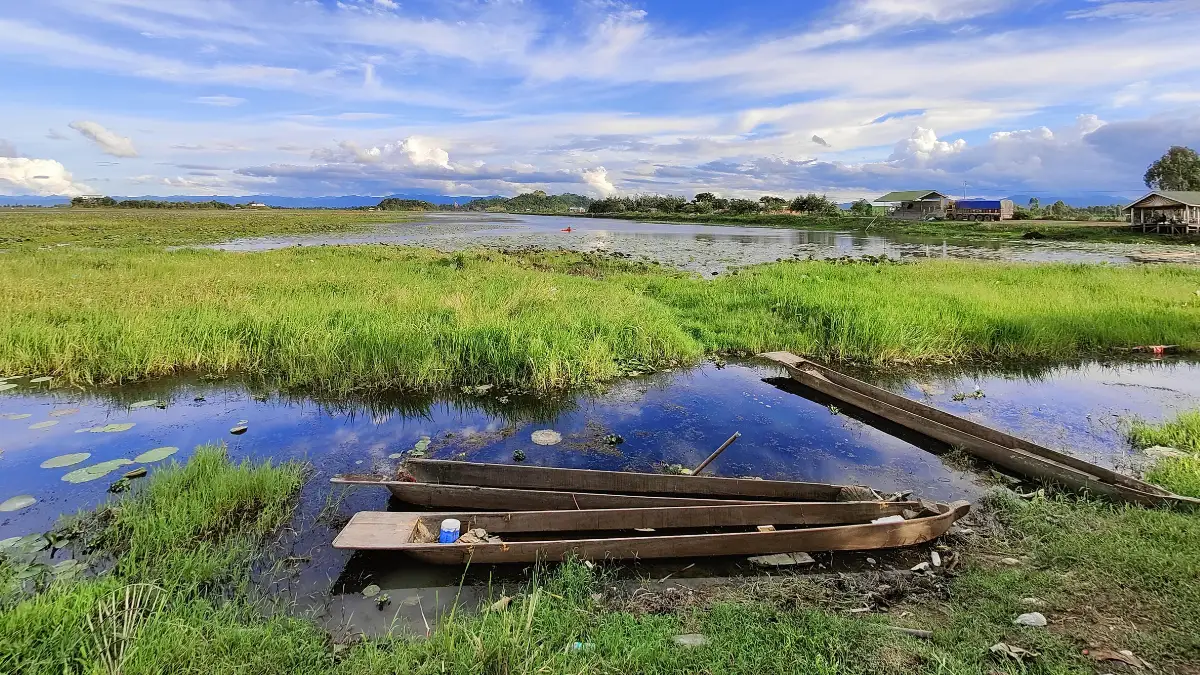

Phumdis are floating masses of vegetation, roots, soil and partly decomposed organic material found across Loktak Lake in Manipur.
Their high proportion of lightweight plant material gives them a low overall density and enough buoyancy to remain afloat. Much of a phumdi stays underwater, while grasses and other vegetation grow on the visible upper surface.
Phumdis are not ordinary islands resting on rock or solid ground. They are living wetland formations that can thicken, thin, move, fragment and change shape as water levels and vegetation conditions change.
What Exactly Is a Phumdi?
A phumdi is a floating wetland mat made from both living and decomposing natural material.
It may appear from above as a patch of grass or floating land, but its structure extends below the water. The submerged section contains intertwined roots, plant remains, humus, soil and other organic material.
Phumdis vary widely in size and thickness. Some form small floating patches, while others cover large areas of Loktak Lake.
The upper surface may support grasses, reeds and other wetland plants. Thicker masses can also support fishing activity, simple huts and wildlife.
A phumdi does not have the fixed foundation of a normal island. Its position and stability depend on its thickness, plant composition, surrounding water depth and connection with the lakebed.
What Are Phumdis Made From?
Phumdis contain a mixture of several materials:
- Living aquatic plants
- Intertwined roots and underground stems
- Dead leaves and plant stalks
- Partly decomposed organic matter
- Humus
- Soil and fine sediment
- Plant debris trapped within the root network
Fresh vegetation grows over older layers. When roots, stems and leaves die, they collect within the mass and begin decomposing.
New roots grow through the older material and help bind the layers together. Fine soil particles and organic debris also become trapped within the vegetation.
This creates a thick, spongy structure containing both living plants and decomposing material.
A mature phumdi therefore does not consist only of floating grass. The visible vegetation grows over a much deeper biological mat.
How Do Phumdis Form?
A phumdi can begin when floating vegetation or undecomposed organic material accumulates plant debris and fine sediment.
Grasses and other wetland plants then colonise the developing mass. Their roots spread through the material and help hold living vegetation, soil and decomposing matter together.
As older plants die, new plants continue growing above them. More roots, soil particles and organic material gradually become part of the mat.
This repeated process can make the phumdi thicker and more stable.
Phumdis do not all form through one identical sequence. Water depth, plant species, currents, sediment, seasonal water levels and human activity can influence how each mass develops.
Some may remain close to shallow areas, while others break away and float into deeper water.
Why Do Phumdis Float?
Phumdis float because their overall structure has a lower density than compact mineral soil.
A phumdi contains large amounts of roots, stems, partially decomposed vegetation and porous organic matter. These lightweight materials create enough buoyancy to keep the mass from sinking completely.
Much of a thick phumdi remains submerged. Only the upper section rises above the water and supports visible vegetation.
The structure behaves more like a broad floating wetland mat than a solid island.
Different phumdis sit at different heights in the water. A thick mass with dense vegetation may remain more stable, while a thin or degraded phumdi may sit lower or break apart more easily.
Its buoyancy can also change as the material becomes waterlogged, decomposes or loses healthy plant growth.
Are Phumdis Permanently Free-Floating?
Not every phumdi remains permanently free-floating.
Some masses drift or move slowly under the influence of wind and water. Others may touch or partly rest on the lakebed when water levels fall.
A phumdi floating during the wet season may come into contact with bottom sediments during a lower-water period.
Its relationship with the lakebed depends on:
- The thickness of the phumdi
- The depth of the surrounding water
- Seasonal changes in lake level
- The shape of the lakebed
- The movement of wind and currents
It would therefore be inaccurate to describe every phumdi as permanently attached to the bottom or permanently floating above it.
Do Phumdis Settle Onto the Lakebed During the Dry Season?
Historically, Loktak Lake experienced stronger seasonal changes in water level.
As water levels fell during the dry season, some thick phumdis settled onto or came into contact with the lakebed. Their plants and roots could then obtain nutrients from bottom sediments.
When water levels rose again, those masses regained buoyancy and lifted away from the lakebed.
This seasonal contact helped maintain parts of the floating vegetation.
Changes in Loktak Lake’s water regime have disrupted that cycle in some areas. More consistently maintained water levels can prevent certain phumdis from reaching the lakebed as regularly as they once did.
A phumdi that remains floating for long periods without enough nutrient renewal may gradually become thinner or weaker.
However, not every phumdi follows the same seasonal pattern. Location, thickness and water depth determine whether a particular mass reaches the bottom.
Are Loktak Lake’s Circular Floating Islands Natural?
Many aerial photographs of Loktak Lake show striking circular or ring-shaped patches of vegetation.
Not all of these circles formed naturally.
Fishing communities create or maintain some circular enclosures called athaphums. People arrange strips or sections of phumdi vegetation into controlled shapes for fishing.
Natural phumdis usually have less regular outlines, although wind, currents and plant growth can still change their shape.
An athaphum therefore differs from an ordinary natural phumdi.
A phumdi forms through wetland processes involving vegetation, roots, soil and decomposing organic matter. An athaphum involves deliberate human shaping or management of floating vegetation.
Dense concentrations of athaphums can reduce open-water areas, obstruct movement and affect the wider wetland system.
Can People Build Huts on Phumdis?
Some people connected with Loktak Lake’s fishing economy use floating huts built on sufficiently thick phumdis.
These huts are often called phumsangs.
A phumsang can provide shelter or working space for people who depend on fishing and other lake resources.
Not every phumdi can support a structure. The underlying mass must have enough thickness and stability.
Construction, repeated movement and waste can also place pressure on the floating vegetation. People must maintain the supporting surface and avoid weakening exposed areas.
Phumdis should not be treated like permanent plots of solid land. They remain living and changing parts of the lake.
How Do Phumdis Support Wildlife?
A sufficiently thick phumdi can spread weight across a broad network of roots, soil and compressed vegetation.
Fish, insects, wetland birds and smaller animals use floating vegetation for shelter, feeding and breeding.
The strongest phumdi masses can also support larger animals.
The most famous example is the Sangai, or Manipur brow-antlered deer, which lives in Keibul Lamjao National Park.
The deer depends on thick floating meadows for movement, feeding and shelter. It does not stand on thin patches of loose vegetation.
The largest concentration of phumdi lies within Keibul Lamjao, the last natural habitat of the Sangai.
The park contains floating meadows, water channels and an elevated strip of firmer ground. It does not drift around Loktak Lake as one solid island.
Why Are Phumdis Important to Loktak Lake?
Phumdis support both the ecology of Loktak Lake and the livelihoods of communities that depend on it.
They provide habitat
Floating vegetation creates shelter and feeding areas for fish, insects, birds and other wetland animals.
They support fisheries
Fishing communities use parts of the phumdi system and specially shaped athaphums as part of their traditional livelihoods.
They hold useful plants
People collect some wetland plants for food, animal fodder, fuel and household purposes.
They influence nutrient movement
Plants take up nutrients from the water, while roots and organic material trap particles within the wetland.
They support the Sangai habitat
Thick phumdis create the distinctive floating meadow environment used by the endangered Sangai deer.
Phumdis are therefore not decorative floating islands. They form an active part of Loktak Lake’s ecological system.
When Can Phumdi Growth Create Problems?
Natural phumdis remain essential to Loktak Lake, but their location, condition and density matter.
Unchecked floating vegetation can reduce open-water areas, obstruct navigation and affect water movement.
Degraded biomass may also collect in places where it no longer provides healthy habitat.
Dense athaphums can add pressure when they occupy large areas or restrict normal water circulation.
Wetland management must distinguish between:
- Healthy natural phumdi habitat
- Degraded floating vegetation
- Artificial fishing enclosures
- Areas where open water needs protection
Removing all phumdis would damage the wetland. Leaving every floating mass unmanaged could also create ecological and livelihood problems.
The goal should be careful management rather than treating every phumdi as either valuable or harmful.
What Threatens Healthy Phumdis?
Several pressures can weaken Loktak Lake’s phumdi system.
Altered seasonal water levels
Changes in the lake’s natural rise-and-fall cycle can prevent some phumdis from contacting the lakebed and renewing nutrients.
Thinning and fragmentation
Weak phumdis may become thinner, break into smaller pieces or drift away from important habitat areas.
Pollution and sediment
Wastewater, agricultural runoff and eroded soil can change water quality, lake depth and plant growth.
Uncontrolled cutting and reshaping
Cutting, towing or rearranging natural phumdis without ecological planning can damage habitat and alter water movement.
Protecting phumdis requires more than preserving visible vegetation. The condition of the entire lake, surrounding catchment and water regime affects their survival.
How Are Phumdis Different From Living Root Bridges?
Both phumdis and living root bridges involve living plant material, but they develop through completely different processes.
Meghalaya’s living root bridges are deliberately grown by guiding rubber fig roots across streams over many years.
Phumdis develop when aquatic plants, roots, soil and decomposing organic material accumulate into floating wetland masses.
Communities engineer living root bridges from the beginning. Natural phumdis form through ecological processes, although people may later cut, move or reshape them.
One represents guided plant engineering. The other represents a naturally developing floating ecosystem.
Why Are Loktak Lake’s Phumdis So Unusual?
Phumdis blur the normal boundary between land and water.
They support plants and animals like land, but most of their structure remains submerged. They can move, thin, thicken, fragment and change shape as the lake changes.
Some support fishing huts and livelihoods. The thickest areas create habitat for the endangered Sangai deer.
Their survival depends on suitable water levels, healthy vegetation, clean inflows and responsible wetland management.
Phumdis are not simply floating islands. They are living and constantly changing parts of Loktak Lake.

1 thought on “What Are Phumdis in Loktak Lake and How Do They Float?”