
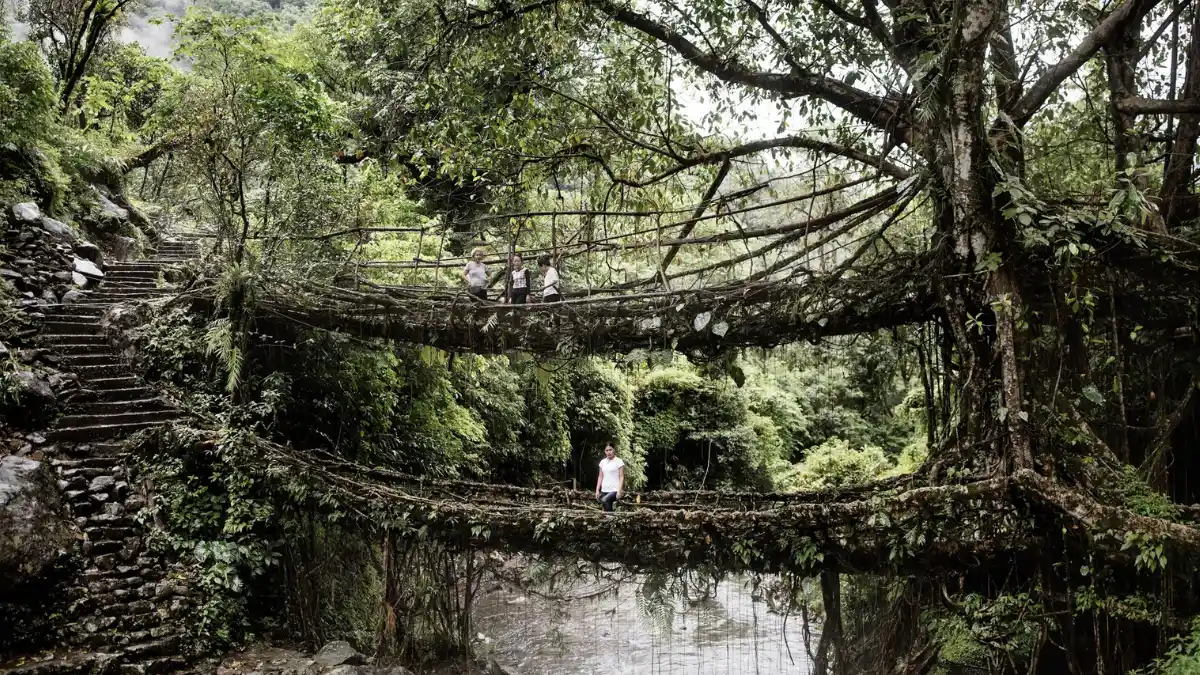

Meghalaya’s living root bridges are grown by guiding the flexible aerial roots of Indian rubber fig trees across streams on temporary bamboo or wooden frameworks.
When the roots reach the opposite bank, Khasi and Jaintia communities anchor them in the ground, weave in additional roots and maintain the developing structure for many years.
The bridges do not form into usable crossings without human guidance. They combine living tree growth with careful engineering, patience and knowledge passed from one generation to another.
What Is a Living Root Bridge?
A living root bridge is a pedestrian crossing made from the living aerial roots of trees rather than cut timber, steel or concrete.
These bridges are mainly associated with the Khasi and Jaintia hills of Meghalaya, where steep terrain, dense forests, fast-flowing streams and heavy rainfall make ordinary crossings difficult to maintain.
Local communities guide living roots into a bridge-shaped structure instead of cutting down a tree and building with dead wood.
The roots remain attached to the tree. They continue absorbing water and nutrients, growing thicker and responding to pressure as long as the tree and surrounding environment remain healthy.
Which Tree Is Used to Make Living Root Bridges?
Communities mainly use the Indian rubber fig tree, scientifically known as Ficus elastica.
This tree produces long aerial roots from its trunk and branches. Young roots remain flexible enough to bend and guide across streams, ravines or narrow valleys.
The tree also grows well in Meghalaya’s humid climate. It can survive on rocky slopes, develop strong root systems and continue producing new aerial roots over many years.
A single tree may provide several roots for one bridge. Some bridges may also incorporate roots from additional trees or use older crossings as part of the developing structure.
How Does the Bridge-Making Process Begin?
The process begins with selecting a suitable location and a healthy rubber fig tree near the stream.
The tree must stand close enough to the crossing point for its roots to reach the opposite bank. The surrounding soil and slope must also provide enough stability for long-term growth.
Community members then identify young aerial roots that can be guided without damaging them.
They do not force the roots sharply into position. They direct them gradually as they grow, allowing each root to adjust to the required path.
During the early stage, the structure may look like a loose collection of thin roots supported by bamboo. It gains strength only through years of growth, weaving and maintenance.
How Do Bamboo Frameworks Guide the Roots?
Young aerial roots cannot immediately support themselves across a wide stream.
Communities commonly train them over bamboo frameworks. Some methods also use areca palm trunks, timber elements or an existing crossing as temporary guidance and support.
A young root may be threaded through a hollow bamboo section, tied loosely along a framework or directed across a simple temporary walkway.
The support encourages the root to grow horizontally toward the opposite bank instead of dropping directly to the ground.
Bamboo works well because it is light, flexible and locally available. However, it does not provide the permanent strength of the finished bridge.
The bamboo may decay and require replacement while the living roots continue to thicken. Community members can add fresh supports and guide more roots into the developing structure.
How Are the Roots Anchored on the Opposite Bank?
Once a root reaches the opposite side, community members guide it into soil, around stable rocks or toward another secure anchoring point.
A root that enters the ground can continue growing and form a stronger connection with the bank.
Builders rarely depend on one root alone. They guide several roots across the stream and weave them around older roots to create a denser network.
New roots may strengthen the main path, support the sides or form handrails.
Closely intertwined roots can sometimes fuse through a natural grafting process called inosculation. Even when every root does not fuse, the woven network can still form a strong and complex structure.
Some young roots may fail to survive or reach the opposite bank. Communities must therefore keep guiding replacement roots into weak or incomplete sections.
How Is the Walking Surface Created?
The main roots form the supporting framework, but people add natural materials to create a safer walking path.
Community members may place small stones, soil, branches or pieces of wood between the roots. These materials fill gaps and create a flatter surface.
As the bridge continues growing, roots can form around stones and other materials, helping hold them in place.
Smaller aerial roots may also be trained along the sides to create handrails or additional support.
The walking surface changes over time. Loose stones may need repositioning, new gaps may appear and growing roots may alter the shape of the path.
The bridge therefore requires continued inspection rather than a one-time construction effort.
How Long Does a Living Root Bridge Take to Grow?
A living root bridge often takes around 15 to 25 years to become usable, although there is no universal construction period.
The timeline depends on several factors:
- The distance the roots must cross
- The health and growth rate of the tree
- Local soil and moisture conditions
- The number of roots being trained
- The design and intended use of the bridge
- The level of community maintenance
A short bridge in favourable conditions may become usable sooner than a longer structure crossing a wider or more difficult stream.
Even after people begin using it, the bridge continues developing. Communities may add more roots, strengthen the sides and improve the walking surface for decades.
A living root bridge is therefore not completed in the same way as a concrete bridge. It remains an evolving structure.
Why Can a Living Root Bridge Strengthen Over Time?
A healthy, actively maintained living root bridge can strengthen as its roots thicken and additional roots become integrated.
Tree roots increase in diameter as the tree matures. A network of several roots can also spread pressure across more than one supporting element.
When closely placed roots fuse, the connection may add further stability. New aerial roots can also be directed into sections that need reinforcement.
The bridge does not automatically become stronger simply because it becomes older.
Disease, soil erosion, flood damage, fire, careless use or lack of maintenance can weaken the structure. Its condition depends on both biological growth and continued human care.
Can Living Root Bridges Continue Growing After Damage?
Living growth can help a bridge recover from limited damage, but it does not repair itself automatically.
When one root weakens, the tree may produce new aerial roots. Community members can guide those roots toward the damaged area and weave them into the existing network.
They may also support weak sections, replace temporary bamboo, stabilise the approach path or protect exposed roots.
This ability to add new living material gives the bridge a form of renewal that dead construction materials do not possess.
However, severe floods, landslides, fire, major erosion or damage to the supporting tree can destroy a bridge beyond recovery.
Who Builds and Maintains the Bridges?
Khasi and Jaintia communities have traditionally grown and maintained Meghalaya’s living root bridges.
The process often continues across generations because one person cannot complete the structure within a short construction period.
One generation may begin directing the first roots. Another may anchor them, add handrails or improve the walking surface. Later generations continue reinforcing and protecting the bridge.
This long-term responsibility makes the bridges more than unusual structures. They represent practical ecological knowledge built through close observation of trees, rainfall, soil, water movement and local geography.
The work also requires patience. The people who begin growing a bridge may not be the only people who eventually benefit from it.
Why Do Living Root Bridges Work Well in Meghalaya?
Meghalaya’s climate and terrain create difficult conditions for ordinary rural crossings.
The region receives intense rainfall, while many settlements lie among steep slopes, valleys, streams and forested hills.
Wooden bridges can decay in constant moisture. Temporary structures may weaken or wash away, especially where water levels rise rapidly.
Living root bridges suit this environment because their main structural material remains alive and can continue growing.
Their roots can be reinforced over time, and communities can train new growth into areas that need additional support.
However, living bridges are not flood-proof or indestructible. Severe floods, landslides, fire and riverbank erosion can still damage or destroy them.
Their survival depends on the health of the trees, the stability of the site and regular maintenance.
How Long Can a Living Root Bridge Last?
Some documented living root bridges are believed to be several centuries old.
Their actual lifespan varies because each bridge grows under different environmental conditions and receives different levels of care.
A bridge may remain functional for generations when:
- The supporting tree stays healthy
- The anchoring banks remain stable
- New roots continue strengthening the structure
- The community maintains the walking surface
- Visitors and residents avoid damaging exposed roots
A bridge may decline when the tree becomes diseased, soil erodes, water flow changes or maintenance stops.
Claims that every bridge lasts for an exact number of centuries should be treated cautiously. Age estimates often rely on local history and community knowledge rather than modern construction records.
Are Living Root Bridges Completely Natural?
Living root bridges use natural living materials, but people deliberately shape them.
The rubber fig tree produces aerial roots naturally. Those roots would normally grow toward nearby soil, rocks or supporting surfaces.
Human guidance changes their direction and purpose.
Community members decide which roots to use, where to guide them, how to weave them and where to anchor them.
The resulting structure combines natural growth with planned engineering.
Living root bridges are therefore neither ordinary wild formations nor conventional manufactured bridges. They exist because people and trees shape the structure together over time.
Why Are Living Root Bridges Considered Sustainable?
Living root bridges provide an example of infrastructure built through long-term cooperation with a living ecosystem.
Their main supporting material continues growing instead of being cut, processed and transported from another location.
They can provide rural pedestrian connections while relying on locally available materials and knowledge.
The method also encourages long-term responsibility because communities must protect the trees, roots, riverbanks and surrounding landscape.
However, sustainability depends on continued care.
Uncontrolled tourism, careless modifications, soil disturbance and declining community participation can damage the structures.
Calling a bridge sustainable should not imply that it can survive without maintenance or protection.
Why These Bridges Matter Beyond Meghalaya
Meghalaya’s living root bridges show that infrastructure does not always need to separate itself from nature.
Their builders use tree biology, rainfall and local geography as part of the design. The structure changes over time, and each generation contributes to its strength.
Northeast India contains many environmental phenomena shaped by unusual landscapes and long natural processes.
In neighbouring Assam, the Jatinga bird mystery also shows how weather, terrain and human activity can combine to influence wildlife behaviour.
The two subjects involve very different processes, but both demonstrate the value of local ecological knowledge.
Living root bridges also challenge the idea that useful infrastructure must always be built quickly. Their builders accept that a structure may take decades to mature because future generations will continue using and maintaining it.
How Are Meghalaya’s Living Root Bridges Made?
Meghalaya’s living root bridges are grown by guiding the aerial roots of Indian rubber fig trees across streams on temporary bamboo, wooden or areca palm supports.
When the roots reach the opposite bank, communities anchor them in stable soil, weave in additional roots and continue strengthening the structure.
The bridge may take around 15 to 25 years to become usable, but its development does not stop there.
A healthy bridge can continue gaining strength as roots thicken and new growth becomes part of the network.
Its survival depends on both nature and people. The tree provides living material, while generations of Khasi and Jaintia community members guide, protect and maintain the crossing.

3 thoughts on “How Meghalaya Grows Bridges From Living Tree Roots”