
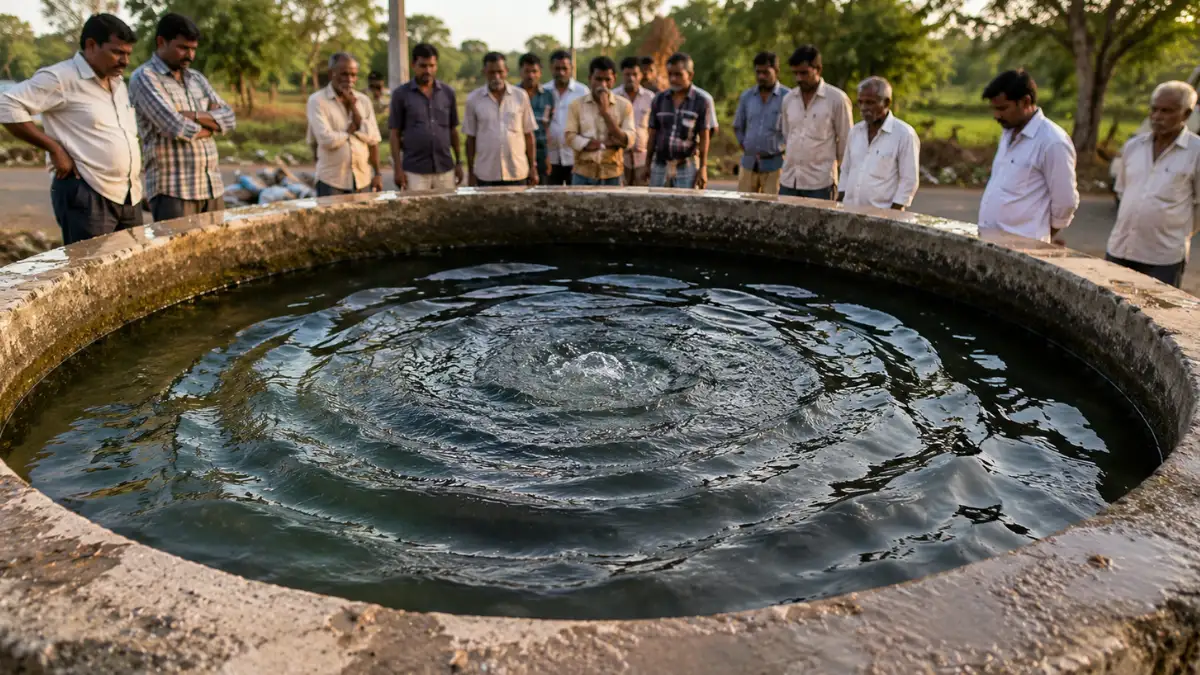

An unusual farm well in Gujarat’s Morbi district has drawn crowds after its water repeatedly surged and formed visible waves even though officials found no evidence of an earthquake causing the disturbance. The 18-foot-deep well is on farmer Pranjivan Sadariya’s land in Virparda village, and the movement was first noticed on August 2, 2026. The recently constructed well was full enough for water to spill over its edge while the surface repeatedly moved back and forth.
Morbi officials say the movement does not appear to be seismic. Their preliminary explanation points instead to heavy rainfall recharging the local groundwater system and displacing air trapped within pores or fractures underground. That escaping air may be disturbing the water inside the well. A groundwater research team was still expected to examine the site in greater detail, so the exact physical mechanism should not yet be treated as completely settled.
The distinction matters because earthquakes really can make water levels oscillate inside wells. That is a documented scientific phenomenon, but it does not mean that every moving well is evidence of an earthquake or an earthquake warning.
What Is Happening in the Morbi Well?
The unusual activity was reported from a newly constructed farm well in Virparda village of Morbi taluka. The owner said he first noticed the disturbance on August 2 after arriving at his farm and seeing water spilling over the well. The movement reportedly continued on Sunday and Monday, settled temporarily on Tuesday, and returned on Wednesday, drawing residents from neighbouring villages to the site.
Videos show the water moving across the well rather than remaining calm. Two or three nearby wells were reportedly still, which made the behaviour of this particular well more noticeable and raised questions about why one water column would respond differently from others in the same area.
Initial speculation focused on earthquakes because strong seismic waves are known to disturb groundwater. Morbi district officials, however, said their preliminary examination did not find evidence of seismic activity behind this event. District geologist J. S. Vadher said officials had also consulted the Institute of Seismological Research in Gandhinagar.
Morbi District Collector Swapnil Khare said a groundwater research team would carry out further examination. This means there is already a leading scientific explanation, but the detailed site investigation remains important for establishing exactly how the underground conditions produced such visible and repeated movement.
What Do Officials Think Is Causing the Waves?
The leading preliminary explanation involves heavy rainfall, groundwater recharge and trapped underground air.
Groundwater recharge happens when water from rainfall infiltrates deeply enough to replenish an aquifer. An aquifer is not necessarily an underground lake. Groundwater often occupies pores, fractures and other spaces within rock and sediment.
Vadher said heavy rainfall upstream appeared to have increased groundwater recharge around the site. As water entered previously air-filled spaces underground, it may have displaced air trapped within rock pores and fractures. Officials believe the release of that air may be creating the disturbance visible inside the well.
The well itself provides an opening into the surrounding groundwater system. It therefore should not be imagined as an isolated tank that happens to contain rainwater. Pressure changes, groundwater movement or air moving through connected subsurface spaces can potentially affect the water column that people see inside the well.
Officials have also mentioned local wind as a possible contributor to surface fluctuation because the well is beside a road, although that alone would not automatically explain why nearby wells reportedly remained calm. The groundwater research team can compare these possibilities against conditions at the site rather than relying only on observations from the surface.
The preliminary explanation is therefore more specific than simply saying “heavy rain caused waves.” The proposed sequence is that rainfall increased groundwater recharge, the rising water altered pressure underground, trapped air was displaced, and the resulting disturbance became visible inside a well connected to that groundwater system.
Whether that sequence fully explains the strength and repeated character of the Morbi waves is the part that still requires detailed investigation.
How Can Groundwater Make Water Inside a Well Move?
The water level inside many wells responds to conditions in the surrounding aquifer. If groundwater pressure changes, water can move into or out of the well until a new balance is reached.
The size of that response can vary considerably between wells because subsurface geology is uneven. Differences in fractures, permeability, well construction and hydraulic connections can make one well respond strongly while another nearby well shows much less change.
This is important in Virparda because the neighbouring wells reportedly did not display the same obvious movement. That does not rule out a groundwater explanation. It means researchers need to determine what is different about this particular well or its connection to the surrounding subsurface system.
Scientific research on well-water oscillations also shows that the behaviour observed at the surface is influenced by more than the original force disturbing the groundwater. A 2024 Journal of Hydrology study examining earthquake-driven well oscillations found that seismic energy was a major factor, but well construction and the hydraulic properties of the aquifer also influenced the observed response.
That study concerns seismic forcing and does not prove that the Morbi well is experiencing the same mechanism. It is useful because it demonstrates a broader principle: a well and the aquifer around it behave as a connected physical system, and characteristics of that system can affect how strongly water responds to pressure disturbances.
The repeated Morbi movement could superficially resemble a standing-wave or resonance effect, but no publicly available site measurements currently establish that as the mechanism. There is therefore no need to label the event a confirmed “well seiche.” The more defensible explanation remains the one officials have actually reported: groundwater recharge and displaced underground air are the leading preliminary causes being investigated.
Does the Morbi Well Movement Mean an Earthquake Is Coming?
There is currently no evidence that the moving water in the Virparda well is warning of an approaching earthquake.
Earthquakes can genuinely affect groundwater. When seismic waves pass through an aquifer, they can compress and stretch the surrounding material, change pore pressure and cause water levels inside connected wells to oscillate. Groundwater levels can also experience other temporary or longer-lasting changes associated with earthquakes.
Modern research confirms that these responses can be measured scientifically. The 2024 Journal of Hydrology study examined a decade of high-frequency well data near Parkfield, California, and found hundreds of reliable water-level responses associated with seismic waves. The strength of those oscillations was influenced primarily by seismic energy, while well construction and aquifer hydraulic properties also affected the response.
That established science explains why a video of moving well water can quickly produce earthquake speculation. However, knowing that earthquakes can move well water does not mean moving well water proves that an earthquake is involved.
In Morbi, officials reported no seismic activity associated with the disturbance and instead identified a groundwater process as the preliminary explanation. The movement was also observed over several days rather than being reported simply as a response coinciding with the arrival of recorded seismic waves.
Groundwater can change for many reasons besides earthquakes, including rainfall, recharge, pumping, atmospheric pressure and changes in underground flow. A single unusual well therefore cannot provide a reliable earthquake forecast without corresponding seismic and geological evidence.
For that reason, descriptions portraying the Morbi well as an “earthquake warning” would go beyond the available evidence.
What Still Needs to Be Confirmed?
Officials have already provided a plausible preliminary explanation, but the specialist investigation can determine why the disturbance became so visible in this particular well.
Researchers can compare groundwater levels in nearby wells, recent rainfall and recharge patterns, local rock and sediment characteristics, the well’s dimensions, and possible pathways through which air or water is moving underground. Measurements of the timing and frequency of the waves could also help establish whether the motion is being driven continuously or repeatedly amplified by the geometry of the well-water system.
The fact that neighbouring wells reportedly remained still is particularly useful evidence rather than a contradiction that must immediately overturn the groundwater explanation. It gives investigators something to compare. If the wells differ in depth, construction, fractures or hydraulic connections, those differences may help explain why one responds much more visibly than another.
As of the reports published on August 7, Gujarat officials had ruled out a seismic explanation in their preliminary assessment and linked the phenomenon mainly to groundwater recharge following heavy rainfall and trapped air beneath the surface. A groundwater research team was expected to provide a more detailed assessment.
The scientifically accurate explanation is therefore neither that the Morbi well is an unexplained supernatural mystery nor that it has already been proven to predict earthquakes. Current evidence points toward an unusual groundwater response following heavy rainfall, with the precise mechanics still requiring confirmation from the site investigation.
