
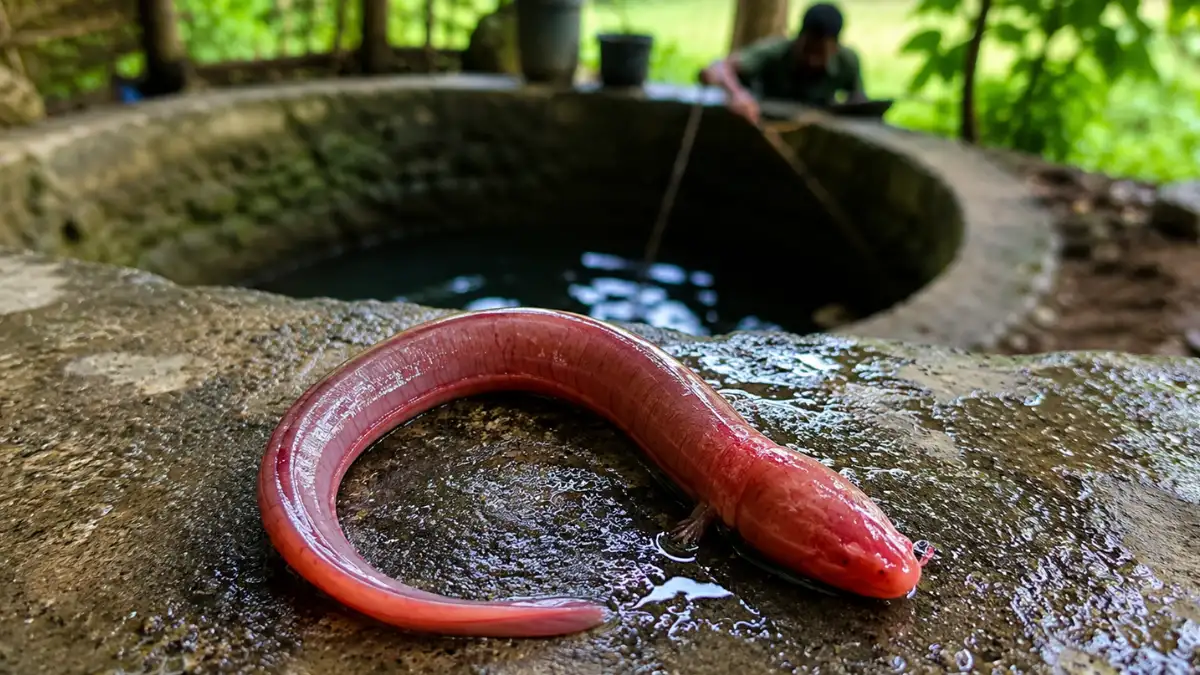

Scientists have described an unusual groundwater-dwelling swamp eel from Assam that has an elongated reddish body, apparently absent eyes and adaptations for a life almost completely hidden beneath the surface. The new species, Rakthamichthys anchi, was found in two dug-out wells in a village in Goalpara district and formally described in the journal Zootaxa on July 30, 2026.
The eel was found in village wells because those wells provide access to the groundwater aquifer where the species lives. The discovery is especially important because another highly specialized groundwater fish, Gitchak nakana, was previously found in the same village, revealing that the aquifer beneath this part of Assam supports a much more complex subterranean fish community than scientists knew existed.
That makes R. anchi more than another strange-looking fish discovery. Its anatomy, genetics and location give researchers new evidence about an aquatic habitat beneath Northeast India’s alluvial landscape that remains extremely difficult to observe directly.
What Is Rakthamichthys anchi?
Rakthamichthys anchi is a newly described species of synbranchid, or swamp eel. Researchers classify it as phreatobitic, meaning it is associated with the phreatic zone of groundwater aquifers rather than ordinary surface waters such as rivers or ponds.
The specimens came from two wells in one village in Assam’s Goalpara district. Reporting on the study says one specimen appeared during the community’s annual well-cleaning process, while another was later captured with a baited trap in a nearby abandoned well. The wells were roughly seven metres deep, giving researchers rare access to animals occupying groundwater below the village.
The precise village has not been publicly identified. Researchers have found the eel only in very small numbers and have withheld the exact locality while its distribution and possible threats remain poorly understood.
The eel is also noticeably larger than the tiny groundwater loach previously found in the area. Reported specimens of R. anchi measured roughly 25.5 to 31.8 centimetres in length, giving the animal a long, narrow, earthworm-like appearance.
Why Was Rakthamichthys anchi Found in Village Wells?
The wells are important because they create openings into an environment humans usually cannot reach.
An aquifer contains groundwater within spaces in underground sediment or rock. A sufficiently deep dug-out well can intersect this saturated underground zone. An animal recovered from such a well may therefore belong to the wider groundwater habitat connected to it rather than living only inside the man-made shaft.
That distinction is particularly important in Goalpara.
The peer-reviewed description of R. anchi identifies groundwater aquifers in the area’s alluvial deposits as a previously unknown and dynamic subterranean habitat. The authors make this point partly because the new eel was discovered in the same village where another remarkable groundwater fish, Gitchak nakana, had already been documented.
Finding an unusual fish in one well could leave many questions about how representative that well is. Finding two highly specialized but very different fishes associated with groundwater in the same village provides stronger evidence that researchers are seeing pieces of a larger biological system beneath the surface.
The wells therefore matter scientifically not because the constructed wells themselves created the species’ habitat, but because they gave researchers rare windows into it.
Why Does Rakthamichthys anchi Look So Unusual?
Reports describing R. anchi note an absence of normal skin pigmentation, apparently absent eyes and translucent tissue through which blood vessels are visible. This produces the striking reddish appearance that has attracted attention to the species.
These characteristics make sense in the context of permanent underground life, where conditions differ dramatically from those at the surface. However, it would be too simplistic to say that an individual eel became blind merely because it lived in a dark well.
Loss or extreme reduction of eyes and pigmentation occurs in many lineages that have evolved in subterranean habitats over long periods. The nearby Gitchak nakana, for example, also lacks eyes and has a translucent body, characteristics its scientific description identifies among adaptations associated with subterranean life.
That broader evolutionary explanation is already relevant to Assam’s other groundwater fish, so it does not need to be repeated in detail for R. anchi. What matters here is that the new eel shows another example of a fish lineage highly modified for an environment that humans rarely see.
Its blood-red appearance also does not mean the eel is covered in bright red pigment. Reporting based on the species description explains that its reduced pigmentation and translucent body make the underlying vascular system visible, contributing to its reddish colour in life.
How Did Scientists Know Rakthamichthys anchi Was a New Species?
An unusual appearance alone is not enough to establish a new species. Researchers compared the eel’s anatomy and genetic information with other known members of Rakthamichthys.
One important difference involves small sensory structures in the skull. The Zootaxa description reports that R. anchi lacks lateral-line canal pores in part of the frontal region that help distinguish it from the northeastern Indian species Rakthamichthys rongsaw and several relatives from the Western Ghats.
Its skeleton provided additional evidence. The researchers found differences in vertebral counts and other osteological, or skeletal, characteristics when they compared the Assam specimens with previously described species. They used micro-CT imaging to examine internal structures without relying only on the eel’s external appearance.
The genetic evidence reinforced those anatomical differences. According to the paper, R. anchi shows approximately 15 to 20 percent uncorrected genetic distance in the DNA barcoding gene compared with Rakthamichthys species from the Western Ghats.
In practical terms, scientists were not naming a new species simply because they found a red eel in an unusual location. Multiple independent lines of evidence showed that these specimens were sufficiently different from known relatives to warrant recognition as a separate species.
Researchers also reported an unusual feature near the animal’s tail. A paired bony structure connected with the final vertebra was interpreted as a caudal fin ray, a feature absent from almost all adult swamp eels examined previously.
That finding gives the species additional anatomical interest beyond its colour and underground habitat.
How Is Rakthamichthys anchi Different From Gitchak nakana?
The two fishes were found in the same Goalpara village, but they should not be treated as two versions of the same type of fish.
Gitchak nakana is a tiny cobitid loach belonging to the family Cobitidae. Its scientific description reported a maximum examined standard length of only about 20.8 millimetres. It is so anatomically unusual that researchers placed it in both a newly described species and a newly established genus.
Rakthamichthys anchi, by contrast, is an elongated swamp eel belonging to the family Synbranchidae and reaches several tens of centimetres in length. It belongs to the already recognized Indian genus Rakthamichthys.
The distinction matters because these fishes represent very different evolutionary lineages.
Their shared underground characteristics therefore do not mean that one is closely related to the other. Instead, both appear to have become highly specialized for life in groundwater environments.
The earlier discovery of Gitchak nakana provided the first documented evidence of an aquifer-dwelling fish from Northeast India. Its peer-reviewed description specifically identified the finding as evidence of a previously unknown subterranean fauna in this part of Asia.
The subsequent discovery of R. anchi changes that picture again. Scientists now have evidence of at least two very different specialized fish lineages associated with groundwater in the same village.
That is much more informative than finding a second specimen of the same species.
Why Do Two Groundwater Fish Species in the Same Assam Village Matter?
This is the part of the discovery with the greatest scientific significance.
When Gitchak nakana was described earlier in 2026, it established that specialized fish could inhabit groundwater aquifers in Northeast India. At that time, researchers had recovered the species from a single dug-out well in Goalpara.
Rakthamichthys anchi now adds a different fish lineage to the same subterranean setting.
The authors of the Zootaxa paper explicitly say that discovering the eel in wells in the same village as Gitchak nakana highlights a formerly unknown and highly dynamic subterranean habitat in the groundwater aquifers of Northeast India’s alluvial deposits.
This does not yet tell scientists how large the ecosystem is or how its populations are connected. Researchers have not mapped an enormous underground lake filled with unknown fishes. Aquifers can instead consist of complex water-filled spaces through sediment and other geological material, and the actual distribution of these animals remains poorly understood.
Scientists still need to determine whether R. anchi occurs beyond the two wells where it has been recorded, how individuals move through the groundwater environment, how large the population is and whether apparently separate wells provide access to connected parts of the same aquifer.
Those unanswered questions are precisely why the discovery matters.
Groundwater biodiversity is difficult to document because most of the habitat cannot be directly observed. The Gitchak nakana study noted that although hundreds of subterranean fish taxa are known globally, only a small proportion have been recovered from aquifers rather than more accessible cave systems.
Village wells can therefore reveal biological communities that might otherwise remain completely undetected.
In Goalpara, two discoveries in the same locality have already changed the scientific picture. First, a tiny blind loach showed that Northeast India’s groundwater contained a specialized fish fauna. Now, Rakthamichthys anchi shows that the same hidden environment supports another, very different subterranean fish lineage.
The blood-red appearance of the eel may be what first catches attention, but its real significance lies beneath the village. The discovery provides another glimpse into an Assam groundwater ecosystem that science has only recently begun to recognize.
