
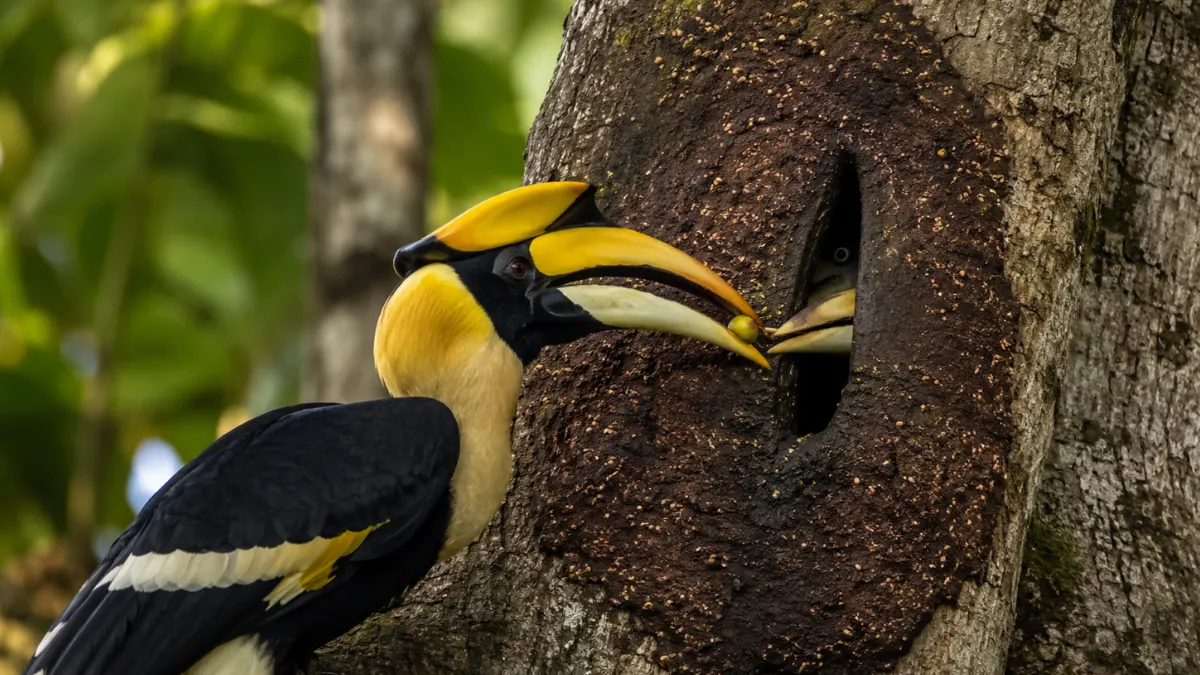

Most tree-nesting hornbills leave a tiny slit in the sealed entrance because it preserves the protection of a restricted opening while allowing the nesting family to remain connected to the outside. The male can deliver food through the slit and the female and chicks can use it to remove waste.
Researchers generally interpret the sealed entrance as a defence against predators, rival hornbills or other animals competing for the cavity. The relative benefit may differ among hornbill species, so scientists cannot attribute the behaviour to one proven purpose in every case.
The slit is therefore not an unfinished part of the wall. It is the functional opening that makes this specialised nesting system possible.
How Does a Hornbill Create a Sealed Nest With a Slit?
Tree-nesting hornbills generally use existing cavities in large trees. The hollow may form after a branch breaks, through internal decay or through another natural process that leaves enough protected space inside the trunk.
Once a suitable cavity has been selected, the female enters and reduces the entrance with a plaster-like wall. The male may help carry materials or participate in sealing in some species, but the division of work varies.
The wall can contain droppings, food remains, plant material, soil or other substances, depending on the hornbill species and local conditions. The female shapes the material from inside until most of the original opening has been covered.
She deliberately leaves a narrow vertical gap. The opening is usually large enough for a hornbill to place its bill through but too small for the female to leave without breaking part of the wall.
The Nature Conservation Foundation’s Hornbill Nest Adoption Program has monitored hornbill nests in Arunachal Pradesh. It describes females sealing themselves inside tree cavities while leaving a slit through which males bring food to the family.
The nest is enclosed but not hermetically sealed. The opening permits ordinary air exchange, although available research does not establish ventilation as the principal reason this nesting behaviour evolved.
What Protection Does the Tiny Slit Provide?
Reducing the size of a cavity entrance can make direct access more difficult for many animals. The female, eggs and newly hatched chicks remain behind a wall with only a narrow point of entry.
Researchers generally consider defence an important benefit of nest sealing. Potential threats include predators searching for eggs or chicks and other hornbills or cavity-nesting animals attempting to take over a valuable nest site.
The wall does not make the nest completely predator-proof. Snakes, mammals, competing birds and damage to the tree can still threaten a breeding attempt. The main threat may also differ according to species and location.
Research on some African hornbills indicates that defence against rival hornbills may be especially important. In other settings, restricting access by predators may provide the greater advantage. This variation makes it more accurate to describe protection as the leading scientific interpretation rather than a universally proven single purpose.
The sealed entrance is an evolved reproductive behaviour. It differs from the accidental, weather-and-light-driven bird disorientation involved in Assam’s Jatinga phenomenon.
How Does the Male Pass Food Through Such a Small Slit?
The opening needs to admit a hornbill’s bill rather than its entire body.
During the nesting period, the male repeatedly returns to the cavity with food. He positions himself at the entrance and passes individual items or regurgitated food through the slit, depending on the species and the type of food.
The female receives the food from inside. During incubation, she eats what the male provides. After the eggs hatch, she can divide suitable food and feed the chicks.
This arrangement allows the female to remain with the eggs and newly hatched young while the male searches across the surrounding habitat. Neither bird needs to open the wall every time food arrives.
Food delivery becomes a critical part of the nesting strategy because the female cannot forage normally while she remains sealed inside. In some cooperatively breeding hornbill species, other group members may also help bring food but this does not occur in every species.
How Do the Female and Chicks Remove Waste?
Confinement inside a cavity for weeks or months creates a sanitation problem. The narrow slit also serves as an opening through which waste can leave the nest.
The female can turn inside the cavity and propel droppings through the gap. Developing chicks may later direct their waste toward or through the same opening.
Researchers studying Indian Grey Hornbills in Nagpur observed females ejecting excreta approximately 2.9 metres from the cavity. The study, published in the Raffles Bulletin of Zoology, also found that males removed waste accumulated near the entrance.
The males brought dry bark pieces that collected on the cavity floor. Researchers suggested that the bark absorbed moisture from semi-solid waste and may have helped control moisture inside the nest.
These observations demonstrate that the slit performs more than one directly visible task. It accepts food from outside while allowing waste to move in the opposite direction.
Sanitation methods differ among species, so the behaviour recorded in Indian Grey Hornbills should not be treated as an exact description of every hornbill nest.
Do All Hornbills Use Mud to Build the Wall?
No. The common statement that hornbills always combine mud with droppings oversimplifies important differences among species.
Some hornbills use soil or mud when sealing their cavities. Droppings, food remains, fruit pulp, bark fragments and other organic materials can also contribute to the wall.
Great Hornbills provide a well-documented exception to the familiar mud description.
Researchers observed wild Great Hornbills in southern India for 183 hours and found no evidence that they collected or used mud. Chemical analysis of fallen plaster showed fecal material rather than soil.
The study also referred to four years of observations in Northeast India in which Great Hornbill females sealed their nests with fecal material containing large quantities of fig seeds.
The official publisher’s page for Wild Great Hornbills Do Not Use Mud to Seal Nest Cavities explains why popular descriptions should not assign one construction material to every species.
In the southern Indian observations, the female performed the sealing, and the male did not participate. Other hornbill species divide the work differently.
Does the Slit Change During the Nesting Period?
The wall is a temporary structure that can change as the female incubates the eggs and the chicks develop.
During the early stage, the female remains inside while the male delivers food through the slit. After hatching, the opening continues serving the female and growing chicks.
Later events depend on the species.
Some females remain inside until shortly before the chicks are ready to leave. Others break through the wall earlier and begin helping the male gather food while the chicks remain in the cavity.
In some species, the chicks reseal part of the entrance after the female emerges. They maintain a narrow feeding opening until they are sufficiently developed to break through the wall and fledge.
The Great Hornbill research documented a chick using its own fecal material to reseal the cavity after the female left. Observations of Helmeted Hornbills have also recorded chicks repairing the seal before eventually breaking it open to emerge.
The slit therefore does not necessarily remain identical throughout the breeding attempt. Its users and dimensions can change as the family moves from incubation to chick development and fledging.
Why Does the Original Tree Cavity Matter?
The wall and slit can work only when the hidden cavity behind them provides sufficient space and protection.
A peer-reviewed study of Great, Wreathed and Oriental Pied Hornbills in Arunachal Pradesh found that cavity size helped separate the nest sites used by the three species. Great Hornbills used larger cavities, while Oriental Pied Hornbills used smaller ones.
The Arunachal Pradesh hornbill nesting study shows that hornbills need more than an entrance they can seal. They also require an appropriately sized cavity within a suitable living tree.

1 thought on “Why Do Hornbills Leave Only a Tiny Slit in Their Sealed Nests?”