
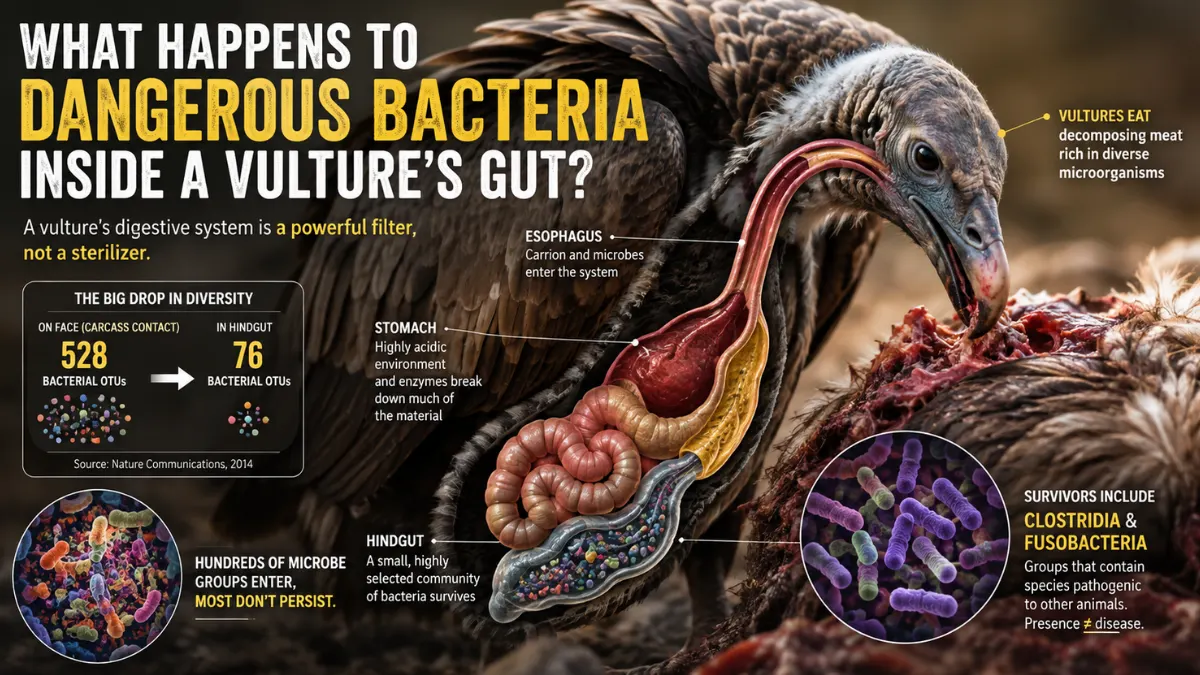

Vultures routinely swallow decomposing tissue carrying large and diverse microbial communities. Yet their intestines do not simply become populated by everything found on the carcass.
Many microorganisms entering with carrion fail to persist through digestion. A much smaller and highly selected bacterial community reaches the lower gut, including groups such as Clostridia and Fusobacteria that contain species capable of causing disease in other animals.
That does not mean a vulture’s intestine is sterile, nor does it mean every surviving bacterium is dangerous. The important finding is that the digestive tract appears to act as a powerful biological filter while the bird remains unusually tolerant of the microbial community that survives.
What Happens to Bacteria After a Vulture Swallows Carrion?
A decomposing carcass can contain microorganisms from the dead animal itself, the surrounding environment and the decomposition process.
When a vulture feeds, those microbes enter the digestive system alongside the tissue.
Researchers received an unusually clear view of what happens next in a major study of black vultures and turkey vultures. They compared bacterial diversity on the birds’ facial skin, which directly contacts carcasses, with bacterial diversity in the hindgut.
The difference was substantial.
The researchers detected an average of 528 bacterial operational taxonomic units, or OTUs, on facial samples but only 76 in the hindgut.
An OTU is a way researchers group closely related microorganisms when studying microbial diversity. The numbers therefore do not mean that exactly 528 bacterial species were present on every face and exactly 76 lived in every intestine.
They do show something important: microbial diversity dropped dramatically between carcass exposure and the lower digestive tract.
The original vulture microbiome research published in Nature Communications described this gastrointestinal environment as strongly selective.
The vulture is therefore not simply carrying the carcass’s entire bacterial community into its intestine.
Much of that community does not persist.
Does Stomach Acid Destroy All of Those Bacteria?
No.
Strong digestive conditions are almost certainly part of the filtering process, but it would be inaccurate to say that stomach acid sterilizes everything the vulture eats.
Vultures have highly acidic digestive systems, and acidic conditions can damage or prevent the survival of many microorganisms. Digestive enzymes and the broader gastrointestinal environment also break biological material down as food passes through the bird.
However, the microbiome studies did not track every bacterial cell through the stomach and prove precisely where or how each one disappeared.
The safest conclusion is therefore that the digestive tract strongly selects which microorganisms can continue through the system.
Evidence from the same study supports the idea that biological material undergoes extensive degradation during digestion.
Researchers detected DNA from prey animals on the vultures’ facial samples, as expected after feeding on carcasses. Very little identifiable prey DNA remained in hindgut samples.
That does not directly measure bacterial death, but it demonstrates how thoroughly material entering the digestive tract can be broken down before reaching the lower intestine.
Which Bacteria Actually Survive?
This is where vulture biology becomes especially unusual.
Despite the large reduction in overall bacterial diversity, bacteria belonging to Clostridia and Fusobacteria were prominent in the hindgut communities studied.
Both names can sound alarming because these bacterial groups contain species associated with serious disease in humans and other animals.
But a bacterial group is not the same thing as a single pathogen.
Clostridia include many different organisms with different ecological roles. Some species or strains can cause severe disease, while others may occur without producing illness.
The same caution applies to Fusobacteria.
Researchers therefore cannot simply say, “Vultures are full of deadly bacteria but somehow survive.”
The more accurate interpretation is that their digestive systems support a relatively restricted microbial community that includes bacterial groups containing potentially pathogenic members.
Why Does Finding Clostridia or Fusobacteria Not Mean the Vulture Is Infected?
The presence of a microorganism does not automatically equal disease.
For disease to develop, a microorganism generally needs to survive in the host, establish itself in a suitable location, multiply under appropriate conditions and damage tissues or disrupt normal biological functions.
The relationship between a bacterium and its host also depends on the particular bacterial species or strain, its abundance and the surrounding microbial community.
A microorganism capable of causing disease under one set of circumstances may exist very differently within another animal’s intestinal ecosystem.
This is particularly important when interpreting microbiome research.
DNA sequencing can reveal which microbial groups are present, but detecting bacterial DNA does not by itself demonstrate that those organisms are causing disease.
The striking finding in vultures is therefore not merely that potentially concerning bacterial groups are present.
It is that these groups can be prominent within the gut communities of animals apparently well adapted to repeated exposure to decomposing carrion.
Why Can Some Bacteria Persist When So Many Others Disappear?
Scientists do not yet have a complete answer for every organism.
The sharp reduction from hundreds of microbial groups on the face to a much smaller hindgut community strongly suggests that the vulture gastrointestinal tract imposes difficult conditions that only certain microorganisms can tolerate.
Some bacteria may possess physiological characteristics that allow them to survive those conditions better than others.
However, researchers have not mapped a complete pathway explaining exactly why each surviving bacterium succeeds.
That distinction matters because it prevents an observation from being presented as a proven mechanism.
Scientists know that microbial diversity changes dramatically through the digestive system.
They know that certain groups become unusually prominent in the hindgut.
They do not yet know every biological interaction responsible for producing that final community.
Is the Vulture Gut Microbiome Helping the Bird?
There is evidence that the surviving microorganisms participate in normal digestive and metabolic processes, but researchers should be cautious about describing individual bacteria as protective.
Metagenomic studies of vulture digestive systems have identified microbial genes connected with metabolism and digestion.
That means at least part of the microbial population is biologically active rather than simply consisting of microorganisms temporarily passing through the bird.
What has not been demonstrated is a simple arrangement in which one particular “good bacterium” protects the vulture from every pathogen found in rotten meat.
The gut is an ecosystem involving interactions among microorganisms, nutrients and the host.
Research in animal microbiomes more broadly shows that established microbial communities can influence which incoming organisms successfully colonize the intestine. Whether particular mechanisms operate in exactly the same way in every vulture species remains an active research question.
The strongest vulture-specific conclusion is therefore narrower: their digestive systems consistently produce a highly selective microbial community despite continuous exposure to carrion.
Does the Vulture’s Own Biology Provide Additional Protection?
Probably.
The microbiome is only one part of the story.
Comparative genomic studies of vultures have found candidate evolutionary changes involving pathways associated with immune function and gastric acid secretion.
For example, research on the cinereous vulture identified changes in genes associated with gastric physiology and immune responses. These findings suggest that the bird’s own physiology may have evolved alongside its carrion-feeding lifestyle.
However, genomic evidence must be interpreted carefully.
Finding an evolutionary change in a gene does not automatically prove that the change protects the animal from a particular bacterium.
Researchers themselves have treated several of these genomic findings as candidate adaptations requiring additional functional investigation.
The evidence therefore supports a combined explanation rather than a single defensive mechanism.
Vultures appear to rely on a highly selective digestive environment, host physiology and a distinctive gut microbial community.
Scientists are still determining exactly how those components interact.
Are These Gut Findings True for Every Vulture Species?
Not necessarily.
This is one of the most important limitations of the research.
The widely cited study showing an average of 528 facial OTUs and 76 hindgut OTUs examined black vultures and turkey vultures, which are New World vultures.
Those exact numbers should not be applied automatically to every vulture species.
Old World vultures, including the species occurring across India, belong to different evolutionary lineages.
Studies of Old World species nevertheless provide independent evidence that scavenging has been accompanied by unusual digestive and immune adaptations.
The broad biological pattern is therefore credible, but the precise microbial composition can differ according to species, diet, geography, environment, age and other factors.
When discussing the vulture microbiome, it is better to distinguish between what researchers have demonstrated in particular species and what they infer about vultures more generally.
So What Ultimately Happens to Dangerous Bacteria Inside a Vulture?
They do not all experience the same fate.
A large and diverse microbial population enters the bird with decomposing tissue. As that material moves through the digestive tract, microbial diversity falls sharply.
Many organisms apparently fail to persist.
A much smaller community reaches the hindgut.
Among those survivors are Clostridia, Fusobacteria and other bacterial groups, some of which contain organisms capable of causing disease in other vertebrates.
Yet their presence does not automatically make the vulture ill.
The bird appears to combine a strongly selective digestive environment with physiological and immune adaptations that allow it to tolerate a microbial ecosystem associated with a carrion-based diet.
That is more scientifically accurate than saying vultures simply possess acid powerful enough to kill every germ.
Their intestines are not sterile.
They are selective ecosystems built around an exceptionally challenging food source.
For another example of how unusual biological pressures shape bird adaptations, DesiVibe’s explainer on why hornbills leave only a tiny slit in their sealed nests examines a very different survival strategy.
