

Discovering elevated nitrogen compounds in a well or drinking-water supply can be alarming but the right treatment depends on which form of nitrogen is actually present. For household drinking water, the main concern is usually nitrate and, less commonly, nitrite rather than ordinary dissolved nitrogen gas.
This guide therefore focuses primarily on removing nitrate and nitrite from drinking water. Ammonia, ammonium, organic nitrogen and total nitrogen in wastewater, ponds or industrial systems may require different treatment processes.
Boiling contaminated water is not the answer. Nitrate does not evaporate with ordinary boiling and losing water as steam can actually increase the nitrate concentration in what remains. EPA specifically warns against boiling water as a nitrate-removal method.
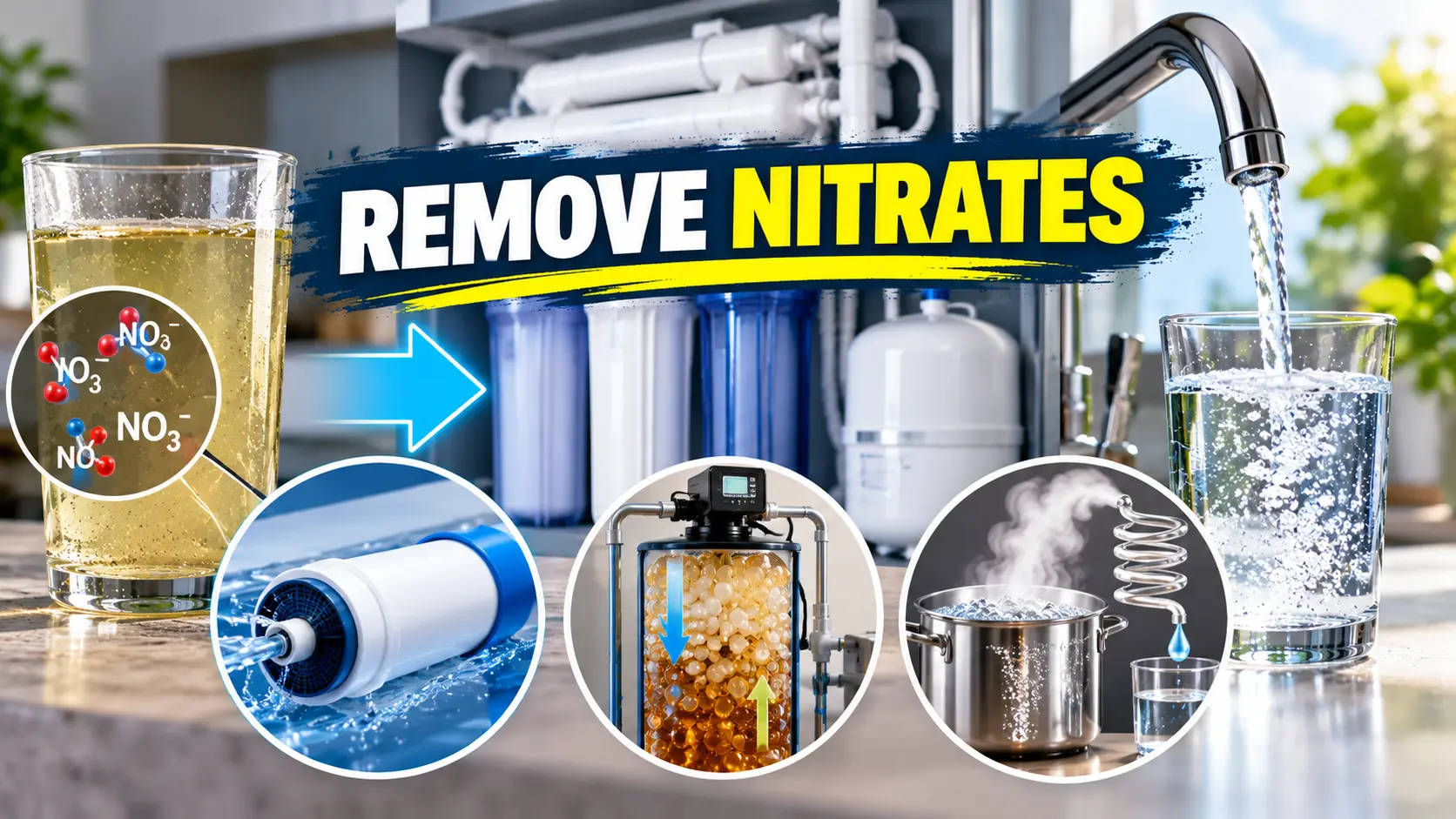
Three established methods used to reduce nitrate in drinking water are:
- Reverse osmosis (RO): uses a membrane to separate nitrate and other dissolved contaminants from treated water.
- Anion exchange: uses a nitrate-capable resin that exchanges negatively charged nitrate ions for another ion, usually chloride.
- Distillation: converts water to steam and condenses it separately, leaving nitrate and many other dissolved substances behind.
CDC identifies ion exchange, distillation and reverse osmosis as treatment methods for nitrate-contaminated drinking water. The right choice depends on your laboratory results, water chemistry, required treatment volume, maintenance needs and whether treatment is needed at one faucet or throughout the property.
Step 1: Diagnose Your Water
Do not choose a nitrate water filter based only on appearance, taste or smell. Nitrate usually cannot be detected by the senses, so clear and normal-tasting well water can still contain an elevated concentration.
A home test strip can be useful for initial screening, but a certified or otherwise appropriate laboratory test is preferable when the result will determine whether the water is suitable for drinking or which treatment equipment should be installed. The report should identify the concentration in mg/L or ppm and clearly state whether nitrate is reported as nitrate ion or as nitrate-nitrogen.
That distinction matters because the numbers use different chemical reporting conventions. Before deciding whether treatment is necessary, compare the result with the correct standard using this guide to safe nitrate and nitrite levels in drinking water.
A broader water analysis can also help when selecting equipment. Hardness, sulfate, iron, sediment, bacteria and other substances can affect treatment design or interfere with certain technologies.
If a confirmed result exceeds the applicable drinking-water standard, use a verified safe alternative source for drinking and cooking while the problem is being investigated. This is particularly important when water is used to prepare infant formula.
How to Filter Nitrates at Home
Household treatment generally takes place either at the point of use or the point of entry.
A point-of-use system treats water at one location, such as a dedicated kitchen faucet. A point-of-entry system treats water as it enters the property, supplying treated water to multiple fixtures.
Whole-house treatment is not automatically necessary for every nitrate problem because ingestion through drinking and cooking is the primary household concern. The most appropriate scope should be based on testing, household use and professional water-treatment advice where needed.
1. Reverse Osmosis (RO) Systems
Reverse osmosis is one of the most widely used household methods for reducing nitrate in drinking water. The system applies pressure to force water through a semipermeable membrane while a separate stream carries away rejected dissolved contaminants.
RO can reduce nitrate as well as a range of other dissolved substances. However, nitrate reduction varies among products, membranes, water conditions and operating systems, so a device should never be selected simply because the words reverse osmosis appear on the label.
CDC advises consumers to check the system’s label for the specific chemicals it is designed to reduce. RO systems may reduce nitrate but individual performance depends on the particular system.
For additional assurance, look for an independently verified nitrate/nitrite reduction claim. NSF/ANSI 58 covers point-of-use reverse-osmosis drinking-water systems but nitrate/nitrite reduction is an optional contaminant-reduction claim under that standard rather than an automatic feature of every certified RO system.
This distinction is important. A product may comply with NSF/ANSI 58 for required performance requirements while not carrying a nitrate/nitrite reduction claim, so the exact certification listing and product documentation should be checked. Current NSF listings identify individual RO systems that have specifically been evaluated for nitrate/nitrite reduction.
RO is often well suited to an under-sink drinking-water system where the household mainly needs treated water for drinking and cooking. It can also be helpful when testing identifies additional dissolved contaminants that the particular certified system is designed to reduce.
The limitations include reject water, membrane and prefilter replacement, slower production than an unrestricted faucet and sensitivity to water pressure and fouling. Hardness, sediment, iron or other water-quality problems may require pre-treatment to protect the RO membrane.
2. Anion Exchange Resin Units
Ion exchange is another established method for nitrate removal but the correct resin must be used. An ordinary household water softener is primarily designed to remove hardness minerals and should not automatically be assumed to remove nitrate.
Nitrate treatment uses an anion-exchange resin. As water passes through the resin bed, negatively charged nitrate ions are retained while another ion, typically chloride, is released into the treated water.
This approach can be suitable for larger water volumes and may be used in point-of-entry treatment when treating more than one drinking-water outlet is justified.
Water chemistry is especially important for ion exchange. Other negatively charged ions, including sulfate, can compete with nitrate for resin capacity, so equipment sizing and resin selection should be based on laboratory results rather than a generic treatment claim.
The resin eventually becomes exhausted and requires regeneration or replacement. Regeneration commonly creates a concentrated waste brine containing the nitrate removed from the water, which must be managed appropriately.
For that reason, homeowners should choose a system specifically designed for nitrate removal rather than purchasing a standard softener and assuming that all ion-exchange systems perform the same function. CDC recognizes ion exchange as one of the established treatment options for nitrate in drinking water.
3. Water Distillation
Distillation removes nitrate using a different principle. Water is heated until it becomes vapor, that vapor is transferred away from the concentrated contaminants left behind and the vapor is then cooled into liquid water.
Nitrate and many other dissolved substances remain in the boiling chamber rather than moving with the collected water vapor. CDC lists nitrate among the chemicals that distillation can remove.
Distillation can work well when a household needs relatively small amounts of treated drinking water. Countertop units can produce highly demineralized water without requiring a pressurized membrane system.
Its disadvantages are production speed and energy consumption. Distillation takes longer than many other household treatment methods and requires electricity to repeatedly heat water.
The boiling chamber also needs regular cleaning because minerals and other non-volatile contaminants become concentrated inside it.
Most importantly, distillation is not the same as ordinary boiling. A distiller captures the water vapor and condenses it in a separate container, while simply boiling water in a pot allows water to escape and leaves the nitrate behind.
Choosing the Right Method for Your Setup
No nitrate-removal method is universally best. Your choice should depend on the laboratory result, water chemistry, treatment volume, installation requirements, maintenance capacity, waste handling and any other contaminants present.
| Method | Nitrate Reduction | Typical Scope | Key Advantage | Main Limitation |
|---|---|---|---|---|
| Reverse Osmosis | High with an appropriate nitrate-rated system; actual performance varies | Usually point-of-use | Can reduce nitrate plus several other dissolved contaminants | Produces reject water and needs filter/membrane maintenance |
| Anion Exchange | High when properly designed for nitrate and matched to water chemistry | Point-of-entry or larger-volume systems | Suitable for treating larger continuous water volumes | Requires resin management/regeneration and produces waste brine |
| Distillation | Very effective for nitrate when properly operated | Batch / point-of-use | Separates nitrate and many dissolved substances from collected water | Slow and comparatively energy-intensive |
The table should be used as a decision framework rather than as a performance guarantee. Real treatment effectiveness depends on the individual product and operating conditions.
For a kitchen drinking-water supply, a reverse-osmosis system with a verified nitrate/nitrite reduction claim can be a practical option. NSF specifically lists nitrate/nitrite reduction as an available optional performance claim for RO systems under NSF/ANSI 58.
Where higher volumes require treatment, a professionally designed nitrate-selective anion-exchange system may be more appropriate. Distillation can make sense where only relatively small quantities of treated drinking water are required and slower production is acceptable.
Whatever method is selected, testing should not stop once the equipment is installed. Post-treatment water should be analysed to verify that nitrate has actually been reduced to an acceptable concentration, followed by appropriate periodic monitoring and equipment maintenance.
What DOES NOT Remove Nitrogen From Water
Many familiar household water-treatment methods are designed to disinfect water or improve taste rather than remove dissolved nitrate.
This distinction matters because treated water may look and taste perfectly normal while still containing nitrate if the device was never designed to remove it.
Standard Activated Carbon Pitchers
Activated carbon is useful for reducing certain substances and improving taste or odor but an ordinary carbon filter is not a reliable nitrate-removal method.
EPA specifically states that common activated-carbon pitcher filters do not remove nitrate.
The same caution applies to many refrigerator and faucet filters. Unless the product has a verified nitrate-reduction claim, it should not be relied upon to solve a nitrate contamination problem.
Carbon can still appear inside a multi-stage RO system as a prefilter or post-filter. In that case, however, the nitrate reduction primarily depends on the appropriate RO treatment stage rather than on ordinary activated carbon alone.
Boiling Water
Boiling is useful for controlling many disease-causing microorganisms but it should not be used to treat nitrate contamination.
Nitrate remains behind as ordinary boiling removes water through evaporation. The remaining liquid can therefore contain a higher nitrate concentration than before it was boiled. EPA explicitly advises that boiling will not reduce nitrate levels and can make the concentration worse.
This is why ordinary boiling and distillation have very different outcomes. Distillation collects the vapor as a separate treated product, while simple boiling does not.
Chemical Disinfection, Chlorine and UV
Chlorine and ultraviolet systems are primarily used to control microorganisms. They can be valuable when water contains bacteria, viruses or other biological hazards but nitrate is a dissolved chemical ion rather than a living organism.
CDC explains that UV systems do not remove chemicals from water. A household with both microbial contamination and elevated nitrate may therefore require more than one treatment process.
Disinfection should never be assumed to replace a nitrate-specific treatment method simply because both problems involve unsafe drinking water.
Watershed & Large-Scale Nitrogen Management
Household filters protect an individual water supply, but they do not remove excess nitrogen from an entire aquifer, agricultural drainage network, river, lake, wastewater stream or watershed.
Large-scale nitrogen management therefore relies on different strategies, including biological treatment, wastewater-process improvements, agricultural controls, wetland systems and measures that reduce nitrogen before it reaches sensitive water bodies.
Biological Denitrification & Constructed Wetlands
Biological denitrification takes advantage of microorganisms capable of transforming nitrate through several chemical stages and ultimately returning much of that nitrogen to the atmosphere as nitrogen gas.
This approach is fundamentally different from capturing nitrate on a household filter. Instead of simply separating nitrate from drinking water, biological treatment converts the nitrate into other nitrogen forms, ultimately producing gaseous nitrogen under appropriate conditions.
Constructed wetlands can also help manage nitrogen in some agricultural, stormwater and wastewater settings. Plants, soils, microorganisms, water movement, oxygen conditions and retention time work together to support processes that store, transform or remove nutrients.
Such systems must be properly designed for the site and nitrogen load. A wetland cannot simply be added anywhere and expected to solve every nutrient problem.
Large-scale treatment also needs to match the actual pollution pathway. Fertilizer losses, livestock manure, septic systems, municipal wastewater, industrial discharges, urban runoff and atmospheric deposition introduce nitrogen in different ways.
Those pathways are covered in detail in how nitrogen gets into water, which can help explain why source identification should come before choosing a watershed-level solution.
Preventing Nitrogen Contamination at the Source
Filtration is important when nitrate has already reached a drinking-water supply but filtration remains a reactive measure. An under-sink RO system may protect one household’s drinking water while doing nothing to stop additional nitrate from entering the groundwater outside.
Long-term control therefore means reducing unnecessary nitrogen losses before they become contamination. Farms can improve fertilizer timing and application, livestock operations can manage manure more effectively, households can maintain septic systems, municipalities can improve wastewater and stormwater management and industries can control nutrient-containing discharges.
Source prevention is particularly important for groundwater because nitrate that has already moved deep below the surface can remain in an aquifer and continue traveling long after the original release occurs.
Treatment and prevention should therefore complement each other. Where contamination already exists, use a treatment method that has been shown to work for the specific contaminant and verify its performance through testing; where the source can be identified, reduce the continuing nitrogen input.
The consequences extend beyond household drinking water. Excess reactive nitrogen reaching rivers, lakes, reservoirs, and coastal areas can contribute to algal growth, oxygen depletion, habitat degradation, and other ecological problems explained in why excess nitrogen harms water quality.
Nitrate can be effectively reduced in household drinking water when the treatment method is matched to the tested water chemistry and the specific system has appropriate performance evidence. Preventing excessive nitrogen from reaching the water in the first place remains the more complete long-term solution.

2 thoughts on “How to Remove Nitrates From Water: 3 Effective Methods”