
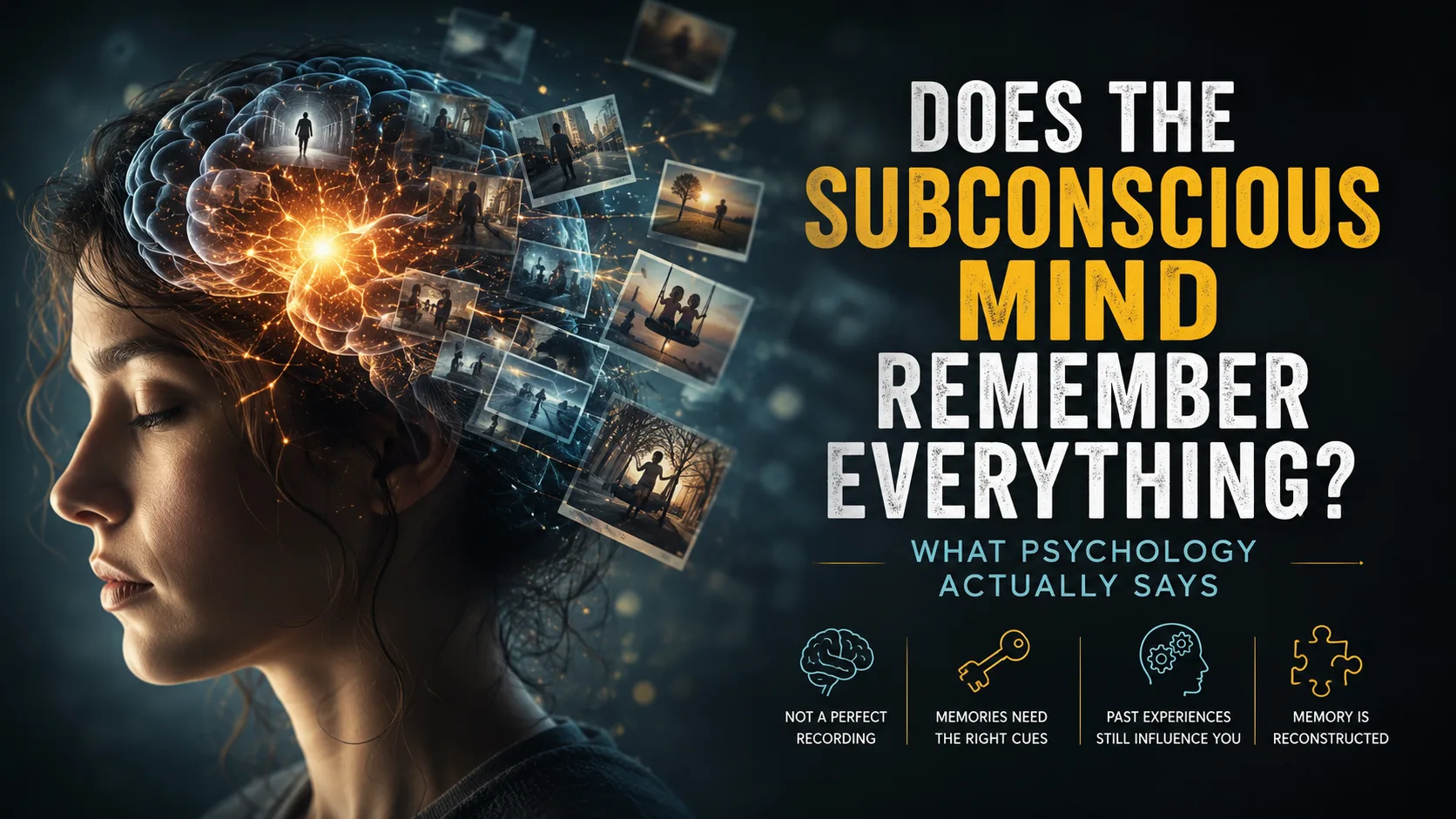

It can sometimes feel as though the mind remembers far more than we consciously know.
A song you have not heard for twenty years suddenly brings back a school corridor. A smell reminds you of a relative before you can work out why. A name that seemed completely forgotten appears in your mind hours after you stopped trying to remember it.
Experiences like these have helped create a popular idea: even when the conscious mind forgets something, the subconscious mind remembers it.
There is a small piece of truth behind that idea, but the larger claim goes too far.
Human memory can preserve information that is not immediately available to conscious recall, and previous experiences can sometimes affect us without deliberate remembering. But psychology does not support the idea that a hidden part of the mind keeps a complete, permanent record of everything we have ever experienced.
Understanding the difference requires looking at what forgetting actually means.
Does the Subconscious Really Store Everything We See and Hear?
There is no good evidence that it does.
The subconscious mind is a familiar way of describing thoughts and mental processes that operate outside immediate awareness, although psychology usually separates these into more specific processes such as memory, learning, attention and automatic processing.
More importantly, the brain does not appear to create a detailed lifelong memory of every piece of information that reaches the senses.
Think about an ordinary visit to a restaurant.
You may remember the person you were with, what you ordered and perhaps a conversation at the next table that caught your attention. You probably could not later describe every customer’s clothing, every song that played, every object on the walls or every movement made by the staff.
All of those things were around you, but experiencing an environment is not the same as creating a durable memory of every detail in it.
Attention matters greatly for memory. Information that receives attention is often more likely to be successfully encoded and remembered later, although the relationship between attention and memory is complex.
The brain can process some information without our being consciously aware of it. That still does not mean everything it processes becomes a detailed memory.
Processing something is not the same as permanently remembering it.
If Something Is Forgotten, Can It Still Be Somewhere in Memory?
Sometimes. The word forgotten can describe several different situations.
Imagine being introduced to someone at a noisy wedding. A few minutes later, you cannot remember the person’s name. It is possible that you were distracted and never formed a strong memory of the name in the first place.
Now imagine trying to remember the name of a teacher you knew for several years. Nothing comes to mind, but later that evening the name suddenly appears.
The information may have been stored but temporarily difficult to retrieve.
There is also a third possibility. You may retain part of an experience while many of its details become weaker or unavailable over time.
These situations can all feel like forgetting, but they are not identical.
This is why the statement “your subconscious remembers everything your conscious mind forgets” is too simple. Sometimes information may still be available somewhere in memory. Sometimes only part of it remains useful. Sometimes the original experience may never have produced a strong lasting memory at all.
Why Do Forgotten Memories Suddenly Come Back?
Memory retrieval depends partly on cues.
A cue is something connected with an earlier experience that helps make related information accessible again.
That cue might be a place, smell, photograph, song, phrase or person.
Someone may walk past a particular house and suddenly remember visiting it as a child. Another person may hear an old song and recall a journey that had not crossed their mind for years.
The experience can be surprising because the memory seemed to have disappeared.
But being unable to retrieve a memory yesterday does not necessarily mean it was absent from memory yesterday.
The right cue can sometimes make previously inaccessible information easier to retrieve.
This also explains why trying harder is not always the best way to remember something. Most people have experienced struggling with a name or word, moving on to something else and then having the answer unexpectedly return.
None of this requires a hidden mind that has recorded every moment of life.
It simply shows that having information in memory and being able to retrieve it on demand are not the same thing.
Can a Past Experience Affect You Even When You Don’t Remember It?
Yes, and this is probably the most interesting part of the question.
Psychologists have found that previous experiences can sometimes affect later performance even when people are not deliberately trying to remember those experiences.
One concept used to describe this is implicit memory.
A classic example involves previous exposure. Seeing something earlier can sometimes make it easier to recognize, identify or respond to related information later, even when a person does not consciously remember the original encounter.
Skills provide another familiar example.
An experienced typist does not consciously think about the location of each letter before every keystroke. Someone who has ridden a bicycle for years does not need to verbally remember every small adjustment required to remain balanced.
Past learning is affecting present behaviour without requiring constant conscious recollection.
Research involving people with memory impairment has been particularly important in showing that deliberate recollection and other effects of previous learning can sometimes come apart. This is a genuine phenomenon.
But it does not mean there is a subconscious memory bank containing everything that has ever happened to you.
Implicit memory tells us that past experience can sometimes influence behaviour without conscious remembering. It does not tell us that every past experience continues to exist as an unconscious memory.
That difference is easy to miss.
What About Things You Never Consciously Noticed?
The answer here is more complicated than either “the brain ignores them” or “the subconscious stores them.”
The brain constantly deals with information outside the narrow centre of conscious attention.
While walking down a busy street, for example, you adjust your direction around other people, react to movement and use visual information to navigate without consciously describing every object around you.
Some information can therefore be processed without becoming the focus of conscious thought.
But there is a large gap between saying that the brain can process information outside awareness and saying that it permanently stores everything outside awareness.
Imagine walking through a railway station containing hundreds of people.
Your visual system processes enough information for you to move through the crowd safely. That does not mean you could later recover detailed memories of every face you passed simply by accessing your subconscious mind.
Some traces of an experience may remain. Others may not.
Psychology does not give us a reason to assume that an unnoticed detail must exist somewhere as a recoverable memory merely because the eyes or ears were exposed to it.
Is a Vivid Memory Proof That the Mind Preserved It Perfectly?
No. This is another reason the “subconscious remembers everything” idea can be misleading.
A very old memory can sometimes return with remarkable vividness. You may suddenly picture a room from childhood, remember how someone’s voice sounded or feel almost transported back to a particular afternoon.
The strength of that experience can make the memory seem like a recording.
Human remembering, however, is reconstructive.
When we remember an event, the brain does not simply open an untouched video file. Remembering involves retrieving and reconstructing information from what remains available.
That process usually works well enough for everyday life, but it is not perfect.
Details can fade. Similar experiences can become confused. Later information can sometimes influence how an earlier event is remembered.
The well-established misinformation effect, for example, shows that misleading information presented after an event can sometimes alter what people later report remembering about it.
None of this means that old or vivid memories should automatically be distrusted.
It means that feeling certain about a memory is not proof that every detail has remained unchanged since the original event.
If the mind secretly retained flawless recordings of everything, the reconstructive and error-prone nature of human memory would be difficult to explain.
Why Does It Feel Like the Subconscious Knows More Than We Do?
Because conscious recall represents only part of what memory and learning can do.
There are many ordinary experiences in which something seems to emerge before a clear explanation does.
- A face looks familiar before you remember the person’s name.
- A song creates a feeling before you identify the memory connected with it.
Your hands perform a practised movement more easily than you can explain the movement.
An old location brings back details you had not deliberately thought about for years.
Past exposure makes something seem familiar even though you cannot remember where you encountered it.
These experiences are real. They show that mental activity does not begin and end with whatever happens to be in conscious awareness at a particular moment.
But they do not require the idea of an unlimited subconscious recorder.
Different mechanisms can contribute to them: implicit memory, learned associations, automatic processing, retrieval cues, familiarity and practised skills.
Calling all of these experiences “the subconscious” can be convenient in everyday language, but it can hide the fact that several different processes are involved.

1 thought on “Does Your Subconscious Mind Really Remember Everything?”