
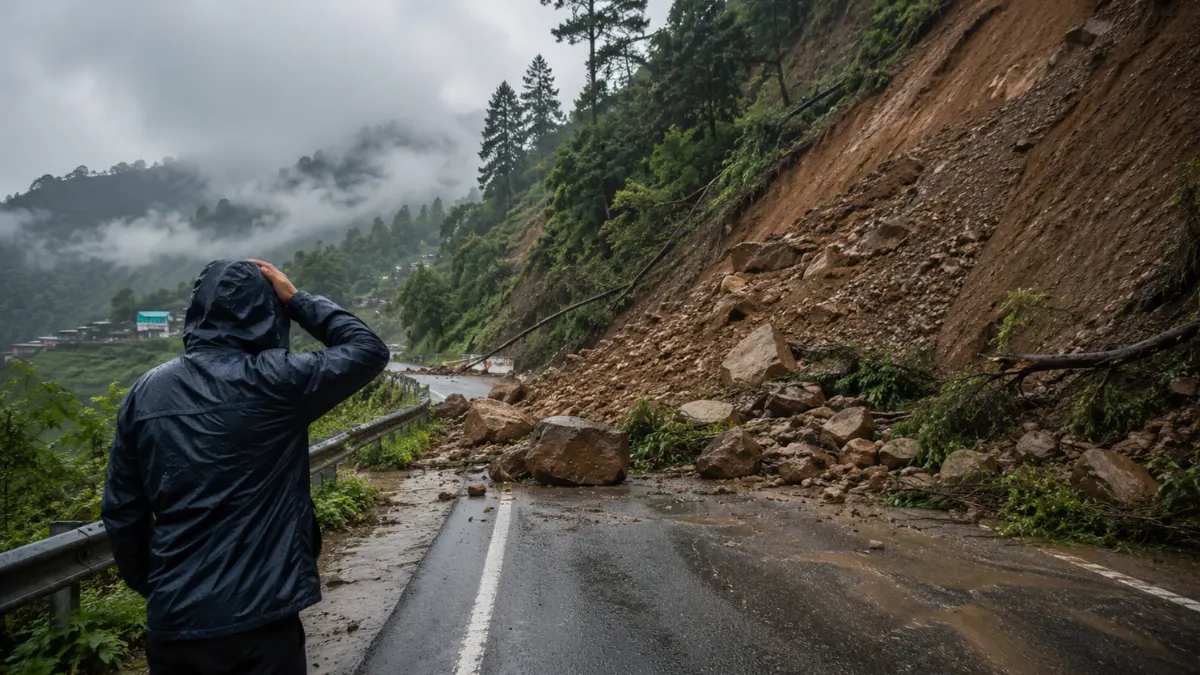

A landslide happens when rock, soil or debris moves down a slope. Some landslides move slowly over several days, while others collapse suddenly and travel fast enough to damage homes, block roads and trap people with little warning.
Heavy and prolonged rain can weaken a slope by filling spaces in the soil with water. The added water increases weight, reduces the soil’s strength and can allow part of the hillside to move downhill.
Some slopes show visible or audible warning signs before they fail. However, a landslide can also happen suddenly without clear warning, so people should never rely only on what they can see.
Why Does Heavy Rain Trigger Landslides?
A stable slope depends on the strength of its rock, soil, roots and internal structure. Gravity constantly pulls the material downhill but friction and natural support normally keep it in place.
During prolonged rain, water enters cracks and spaces inside the ground. Saturated soil becomes heavier, while water pressure can weaken the contact between layers of rock and earth.
Once the downhill force becomes stronger than the slope’s ability to resist movement, the slope may fail. Rainfall, erosion, changes in groundwater, earthquakes and human disturbance can all contribute to landslide development.
The danger can increase when:
- Rain continues for several hours or days
- A slope already contains loose soil or fractured rock
- Construction has removed vegetation
- Workers have cut a steep roadside slope
- Drains send water directly onto a hillside
- A stream or river erodes the bottom of the slope
- Previous landslides have weakened the area
- Soil, rubbish or building material blocks natural drainage
Heavy rain does not make every slope collapse. The condition of the land, drainage and local geology determines how easily movement can begin.
What Are the Early Warning Signs of a Landslide?
Several physical changes can indicate that part of a slope has started moving. These signs require urgent attention during or after prolonged rain.
New cracks in the ground
Watch for fresh cracks across soil, paths, gardens, retaining walls or roads. A crack may widen, lengthen or appear where the ground previously looked undisturbed.
Cracks near the top of a slope can indicate that the ground is pulling apart before part of it moves downhill.
One small crack does not always mean that a large landslide will occur. However, new or quickly changing cracks during heavy rain should never be ignored.
Soil pulling away from a building
A gap may develop between the soil and a house foundation, staircase, veranda or retaining wall.
The movement can indicate that the ground beneath or beside the structure has started shifting. Walls may also separate at corners or where an extension joins the original building.
Leave the area and inform local authorities when the gap grows quickly or appears alongside other warning signs.
Leaning trees, poles or fences
Trees, utility poles, boundary posts and fences may begin leaning downhill as the soil beneath them moves.
A single naturally bent tree may not indicate immediate danger. Several objects leaning in the same direction, particularly after heavy rain, provide a stronger warning.
The Geological Survey of India and other landslide authorities advise people to watch for progressively tilting trees and small movements of soil or debris on vulnerable hillsides.
Doors and windows suddenly sticking
Ground movement can twist a building’s frame. Doors and windows that opened normally may suddenly become difficult to close.
New cracks can also appear in walls, floors, pillars or ceilings. Tiles may lift, and steps may begin separating from the building.
These changes may have other structural causes, but they require urgent inspection when they appear during prolonged rain on or below a slope.
New water flowing from the slope
Water may begin seeping from a place that was previously dry. New springs, wet patches or muddy flows can indicate that water pressure has changed inside the hillside.
The flow may remain clear at first and later carry soil. A sudden increase, decrease or change in the direction of hillside water can also signal ground movement.
Do not approach the source to inspect it closely during heavy rain.
Small stones and soil falling repeatedly
A few loose stones may fall naturally from a cut hillside. Repeated rockfall, fresh soil movement or steadily increasing debris can indicate that the slope is becoming unstable.
Road users should not stop below the affected slope to watch the movement. Leave the exposed area and report the location to the police or road authority.
Bulges at the bottom of a slope
The ground near the base of a hill may begin rising, swelling or pushing outward as material moves from above.
Retaining walls may bend, crack or tilt. Soil may also push into a road, drain or building.
A bulging lower slope can signal serious pressure and should prompt immediate movement away from the area.
Unusual sounds from the hillside
Cracking wood, knocking stones, rumbling ground or snapping roots can indicate movement inside or above the slope.
A rapidly moving landslide may create a loud roar and ground vibration. The sound can grow stronger as the debris approaches.
Do not spend time trying to identify the exact source. Move away from the likely path and alert others only when doing so does not delay your escape.
Sudden changes in a nearby stream
A stream may become muddy, rise rapidly or carry branches and rocks. Its level may also drop suddenly if a landslide has blocked the channel upstream.
A temporary blockage can later break and release a powerful flow of water and debris.
People living beside streams and narrow valleys should treat sudden water-level changes during prolonged rain as an urgent warning.
Can a Landslide Happen Without Warning Signs?
Yes. Some landslides happen before people notice any visible change.
A small, shallow slope failure may develop quickly after intense rain, while rockfall can begin when a weakened section breaks away without obvious movement beforehand.
People living in officially identified landslide-prone areas should follow evacuation instructions even when the ground around their home appears normal.
Warning signs can support a decision to leave, but their absence does not guarantee safety.
Landslide, Rockfall and Debris Flow: What Is the Difference?
People often use the word landslide for several types of slope movement.
Landslide
A landslide broadly describes rock, soil or debris moving downhill. The material may slide as one mass or break apart as it moves.
Rockfall
A rockfall occurs when individual rocks or sections of rock detach from a steep cliff or cut slope.
Rockfall can happen suddenly and may affect roads below hillsides, particularly where water enters cracks and weakens the rock.
Debris flow
A debris flow contains water mixed with soil, rocks, branches and other material. It can move rapidly through channels and valleys.
A debris flow may look like fast, thick mud, but it can carry heavy boulders and destroy structures in its path.
Slope failures can also block or redirect streams and worsen a rapidly developing flash flood in valleys and low-lying settlements.
What Should You Do When Warning Signs Appear?
Leave early when several signs indicate that the slope is moving and a safe exit route remains available.
Do not wait for a large collapse before acting. A road or doorway that remains open now may become blocked within minutes.
Take only essential items that are immediately accessible:
- Medicines
- Identification documents
- A charged phone
- Drinking water
- Essential clothing
- A small emergency bag
Move away from the downhill path of the slope. Follow evacuation routes and instructions from the district administration, police or disaster-response teams.
Inform nearby households when you can do so safely, but do not return to warn others after authorities have closed the area.
Should You Stay on an Upper Floor or Leave the Building?
Leaving early for a safer location is usually better when warning signs appear and authorities provide a safe evacuation route.
An upper floor does not guarantee protection because moving ground can damage the foundation or shift the entire building.
Do not attempt to leave through an active debris flow or beneath falling rocks. When a sudden landslide has already begun and no safe escape route remains, move away from windows, protect your head and follow emergency instructions.
The safest decision depends on the slope, the direction of movement and the available route. Local evacuation orders should take priority over general advice.
Landslide Safety for Drivers
Hill roads become especially dangerous during prolonged rain. Freshly cut slopes, unstable rocks and blocked drains can send debris onto a road with little warning.
Before starting a journey through a hill district, check road closures and understand what IMD red, orange and yellow rain warnings mean.
While driving:
- Reduce speed near exposed slopes
- Watch for loose stones on the road
- Avoid stopping beneath overhanging rock
- Follow barricades and police instructions
- Do not drive across fresh debris
- Keep distance from retaining walls that appear cracked
- Turn back when repeated rockfall begins
- Avoid night travel during severe rain when possible
Do not park beside a steep cut slope during heavy rain. A small initial fall may precede a larger collapse.
What Should You Do During an Active Landslide?
Move immediately out of the path when you can see or hear material approaching.
Travel sideways away from the direction of movement rather than trying to outrun debris downhill. Seek higher, stable ground outside the channel or valley carrying the material.
Do not:
- Cross an active slide
- Stand below a failing slope
- Stop to record a video
- Shelter behind a weak wall
- Enter flowing mud or debris
- Return for belongings
- Gather near the affected road
- Touch damaged electrical lines
NDMA advises people to move away from landslide paths, avoid loose material and damaged electrical infrastructure, and follow official evacuation and safety instructions.
What Should You Do After a Landslide?
Stay away from the affected area because additional movement can occur after the first collapse.
Heavy rain may continue weakening nearby ground. Debris can block streams, damage drains and create a new flood risk.
After a landslide:
- Follow police and administration restrictions
- Watch for additional rockfall or slope movement
- Report broken utility lines
- Avoid damaged buildings
- Check official road information
- Do not walk across unstable debris
- Help children and older people remain away from the area
- Return only after authorities permit it
A slope that appears quiet may still contain loose material and trapped water.
How Can Families Prepare Before Heavy Rain?
People living near slopes should prepare before the monsoon or before a severe rainfall warning takes effect.
Identify a safe route that does not cross the base of the hill, a narrow stream or a known slide path. Decide where the family will meet if members become separated.
Keep drains around the property clear without digging into or weakening the slope. Do not direct roof water onto exposed soil.
Store emergency numbers and follow notices from the district administration, State Disaster Management Authority, IMD and local police.
Households in officially identified high-risk locations should take relocation or evacuation notices seriously.

1 thought on “Landslide Warning Signs to Watch During Heavy Rain”