
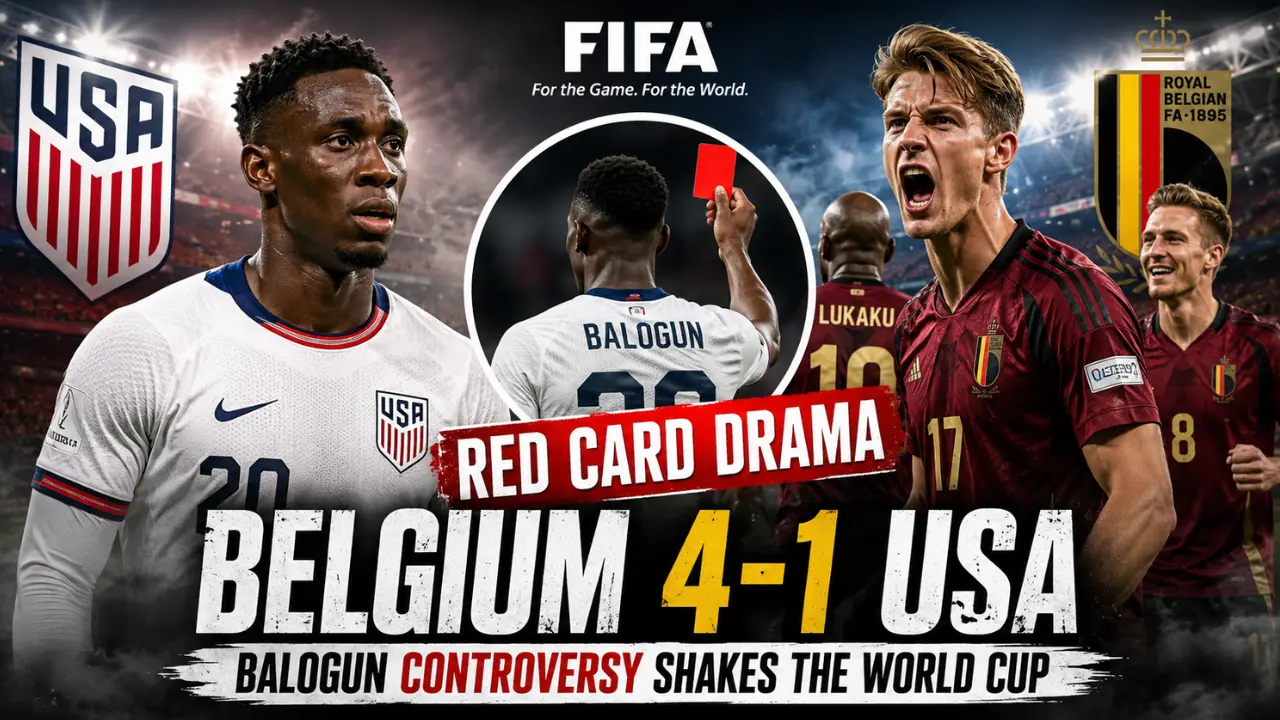

The USA’s 2026 World Cup run ended with a heavy 4-1 defeat to Belgium in the Round of 16, but the match will not only stay in memory because of the scoreline. It will also stay in memory because Folarin Balogun’s red-card suspension controversy turned one knockout game into a debate about fairness, pressure, politics, and trust in football.
Belgium won the match clearly. Charles De Ketelaere scored twice, Hans Vanaken added another goal, and Romelu Lukaku finished the night with a stoppage-time goal. Malik Tillman scored the USA’s only goal, but Belgium controlled the bigger moments and sent the last remaining co-host out of the tournament.
Yet many fans will ask a different question after this game: did football protect the integrity of the tournament, or did it create a controversy that overshadowed the match before the first whistle?
The Scoreline Gave Belgium the Answer FIFA Could Not Give Clearly
Belgium did not need a narrow decision, a late penalty, or a VAR debate to win this match. The 4-1 result gave the game a brutal clarity. Whatever noise surrounded Balogun’s availability, Belgium handled the pressure better, attacked with more purpose, and punished the USA’s defensive weaknesses.
That matters because controversy often gives losing teams or angry fans a ready-made excuse. In this case, Belgium removed most of that excuse with the way they played. They did not scrape through. They dominated enough for the result to feel decisive.
Still, a clear scoreline does not erase the bigger issue. Football can produce a fair result on the pitch and still leave people uncomfortable about the process around the pitch.
That is why this story matters.
Also Read: Super Typhoon Bavi Track Shift and Guam Risk Explained
Why Folarin Balogun Became the Center of the Storm
Balogun received a red card in the USA’s previous knockout match against Bosnia and Herzegovina. Normally, a red card brings an automatic suspension for the next game. That expectation made many people assume he would miss the Belgium match.
Instead, FIFA allowed him to play after delaying the effect of his suspension. FIFA argued that the red card had not been overturned, but that the suspension enforcement had only been postponed under its disciplinary rules.
That explanation did not calm the debate. Belgium challenged the decision, UEFA criticized FIFA’s handling of the situation, and the argument grew bigger because U.S. President Donald Trump had publicly pushed for Balogun’s reinstatement. FIFA denied improper influence and defended the decision as independent and legal.
This is where football’s problem begins. Even when a decision follows a rulebook, people lose trust when the process feels selective, unusual, or poorly explained.
The Real Problem Was Not Only Balogun Playing
Many fans focused on one simple point: Balogun played when they thought he should have missed the match. But the deeper problem was not only his name on the team sheet.
The deeper problem was communication.
Football authorities often ask fans to trust disciplinary panels, VAR rooms, referees, and competition officials. But trust does not grow from authority alone. Trust grows when decisions look consistent, explanations arrive clearly, and every team believes the same standard applies.
Belgium’s frustration came from the feeling that the normal expectation around a red card had changed at the most sensitive possible time. FIFA rejected Belgium’s challenge as inadmissible, saying Belgium did not have standing because it was not part of the original disciplinary process.
That may make procedural sense inside FIFA’s legal structure. But for the watching public, it creates another question: if a team directly affected by a player’s availability cannot get a satisfying explanation before a knockout match, how transparent does the process really feel?
Belgium Chose the Best Reply: They Won the Game
Belgium coach Rudi Garcia later said the controversy had little impact on his team’s performance. He emphasized that the players stayed focused on the match rather than using the Balogun debate as motivation.
That response made Belgium look mature. They did not need to turn the controversy into their identity. They allowed their football to speak.
De Ketelaere’s two goals gave Belgium early control. Vanaken’s second-half goal made the gap wider. Lukaku’s stoppage-time finish made the result look as strong as Belgium’s performance felt.
For the USA, the painful part is that Balogun’s presence did not change the outcome in the way supporters hoped. Reuters described him as quiet on the pitch after the controversy, while Belgium’s performance carried far more force than the debate around one player.
That creates a harsh truth for the USA: the controversy gave them attention, but Belgium gave them a football lesson.
The USA’s Exit Feels Bigger Because This Was a Home World Cup
The USA did not leave the tournament as an ordinary participant. It left as a co-host, playing on home soil, with a rare chance to turn World Cup excitement into a deeper football moment for the country.
U.S. Soccer noted that the team still had historic positives: it topped Group D, won a knockout match for the first time since 2002, and scored 11 goals in the tournament.
Those achievements matter. They show progress. They also make the defeat more painful because the opportunity felt real.
The USA did not enter this match as a team nobody believed in. It entered with momentum, home support, and a story that could have grown even larger. Instead, Belgium exposed the gap between emotional belief and knockout-level sharpness.
At this stage of a World Cup, good stories do not protect teams. Clean defending, composure, depth, and decision-making protect teams.
Why This Controversy Hit Fans So Hard
Football fans can accept mistakes more easily than they can accept confusion. A referee can miss a call. A player can lose discipline. A VAR review can divide opinion. These things frustrate people, but they still belong to the normal chaos of football.
This Balogun situation felt different because it touched the system behind the match.
Fans saw a red card. They expected a suspension. Then they saw a decision that allowed the player to appear in the next round. Then they heard arguments about disciplinary codes, appeals, standing, independence, and political pressure.
That kind of story makes the sport feel less simple. It moves the conversation away from tactics, goals, and players, and pushes it into governance.
For casual fans, that can feel exhausting. For serious fans, it can feel dangerous. Once people believe powerful figures can influence football decisions, every unusual ruling becomes suspicious.
That is why FIFA needed more than a legal explanation. It needed a public explanation strong enough to survive the emotional pressure of a World Cup knockout game.
Balogun Should Not Carry the Whole Blame
It would be unfair to make Balogun the villain of the story. He did not control the disciplinary process. He did not personally write FIFA’s decision. He did not create the political reaction around the case.
He became the face of the controversy because he was the player affected by it.
That difference matters. A player can benefit from a decision without being responsible for how that decision happened. The real scrutiny belongs on the process, not only on the person standing in the middle of it.
Reuters reported that Balogun had a limited impact in the Belgium match, even after the controversy around his availability.
In a strange way, that made the whole situation feel even more unnecessary. A major governance storm formed around a player who did not end up changing the match.
What Belgium’s Win Says About Tournament Football
Belgium’s victory showed one of the oldest truths about tournament football: experience and calm often beat noise.
The USA had the home crowd, the storyline, and the emotional energy. Belgium had control, timing, and the ability to punish mistakes. In knockout football, that difference can decide everything.
Belgium also proved that a team can enter a controversial match and still refuse to become distracted by it. Garcia’s comments after the game suggest the squad treated the controversy as background noise rather than a central motivation.
That mindset matters at a World Cup. Big teams do not only need talented players. They need emotional discipline. They need leaders who do not let drama replace preparation.
Belgium looked like a team that understood the moment better.
The USA Must Separate Progress From Illusion
The USA can still take positives from this tournament, but it should not use those positives to hide the lessons from Belgium.
The team showed growth. It created excitement. It gave American fans moments to believe in. But Belgium showed that the next level requires more than momentum.
The USA must improve defensive reliability, squad depth, pressure management, and finishing against elite opponents. Home support can lift a team, but it cannot cover structural weaknesses forever.
The danger after a tournament like this is emotional overreaction. Some fans may call the entire run a failure because of the 4-1 defeat. Others may call it a complete success because of the historic milestones.
The truth sits between both reactions. The USA moved forward, but Belgium showed how far the team still has to climb.
FIFA’s Bigger Lesson Is About Trust
The biggest lesson from this story belongs to FIFA. A World Cup does not only need rules. It needs rules that people can understand, believe, and see applied consistently.
When disciplinary decisions look unusual, FIFA must explain them quickly and clearly. When political figures comment on player punishments, FIFA must create visible distance between sport and influence. When teams ask for clarity before a knockout match, the answer must not feel like a locked door.
Football cannot stop controversy completely. Controversy has always lived inside the game. But football can control how much confusion it adds to the controversy.
This time, FIFA may believe it followed its rules. The problem is that many fans watched the process and felt the rules did not feel equal enough, clear enough, or strong enough.
That perception damages trust.
The Match Is Over, but the Question Remains
Belgium’s 4-1 win settled the football argument. The better team won on the night. The USA went out because Belgium played with more quality, more composure, and more authority in the decisive moments.
But the Balogun red-card drama leaves another argument behind. Football must decide whether its disciplinary system only needs to be legal inside its own documents, or whether it also needs to feel transparent and credible to the teams and fans who live with the consequences.
That is the bigger issue.
A World Cup knockout match should make people talk about goals, tactics, courage, and heartbreak. This match gave all of that, but it also gave something more uncomfortable: a reminder that football loses part of its beauty when people stop trusting the process behind the game.

1 thought on “FIFA’s Balogun Decision After USA vs Belgium”