
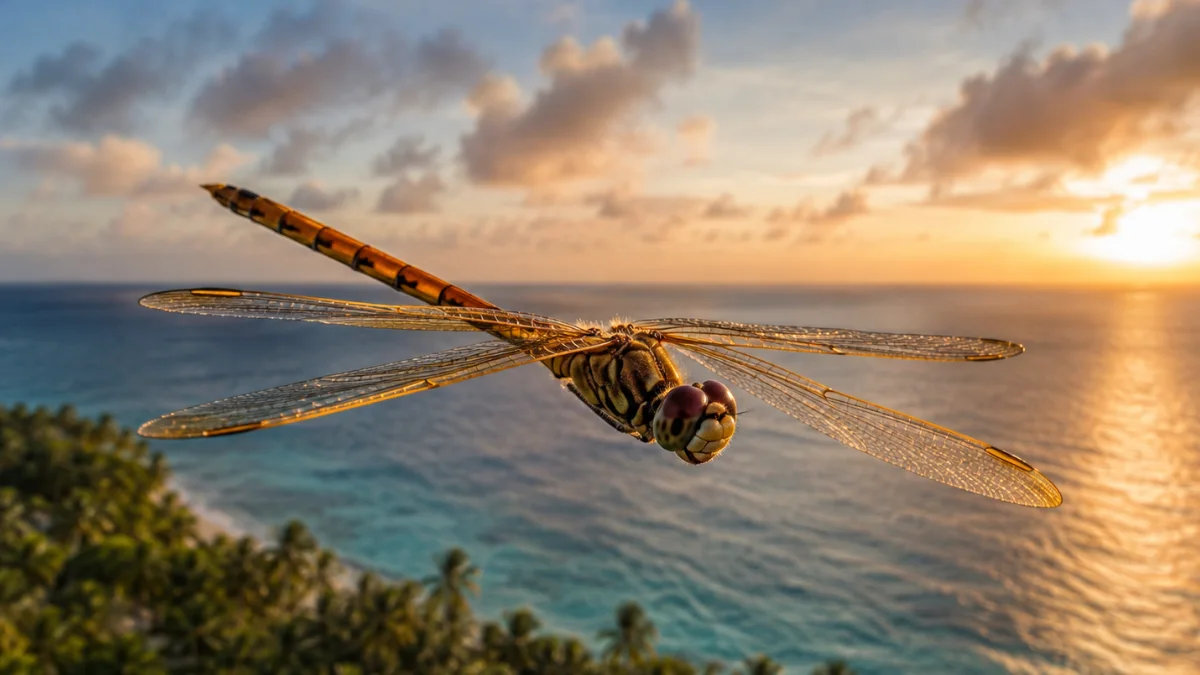

The globe skimmer dragonfly migration is one of the most remarkable long-distance movements known among insects. Although the full India-to-East-Africa route has not been tracked directly from one individual, research suggests that globe skimmers can cross large stretches of the Indian Ocean by combining efficient gliding with favourable seasonal winds.
The dragonfly does not simply beat its wings continuously for thousands of kilometres. Its ability to glide, conserve energy, use tailwinds and move during the right seasonal weather conditions appears to make these extreme journeys possible.
What Makes the Globe Skimmer Built for Long-Distance Flight?
The globe skimmer, Pantala flavescens, is also known as the wandering glider. Its body is small, but its flight style is unusually well suited to long-distance movement.
Globe skimmers have broad wings that allow them to spend considerable periods gliding rather than relying entirely on energy-intensive flapping.
That difference is important.
A 2021 study published in Frontiers in Ecology and Evolution modelled the energy required for the proposed Indian Ocean migration. The researchers found that continuous flapping would allow only a few hours of flight before available energy became a serious limitation.
When gliding was included, the possible flight duration increased dramatically.
The dragonfly still needs to flap, steer and adjust its position, but gliding reduces the amount of muscular energy required to remain airborne over long distances.
How Can Such a Small Dragonfly Cross Open Ocean?
Gliding alone does not fully explain the journey.
The most important factor appears to be wind assistance.
A globe skimmer flying within a favourable air current can travel much faster across the ground than it could through still air. The dragonfly provides some of its own movement, while the surrounding air mass carries it in the same direction.
This makes a long ocean crossing much more realistic.
The 2021 modelling study concluded that favourable winds were probably necessary for globe skimmers to complete the proposed Indian Ocean journey within their physiological limits.
The simulations also showed how strongly success depended on conditions. Only about 15 percent of simulated autumn trajectories successfully reached land, while roughly 41 percent of simulated spring trajectories did so.
These figures do not represent directly observed dragonflies. They come from models combining flight energetics with atmospheric conditions, but they show that the journey becomes much more plausible when the insect encounters the right winds.
Why Do Monsoon Winds Matter So Much?
Wind patterns over the Indian Ocean change throughout the year.
The shifting monsoon system and the movement of the Inter-Tropical Convergence Zone, or ITCZ, create seasonal air currents that can support long-distance insect movement.
During particular periods, winds can favour movement away from the Indian subcontinent toward the southwest. At other times of year, atmospheric circulation changes direction.
This seasonal timing may be one of the most important parts of the globe skimmer’s migration strategy.
A dragonfly entering an unfavourable wind could lose energy while making little progress or drift far from suitable land. Entering a favourable current can dramatically increase the distance travelled without requiring the insect to increase its own flight effort by the same amount.
The ocean itself therefore remains a major obstacle, but the atmosphere above it can become a transport system.
Does One Dragonfly Complete the Whole Migration?
Probably not.
Researchers generally describe the proposed globe skimmer migration as multi-generational.
Globe skimmers often reproduce in temporary freshwater pools created by seasonal rain. Their aquatic young can develop relatively quickly under suitable conditions, allowing a new generation to emerge and continue moving when environmental conditions change.
This means that the broader movement attributed to the species does not require one dragonfly to travel from India to Africa and then return.
Different generations may complete different parts of the wider migration cycle.
Rapid development is therefore almost as important as flight ability. It allows globe skimmers to take advantage of temporary rain-fed habitats before those habitats disappear.
Other insects can follow very different strategies. For example, India’s World Cup cicada follows a four-year life cycle, spending years developing underground before its mass emergence. The globe skimmer instead succeeds through rapid development and continued movement between temporary habitats.
How Do Scientists Know the Dragonflies Came From India?
Scientists face a difficult problem when studying globe skimmers: they are too small for the kinds of tracking devices commonly used on birds, turtles or large mammals.
Researchers therefore rely on several indirect forms of evidence.
One of the strongest comes from the Maldives.
Large numbers of globe skimmers appear there seasonally even though the islands do not contain enough permanent freshwater habitat to easily explain such arrivals as a large resident population.
In a 2009 study published in the Journal of Tropical Ecology, researcher R. Charles Anderson examined seasonal dragonfly arrivals across the western Indian Ocean and proposed that globe skimmers were reaching the Maldives from the Indian subcontinent during favourable atmospheric conditions.
The original study is available through Cambridge University Press.
Later research added chemical evidence.
Scientists analysed stable hydrogen isotopes in the wings of globe skimmers collected in the Maldives.
Hydrogen isotope patterns in rainfall vary geographically. Because dragonflies spend their early life as aquatic nymphs, the chemical signature associated with the water where they developed can become incorporated into their tissues.
Once an adult dragonfly’s wings have formed, those isotope patterns can provide clues about its geographical origin.
A 2012 study published in PLOS ONE analysed 49 globe skimmers collected during migration through the Maldives. The isotope evidence was consistent with origins in the northern Indian subcontinent rather than the Maldives themselves.
The technique cannot identify the exact pond where an individual developed, but it provides strong evidence that at least some of the dragonflies appearing over the Maldives had travelled a considerable distance from farther north.
Are the Maldives a Stopover?
The Maldives provide important evidence for long-distance movement, but scientists cannot assume that every globe skimmer deliberately uses the islands as a regular stopover.
Some individuals may land there temporarily. Others may simply pass through the same atmospheric corridor or arrive after being carried by particular wind systems.
The islands are therefore best understood as an important observation point along the proposed migration route rather than a confirmed scheduled stop for every dragonfly.
That distinction matters because much of the globe skimmer’s migration remains reconstructed from observations, atmospheric data and chemical evidence rather than direct tracking.
What Do Scientists Still Not Know?
Researchers have strong evidence that globe skimmers can travel enormous distances and that some individuals reaching the Maldives originate on the Indian subcontinent.
What remains uncertain is the exact path followed by individual insects across the wider Indian Ocean.
Scientists have not directly tracked a single globe skimmer leaving India and arriving in East Africa. The complete India–Africa migration circuit therefore remains a well-supported scientific hypothesis rather than an end-to-end journey observed in one tagged dragonfly.
Researchers also still need to understand how globe skimmers choose favourable winds, what altitude they use during long crossings and how often individuals successfully reach distant land.
Even with those uncertainties, the mechanism is becoming clearer.
The globe skimmer appears capable of extraordinary oceanic movement because several advantages work together: efficient gliding reduces energy use, favourable winds increase travel speed, seasonal monsoon circulation creates migration opportunities, and rapid reproduction allows different generations to continue the broader journey.
A tiny dragonfly does not overpower the Indian Ocean through continuous flight. It succeeds by using the atmosphere above it.
