
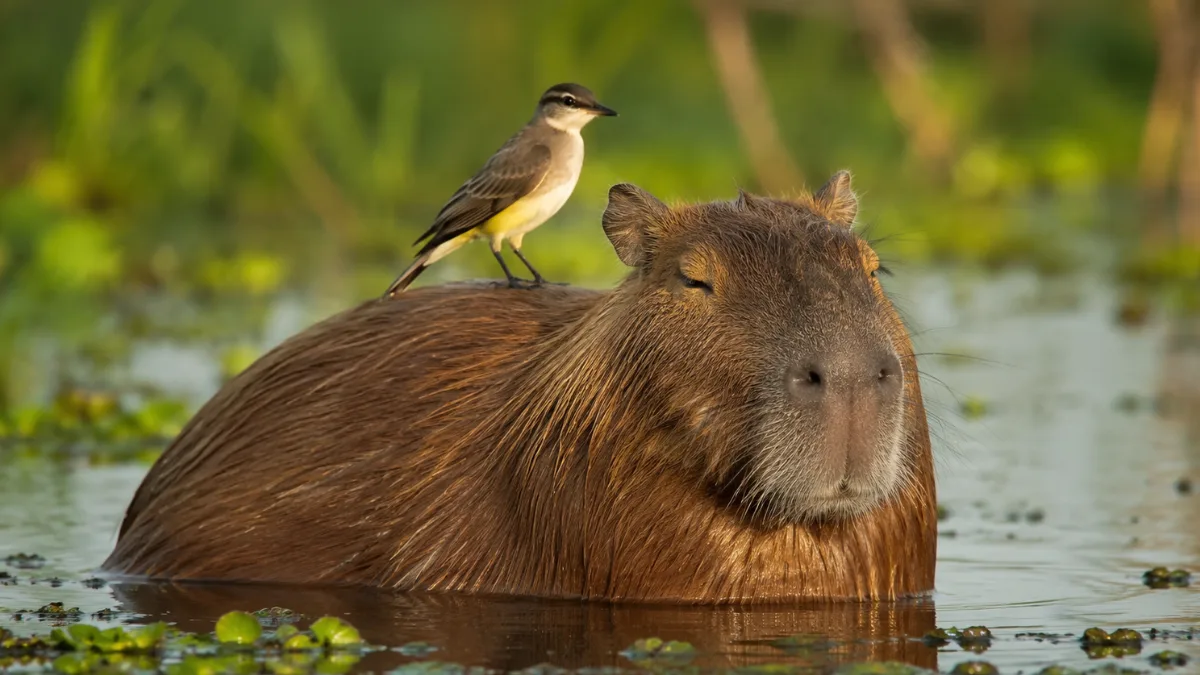

Why do animals sit on capybaras in so many photographs and videos? Most documented cases involve birds using capybaras as raised perches while searching for ticks, flies and insects disturbed by the capybara’s movement.
The capybara may benefit when a bird removes irritating parasites. In other cases, the bird gains food or a useful hunting position while the capybara experiences little effect.
This behaviour looks like an unusual friendship but the scientific explanation is more practical. Birds approach capybaras because the large rodents can provide food opportunities, visibility, and a relatively stable place to stand.
Other viral images may show monkeys, ducks, turtles or domestic animals near capybaras. However, those encounters do not always represent the same ecological relationship. Many simply show temporary tolerance, curiosity, shared space or animals accustomed to one another in managed environments.
Why Do Animals Sit on Capybaras?
Animals do not sit on capybaras for one universal reason. The explanation depends on the species, habitat and behaviour visible during the interaction.
Birds provide the clearest and best-documented examples. Some species perch on capybaras while searching their fur and skin for ticks, flies or other small invertebrates.
Others follow capybaras as they graze through grass. The capybara’s feet, face and body disturb insects hidden among plants, making those insects easier for nearby birds to detect and catch.
A bird may stand on the capybara’s back because the raised position gives it a wider view of the surrounding ground. The bird can watch for prey, fly down to capture it, and then return to the capybara or continue following the animal.
The capybara acts as a feeding opportunity, a moving observation point or both.
The interaction may look affectionate because the capybara often remains calm. However, calm behaviour does not prove that the two animals have formed an emotional friendship.
The capybara may simply have no strong reason to remove a small visitor that causes little discomfort.
Why Do Birds Perch on Capybaras?
Birds often associate with large grazing mammals because those mammals create feeding opportunities.
A grazing animal changes the immediate environment as it moves. Its feet press vegetation down, its mouth pulls at plants, and its body brushes through grass. These movements can expose beetles, grasshoppers, flies, spiders, and other small creatures.
Birds can take advantage of this disturbance.
The cattle tyrant, a South American flycatcher, is one of the best-known birds associated with capybaras. It may follow the rodent closely, stand on its back, and catch insects from the surrounding grass.
The bird does not need to search every patch of vegetation independently. Instead, it watches for prey revealed by the much larger animal.
Standing on the capybara may also give the bird a better viewing position. A bird close to the ground may struggle to see insects through dense vegetation, while a raised perch improves its view.
Capybaras are especially useful because they are broad-bodied and often move slowly while grazing. A small bird can remain on the animal for a short period without being immediately thrown off.
Other birds may land on capybaras to inspect their skin and fur. They can pick at ticks, biting flies, or other small organisms found on the body.
For the bird, the capybara becomes a source of food. For the capybara, the bird may provide relief from irritating parasites.
Do Capybaras Benefit When Birds Sit on Them?
Capybaras can benefit when birds remove parasites from their bodies.
Ticks and biting insects may irritate the skin, consume blood, or create opportunities for infection. A bird that eats these organisms receives a meal while reducing the parasite burden on the capybara.
This creates a relationship in which both animals may gain something.
However, not every bird sitting on a capybara provides such a service. A bird may use the capybara only as a perch while hunting insects in the surrounding grass.
In that situation, the bird benefits, but the capybara may receive no meaningful advantage.
The capybara may still allow the interaction because the bird is small and causes little disruption. Moving, shaking, or chasing the bird away would require a response that may offer no clear benefit.
Animals do not react strongly to every harmless movement around them. They often conserve energy when a nearby animal presents no immediate danger.
This explanation should still remain cautious. A photograph cannot reveal exactly what a capybara is thinking or why it did not move.
Researchers can observe the behaviour and identify likely benefits, but they should not assign human emotions to the animals without evidence.
Is the Relationship Mutualism or Commensalism?
Some bird–capybara relationships can be described as mutualism, while others are closer to commensalism.
Mutualism occurs when both species benefit from the interaction.
For example, a bird gains food by removing ticks or biting insects, while the capybara gains relief from those parasites. Both animals receive a practical advantage.
Commensalism occurs when one species benefits while the other experiences no major benefit or harm.
A bird that uses a capybara as a perch or follows it to catch disturbed insects may benefit without changing the capybara’s condition in a meaningful way.
The same bird and capybara can show different relationships at different moments.
A bird might remove a parasite during one visit, creating a mutual benefit. Later, it might stand on the capybara only to watch for insects in the grass, which would be closer to commensalism.
This is why the simple word “friendship” does not fully explain the behaviour.
Friendship is a human interpretation. Mutualism and commensalism describe what each species gains or loses during the interaction.
The scientific categories may sound less emotional, but they reveal more about how animals use opportunities in their environment.
Why Do Capybaras Appear So Tolerant?
Capybaras often appear tolerant because they may remain still when small birds land on them. Their size makes most of these visitors relatively insignificant.
A small bird usually does not prevent a capybara from grazing, resting, watching its surroundings, or moving toward water. The bird may therefore create too little disturbance to trigger a visible reaction.
Capybaras are also social animals that naturally live near other capybaras. Group members graze, rest, move, and communicate in close proximity.
This social lifestyle means that capybaras regularly experience nearby movement and physical closeness.
However, their social behaviour toward other capybaras does not prove that they automatically welcome every unrelated species.
Capybaras maintain dominance relationships within their groups. Individuals may compete for status, space, food, or access to mates.
They also communicate when they detect danger. A capybara may bark an alarm, become alert, move closer to its group, or head toward water when it feels threatened.
Their calm appearance should not be confused with an inability to recognise danger.
A capybara that tolerates a tiny bird may react very differently to a predator, aggressive rival, unfamiliar dog, or human who moves too close.
Tolerance depends on the situation.
Do Monkeys and Other Animals Really Ride Capybaras?
Photographs sometimes show monkeys, ducks, turtles, dogs, and other animals sitting on or resting near capybaras.
These images attract attention because the animals appear unusually comfortable together. However, they often provide less scientific information than documented bird interactions.
Many such photographs come from zoos, wildlife parks, farms, or other managed environments. Animals living in these settings may become accustomed to seeing other species nearby.
A monkey might climb onto a capybara because of curiosity, play, convenience, or previous experience. A short video usually cannot establish which explanation is correct.
The capybara may tolerate the contact for a few moments without gaining anything from it.
The image also does not reveal what happened before or after the recording. The capybara may have moved away, entered the water, or shown discomfort once the clip ended.
Two animals sharing space peacefully do not necessarily have a special bond.
They may simply have no reason to fight at that moment.
The safest conclusion is that non-bird examples are highly dependent on context. Some may show habituation, some may show curiosity, and others may show nothing more than brief tolerance.
They should not all be treated as examples of mutualism.
Are Capybaras Really Friends With Every Animal?
No. Capybaras are not naturally friendly with every animal they encounter.
The belief comes partly from selective photographs and videos. Social media repeatedly shows peaceful encounters because those scenes appear surprising, funny, and emotionally satisfying.
Ordinary moments receive less attention.
People rarely share videos of capybaras grazing only with their own group, avoiding another animal, entering the water, or moving away from unwanted contact.
This creates the impression that unusual interspecies encounters happen constantly.
A capybara sitting near a predator also does not prove friendship. Predators do not attack every potential prey animal whenever they see one.
Hunger, distance, opportunity, risk, temperature, prey size, and the predator’s physical condition can all affect whether an attack occurs.
A caiman resting near a capybara may not be hunting at that moment. The capybara may also remain alert and ready to move into deeper water.
A peaceful photograph captures only one moment. It does not reveal the complete relationship between the species.
The same principle applies to interactions with domestic animals and humans. A capybara may tolerate a calm individual in one setting while avoiding or defending itself against another.
Can Capybaras Become Aggressive?
Capybaras can defend themselves when they feel threatened, cornered, stressed, or challenged.
Adult males may chase or fight rivals during dominance disputes. Individuals can also compete over food, space, mates, or access to important resources.
Capybaras have large incisors that can cause serious injuries. Their relaxed expression and rounded appearance should not make people treat them as harmless toys.
Water often provides an important escape route. Blocking a capybara’s access to water or surrounding it can increase stress and reduce its ability to leave safely.
A motionless capybara is not always comfortable. It may be watching the situation, waiting for space to open, or deciding whether to move.
People should never force an interaction because a capybara appeared friendly in a viral video.
The animal may tolerate contact, but tolerance is not permission.
Why Do Viral Capybara Videos Look So Peaceful?
Viral videos usually show the most visually appealing part of an encounter.
A viewer may see a bird calmly standing on a capybara but not see the bird landing, leaving, or returning repeatedly to catch insects.
A clip may show a monkey sitting on a capybara without revealing whether keepers introduced the animals gradually or whether the capybara moved away moments later.
Human observers also tend to interpret animal faces through human emotions.
A capybara’s broad head, small ears, and relaxed-looking mouth can make it appear content even when its actual emotional state is uncertain.
Behaviour provides more useful information than facial appearance alone.
Body tension, head position, vocal sounds, attempts to move away, sudden alertness or movement toward water can reveal more about the animal’s response.
Individual differences also matter.
One capybara may tolerate a certain bird, animal, or human that another individual avoids. Age, health, past experience, group position, available space, and stress can all influence the reaction.
The internet presents capybaras as universal peacemakers because that story is simple and memorable.
The real explanation is more interesting.
Birds may sit on capybaras to eat parasites, catch disturbed insects, or gain a raised hunting position. Capybaras may benefit, remain unaffected, or simply tolerate the visitor.
Other animals may approach because of curiosity, habituation, or shared space, especially in managed environments.
These encounters do not prove that capybaras are friends with every species. They show how animals can temporarily share space when the interaction offers a benefit or creates little cost.
